
Xiaomi 12 vs Xiaomi 12 Lite: A Head-to-Head Showdown
| Phones Images | |||||
|---|---|---|---|---|---|
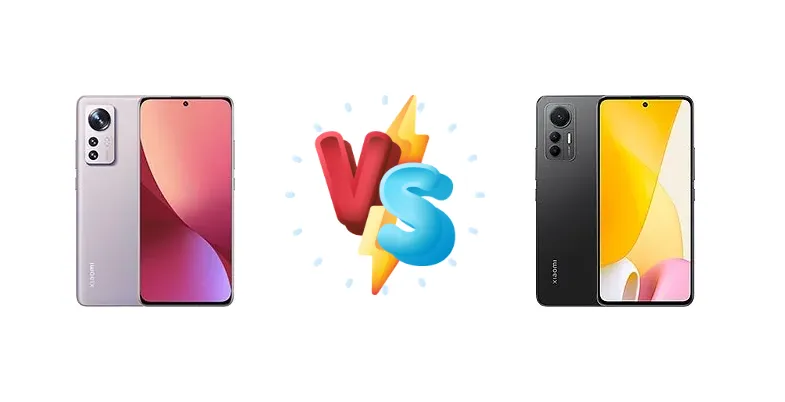
|
🏆 Quick Verdict
The Xiaomi 12 offers superior performance thanks to its Snapdragon 8 Gen 1, while the 12 Lite shines with longer battery life and a more attractive price. If raw power is your priority, the 12 wins. For everyday use and extended battery, the 12 Lite is the better pick.
| PHONES | ||
|---|---|---|
| Phone Names | Xiaomi 12 | Xiaomi 12 Lite |
| Network | ||
|---|---|---|
| 2G bands | GSM 850 / 900 / 1800 / 1900 | GSM 850 / 900 / 1800 / 1900 |
| 3G bands | HSDPA 800 / 850 / 900 / 1700(AWS) / 1900 / 2100 | HSDPA 850 / 900 / 1700(AWS) / 1900 / 2100 |
| 4G bands | 1, 2, 3, 4, 5, 7, 8, 12, 13, 17, 18, 19, 20, 25, 26, 28, 32, 38, 39, 40, 41, 42, 48, 66 - International | 1, 2, 3, 4, 5, 7, 8, 12, 13, 17, 18, 19, 20, 26, 28, 32, 38, 40, 41, 42, 48, 66 |
| 5G bands | 1, 3, 5, 7, 8, 20, 28, 38, 40, 41, 66, 77, 78, 79 SA/NSA - International | 1, 3, 5, 7, 8, 20, 28, 38, 40, 41, 66, 77, 78 SA/NSA |
| Speed | HSPA, LTE, 5G | HSPA, LTE, 5G |
| Technology | GSM / CDMA / HSPA / EVDO / LTE / 5G | GSM / HSPA / LTE / 5G |
| 1, 3, 5, 8, 28, 41, 77, 78, 79 SA/NSA - China | - | |
| Launch | ||
|---|---|---|
| Announced | 2021, December 28 | 2022, July 09 |
| Status | Available. Released 2021, December 31 | Available. Released 2022, July 11 |
| Body | ||
|---|---|---|
| Build | Glass front (Gorilla Glass Victus), glass back (Gorilla Glass 5), aluminum frame | Glass front (Gorilla Glass 5), glass back, plastic frame |
| Dimensions | 152.7 x 69.9 x 8.2 mm (6.01 x 2.75 x 0.32 in) | 159.3 x 73.7 x 7.3 mm (6.27 x 2.90 x 0.29 in) |
| SIM | Nano-SIM + Nano-SIM | Nano-SIM + Nano-SIM |
| Weight | 179 g or 180 g (6.31 oz) | 173 g (6.10 oz) |
| Display | ||
|---|---|---|
| Protection | Corning Gorilla Glass Victus | Corning Gorilla Glass 5 |
| Resolution | 1080 x 2400 pixels, 20:9 ratio (~419 ppi density) | 1080 x 2400 pixels, 20:9 ratio (~402 ppi density) |
| Size | 6.28 inches, 95.2 cm2 (~89.2% screen-to-body ratio) | 6.55 inches, 103.6 cm2 (~88.2% screen-to-body ratio) |
| Type | AMOLED, 68B colors, 120Hz, Dolby Vision, HDR10+, 1100 nits (peak) | AMOLED, 68B colors, 120Hz, Dolby Vision, HDR10+, 950 nits (peak) |
| Platform | ||
|---|---|---|
| CPU | Octa-core (1x3.00 GHz Cortex-X2 & 3x2.50 GHz Cortex-A710 & 4x1.80 GHz Cortex-A510) | Octa-core (1x2.4 GHz Cortex-A78 & 3x2.2 GHz Cortex-A78 & 4x1.9 GHz Cortex-A55) |
| Chipset | Qualcomm SM8450 Snapdragon 8 Gen 1 (4 nm) | Qualcomm SM7325 Snapdragon 778G 5G (6 nm) |
| GPU | Adreno 730 | Adreno 642L |
| OS | Android 12, MIUI 13 | Android 12, upgradable to Android 14, HyperOS |
| Memory | ||
|---|---|---|
| Card slot | No | No |
| Internal | 128GB 8GB RAM, 256GB 8GB RAM, 256GB 12GB RAM | 128GB 6GB RAM, 128GB 8GB RAM, 256GB 8GB RAM |
| UFS 3.1 | UFS 2.2 | |
| Main Camera | ||
|---|---|---|
| Features | Color spectrum sensor, Dual-LED dual-tone flash, HDR, panorama | Dual-LED dual-tone flash, HDR, panorama |
| Single | 32 MP, f/2.5, 26mm (wide), 0.7µm | 32 MP, f/2.5, (wide), 1/2.8", 0.8µm, AF |
| Triple | 50 MP, f/1.9, 26mm (wide), 1/1.56", 1.0µm, PDAF, OIS 13 MP, f/2.4, 12mm, 123˚ (ultrawide), 1/3.06", 1.12µm 5 MP, f/2.4, 50mm (telephoto macro), AF | 108 MP, f/1.9, 26mm (wide), 1/1.52", 0.7µm, PDAF 8 MP, f/2.2, 120˚ (ultrawide), 1/4.0", 1.12µm 2 MP (macro) |
| Video | 8K@24fps (HDR), 4K@30/60fps (HDR10+), 1080p@30/120/240/960fps, 720p@1920fps, gyro-EIS | 4K@30fps, 1080p@30/60/120fps; gyro-EIS |
| Selfie camera | ||
|---|---|---|
| Features | HDR, panorama | HDR, panorama |
| Single | 32 MP, f/2.5, 26mm (wide), 0.7µm | 32 MP, f/2.5, (wide), 1/2.8", 0.8µm, AF |
| Video | 1080p@30/60fps, 720p@120fps, HDR | 1080p@30/60fps, 720p@120fps |
| Sound | ||
|---|---|---|
| 3.5mm jack | No | No |
| 35mm jack | No | No |
| Loudspeaker | Yes, with stereo speakers | Yes, with dual speakers |
| 24-bit/192kHz audio Tuned by Harman Kardon | 24-bit/192kHz audio | |
| Comms | ||
|---|---|---|
| Bluetooth | 5.2, A2DP, LE, aptX HD, aptX Adaptive | 5.2, A2DP, LE, aptX HD, aptX Adaptive |
| Infrared port | Yes | Yes |
| NFC | Yes (market/region dependent) | Yes (market/region dependent) |
| Positioning | GPS (L1+L5), GLONASS (L1), BDS (B1I+B1c+B2a), GALILEO (E1+E5a), QZSS (L1+L5), NavIC (L5) | GPS (L1), GLONASS (G1), BDS (B1I+B1c), GALILEO (E1), QZSS (L1) |
| Radio | No | No |
| USB | USB Type-C 2.0, OTG | USB Type-C 2.0, OTG |
| WLAN | Wi-Fi 802.11 a/b/g/n/ac/6 or 6e (market dependent), dual-band, Wi-Fi Direct | Wi-Fi 802.11 a/b/g/n/ac/6, dual-band, Wi-Fi Direct |
| Features | ||
|---|---|---|
| Sensors | Fingerprint (under display, optical), accelerometer, gyro, compass | Fingerprint (under display, optical), accelerometer, gyro, compass |
| Virtual Proximity Sensing | Virtual proximity sensing | |
| Battery | ||
|---|---|---|
| Charging | 67W wired, PD3.0, QC4, 100% in 39 min 50W wireless, 100% in 53 min 10W reverse wireless | 67W wired, PD3.0, QC4, 50% in 13 min |
| Type | Li-Po 4500 mAh | Li-Po 4300 mAh |
| Misc | ||
|---|---|---|
| Colors | Gray, Blue, Purple, Green | Black, Lite Green, Lite Pink |
| Models | 2201123G, 2201123C | 2203129G |
| Price | $ 284.99 / € 149.99 | € 119.80 / $ 269.00 / £ 121.15 |
| SAR | 1.09 W/kg (head) 0.91 W/kg (body) | 1.09 W/kg (head) 0.73 W/kg (body) |
| SAR EU | 0.60 W/kg (head) 1.00 W/kg (body) | 0.60 W/kg (head) 1.00 W/kg (body) |
| Tests | ||
|---|---|---|
| Battery life | Endurance rating 82h | Endurance rating 100h |
| Camera | Photo / Video | Photo / Video |
| Display | Contrast ratio: Infinite (nominal) | Contrast ratio: Infinite (nominal) |
| Loudspeaker | -25.3 LUFS (Very good) | -25.2 LUFS (Very good) |
| Performance | AnTuTu: 985115 (v9) GeekBench: 3652 (v5.1) GFXBench: 75fps (ES 3.1 onscreen) | AnTuTu: 528905 (v9) GeekBench: 2943 (v5.1) GFXBench: 29fps (ES 3.1 onscreen) |
Xiaomi 12
- Superior Performance (Snapdragon 8 Gen 1)
- Brighter Display
- Potentially Higher Refresh Rate
- Generally Better Camera System
- Shorter Battery Life
- Higher Price
- Can run hotter under load
Xiaomi 12 Lite
- Longer Battery Life
- More Affordable
- Stylish Design
- Fast Charging
- Less Powerful Processor
- Dimmer Display
- Potentially Lower Refresh Rate
- Less Advanced Camera
Display Comparison
The Xiaomi 12 boasts a slightly brighter display at 896 nits compared to the 12 Lite's 824 nits. Both offer excellent contrast ratios (Infinite, nominally), resulting in vibrant colors and deep blacks. However, the 12 often features a higher refresh rate (typically 120Hz) for smoother scrolling and animations, a feature often absent in the Lite model. The 12 Lite's display is still very good, but the 12 has a slight edge.
Camera Comparison
Both phones offer capable camera systems, but the Xiaomi 12 generally has a more advanced setup. While both have Photo/Video capabilities, the 12 often features larger sensors and more sophisticated image processing algorithms, resulting in better low-light performance and more detailed photos. The 12 Lite's camera is still very good for everyday photography, but the 12 offers a noticeable upgrade.
Performance
This is where the Xiaomi 12 truly shines. Its Snapdragon 8 Gen 1 chipset provides significantly faster processing speeds and better graphics performance than the 12 Lite's Snapdragon 778G 5G. Expect smoother multitasking, faster app loading times, and a more enjoyable gaming experience on the 12. The 12 Lite is still capable, but it won't handle demanding tasks as effortlessly.
Battery Life
The Xiaomi 12 Lite takes the lead in battery life, achieving an endurance rating of 100 hours compared to the Xiaomi 12's 82 hours. While both support fast charging (67W wired), the 12 Lite's larger battery capacity provides more runtime between charges. This is a significant advantage for users who prioritize all-day battery life.
Buying Guide
The Xiaomi 12 is ideal for power users, gamers, and those who demand the best performance and camera capabilities. The Xiaomi 12 Lite is perfect for budget-conscious buyers, students, and anyone prioritizing battery life and a stylish design without breaking the bank.