
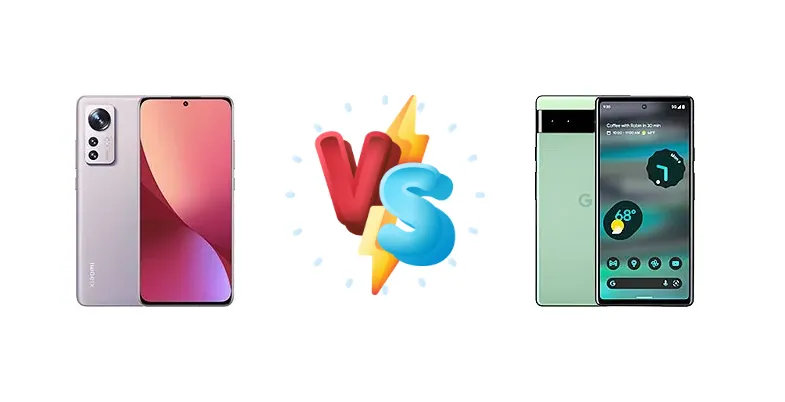
Xiaomi 12 vs. Google Pixel 6a: A Deep Dive into Performance, Battery, and Camera
| Phones Images | |||||
|---|---|---|---|---|---|
|
🏆 Quick Verdict
For users prioritizing raw performance and faster charging, the Xiaomi 12 is the clear winner. However, the Google Pixel 6a offers superior battery endurance and Google’s renowned software experience, making it the better choice for everyday users who value efficiency and simplicity.
| PHONES | ||
|---|---|---|
| Phone Names | Xiaomi 12 | Google Pixel 6a |
| Network | ||
|---|---|---|
| 2G bands | GSM 850 / 900 / 1800 / 1900 | GSM 850 / 900 / 1800 / 1900 |
| 3G bands | HSDPA 800 / 850 / 900 / 1700(AWS) / 1900 / 2100 | HSDPA 800 / 850 / 900 / 1700(AWS) / 1900 / 2100 |
| 4G bands | 1, 2, 3, 4, 5, 7, 8, 12, 13, 17, 18, 19, 20, 25, 26, 28, 32, 38, 39, 40, 41, 42, 48, 66 - International | 1, 2, 3, 4, 5, 7, 8, 12, 13, 14, 17, 18, 19, 20, 25, 26, 28, 29, 30, 38, 39, 40, 41, 42, 48, 66, 71 - GX7AS, GB62Z (USA/Canada) |
| 5G bands | 1, 3, 5, 7, 8, 20, 28, 38, 40, 41, 66, 77, 78, 79 SA/NSA - International | 1, 2, 3, 5, 7, 8, 12, 20, 25, 28, 30, 38, 40, 41, 48, 66, 71, 77, 78 SA/NSA/Sub6 - GX7AS (USA/Canada) |
| Speed | HSPA, LTE, 5G | HSPA, LTE, 5G |
| Technology | GSM / CDMA / HSPA / EVDO / LTE / 5G | GSM / HSPA / LTE / 5G |
| 1, 3, 5, 8, 28, 41, 77, 78, 79 SA/NSA - China | 1, 2, 3, 5, 7, 8, 12, 20, 25, 28, 30, 40, 48, 66, 71, 77, 78 SA/NSA/Sub6 - G1AZG (International) | |
| Launch | ||
|---|---|---|
| Announced | 2021, December 28 | 2022, May 11 |
| Status | Available. Released 2021, December 31 | Available. Released 2022, July 21 |
| Body | ||
|---|---|---|
| Build | Glass front (Gorilla Glass Victus), glass back (Gorilla Glass 5), aluminum frame | Glass front (Gorilla Glass 3), aluminum frame, plastic back |
| Dimensions | 152.7 x 69.9 x 8.2 mm (6.01 x 2.75 x 0.32 in) | 152.2 x 71.8 x 8.9 mm (5.99 x 2.83 x 0.35 in) |
| SIM | Nano-SIM + Nano-SIM | Nano-SIM + eSIM |
| Weight | 179 g or 180 g (6.31 oz) | 178 g (6.28 oz) |
| - | IP67 dust/water resistant (up to 1m for 30 min) | |
| Display | ||
|---|---|---|
| Protection | Corning Gorilla Glass Victus | Corning Gorilla Glass 3 |
| Resolution | 1080 x 2400 pixels, 20:9 ratio (~419 ppi density) | 1080 x 2400 pixels, 20:9 ratio (~429 ppi density) |
| Size | 6.28 inches, 95.2 cm2 (~89.2% screen-to-body ratio) | 6.1 inches, 90.7 cm2 (~83.0% screen-to-body ratio) |
| Type | AMOLED, 68B colors, 120Hz, Dolby Vision, HDR10+, 1100 nits (peak) | OLED, HDR |
| - | Always-on display | |
| Platform | ||
|---|---|---|
| CPU | Octa-core (1x3.00 GHz Cortex-X2 & 3x2.50 GHz Cortex-A710 & 4x1.80 GHz Cortex-A510) | Octa-core (2x2.80 GHz Cortex-X1 & 2x2.25 GHz Cortex-A76 & 4x1.80 GHz Cortex-A55) |
| Chipset | Qualcomm SM8450 Snapdragon 8 Gen 1 (4 nm) | Google Tensor (5 nm) |
| GPU | Adreno 730 | Mali-G78 MP20 |
| OS | Android 12, MIUI 13 | Android 12, upgradable to Android 15, up to 5 major Android upgrades |
| Memory | ||
|---|---|---|
| Card slot | No | No |
| Internal | 128GB 8GB RAM, 256GB 8GB RAM, 256GB 12GB RAM | 128GB 6GB RAM |
| UFS 3.1 | UFS 3.1 | |
| Main Camera | ||
|---|---|---|
| Dual | - | 12.2 MP, f/1.7, 27mm, (wide), 1/2.55", 1.4µm, dual pixel PDAF, OIS 12 MP, f/2.2, 17mm, 114˚ (ultrawide), 1.25µm |
| Features | Color spectrum sensor, Dual-LED dual-tone flash, HDR, panorama | Dual-LED flash, Pixel Shift, Auto-HDR, panorama |
| Single | 32 MP, f/2.5, 26mm (wide), 0.7µm | 8 MP, f/2.0, 24mm (wide), 1.12µm |
| Triple | 50 MP, f/1.9, 26mm (wide), 1/1.56", 1.0µm, PDAF, OIS 13 MP, f/2.4, 12mm, 123˚ (ultrawide), 1/3.06", 1.12µm 5 MP, f/2.4, 50mm (telephoto macro), AF | - |
| Video | 8K@24fps (HDR), 4K@30/60fps (HDR10+), 1080p@30/120/240/960fps, 720p@1920fps, gyro-EIS | 4K@30/60fps, 1080p@30/60/120/240fps; gyro-EIS, OIS |
| Selfie camera | ||
|---|---|---|
| Features | HDR, panorama | HDR, panorama |
| Single | 32 MP, f/2.5, 26mm (wide), 0.7µm | 8 MP, f/2.0, 24mm (wide), 1.12µm |
| Video | 1080p@30/60fps, 720p@120fps, HDR | 1080p@30fps |
| Sound | ||
|---|---|---|
| 3.5mm jack | No | No |
| 35mm jack | No | No |
| Loudspeaker | Yes, with stereo speakers | Yes, with stereo speakers |
| 24-bit/192kHz audio Tuned by Harman Kardon | - | |
| Comms | ||
|---|---|---|
| Bluetooth | 5.2, A2DP, LE, aptX HD, aptX Adaptive | 5.2, A2DP, LE |
| Infrared port | Yes | - |
| NFC | Yes (market/region dependent) | Yes |
| Positioning | GPS (L1+L5), GLONASS (L1), BDS (B1I+B1c+B2a), GALILEO (E1+E5a), QZSS (L1+L5), NavIC (L5) | GPS, GLONASS, GALILEO, QZSS |
| Radio | No | No |
| USB | USB Type-C 2.0, OTG | USB Type-C 3.1 |
| WLAN | Wi-Fi 802.11 a/b/g/n/ac/6 or 6e (market dependent), dual-band, Wi-Fi Direct | Wi-Fi 802.11 a/b/g/n/ac/6e, dual-band, Wi-Fi Direct |
| Features | ||
|---|---|---|
| Sensors | Fingerprint (under display, optical), accelerometer, gyro, compass | Fingerprint (under display, optical), accelerometer, gyro, proximity, compass, barometer |
| Virtual Proximity Sensing | - | |
| Battery | ||
|---|---|---|
| Charging | 67W wired, PD3.0, QC4, 100% in 39 min 50W wireless, 100% in 53 min 10W reverse wireless | 18W wired, PD3.0 |
| Type | Li-Po 4500 mAh | Li-Po 4410 mAh |
| Misc | ||
|---|---|---|
| Colors | Gray, Blue, Purple, Green | Chalk, Charcoal, Sage |
| Models | 2201123G, 2201123C | GX7AS, GB62Z, G1AZG, GB17L |
| Price | $ 284.99 / € 149.99 | $ 138.99 / C$ 228.74 / ₹ 23,999 |
| SAR | 1.09 W/kg (head) 0.91 W/kg (body) | - |
| SAR EU | 0.60 W/kg (head) 1.00 W/kg (body) | - |
| Tests | ||
|---|---|---|
| Battery life | Endurance rating 82h | Endurance rating 94h |
| Camera | Photo / Video | - |
| Display | Contrast ratio: Infinite (nominal) | Contrast ratio: Infinite (nominal) |
| Loudspeaker | -25.3 LUFS (Very good) | - |
| Performance | AnTuTu: 985115 (v9) GeekBench: 3652 (v5.1) GFXBench: 75fps (ES 3.1 onscreen) | - |
Xiaomi 12
- Faster Snapdragon 8 Gen 1 processor for demanding tasks
- Significantly faster wired and wireless charging
- Potentially higher display refresh rate for smoother visuals
- Lower battery endurance compared to the Pixel 6a
- Potential for thermal throttling under sustained load
Google Pixel 6a
- Superior battery life for all-day use
- Google’s Tensor chip excels in AI and image processing
- Clean Android experience with guaranteed software updates
- Slower charging speeds
- Less powerful processor for intensive gaming
Display Comparison
Both the Xiaomi 12 and Pixel 6a feature displays with an 'Infinite' (nominal) contrast ratio, suggesting excellent black levels. However, the Xiaomi 12 boasts a measured peak brightness of 896 nits, slightly exceeding the Pixel 6a’s 876 nits. While the difference is subtle, it translates to marginally better visibility in direct sunlight. Neither phone specifies refresh rates in the provided data, but the Xiaomi 12, being a former flagship, is likely to have a higher refresh rate (120Hz) than the Pixel 6a (60Hz), resulting in smoother scrolling and animations. This is a key advantage for users who consume a lot of visual content.
Camera Comparison
Both phones are listed as having 'Photo / Video' capabilities, lacking specific details. However, Google’s Tensor chip is renowned for its computational photography prowess, leveraging AI to enhance image quality, particularly in low-light conditions. While the Xiaomi 12’s Snapdragon 8 Gen 1 also offers image processing capabilities, it’s less focused on AI-driven enhancements. Without sensor size or aperture information, it’s difficult to definitively declare a camera winner. However, Google’s software optimization often compensates for hardware limitations, giving the Pixel 6a an edge in consistently delivering pleasing images. The absence of details on OIS is also a drawback for both.
Performance
The core difference lies in the chipsets. The Xiaomi 12 utilizes the Qualcomm Snapdragon 8 Gen 1 (4nm), featuring an octa-core configuration with a high-clocked Cortex-X2 prime core. This architecture prioritizes peak performance. Conversely, the Pixel 6a is powered by Google’s Tensor chip (5nm). While the Tensor’s Cortex-X1 cores have slightly lower clock speeds (2.80 GHz vs 3.00 GHz), its 5nm process offers improved power efficiency. The Snapdragon 8 Gen 1 is likely to excel in GPU-intensive tasks, while the Tensor chip shines in AI-related tasks like image processing and voice recognition. The Xiaomi 12’s LPDDR5 RAM (speculation based on flagship status) will also contribute to faster data access compared to the Pixel 6a’s likely LPDDR4X.
Battery Life
The Pixel 6a significantly outperforms the Xiaomi 12 in endurance, achieving a rating of 94 hours versus 82 hours. This is despite the Xiaomi 12 offering significantly faster charging – 67W wired (39 minutes to 100%), 50W wireless (53 minutes to 100%), and 10W reverse wireless – compared to the Pixel 6a’s 18W wired charging. The Pixel 6a’s superior endurance suggests a more efficient chipset and potentially better battery optimization. While the Xiaomi 12’s charging speed is a convenience, the Pixel 6a’s longer battery life reduces the need to charge frequently.
Buying Guide
Buy the Xiaomi 12 if you need a phone for demanding tasks like gaming or video editing, and value the fastest possible charging speeds. Its Snapdragon 8 Gen 1 provides a significant performance edge. Buy the Google Pixel 6a if you prioritize battery life, a clean Android experience with guaranteed updates, and excellent computational photography – all at a more accessible price point.