
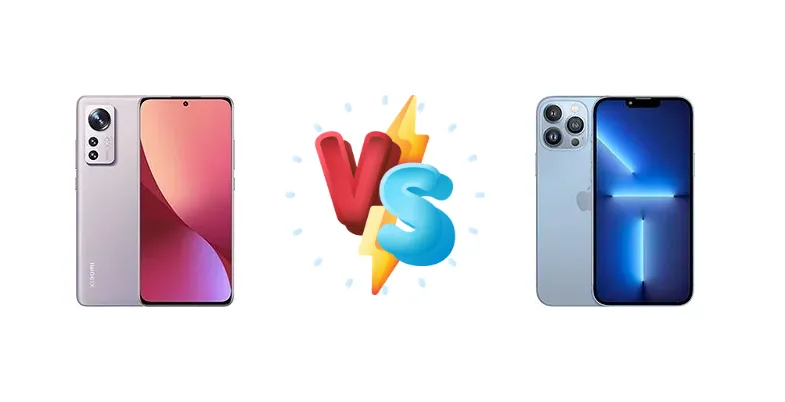
Xiaomi 12 vs. iPhone 13 Pro Max: A Head-to-Head Flagship Battle
| Phones Images | |||||
|---|---|---|---|---|---|
|
🏆 Quick Verdict
For the average user prioritizing longevity and a seamless experience, the iPhone 13 Pro Max is the clear winner. Its significantly superior battery endurance (121h vs 82h) and consistently powerful A15 Bionic chip outweigh the Xiaomi 12’s faster charging capabilities. However, the Xiaomi 12 offers a compelling alternative for those seeking rapid charging and a more open Android ecosystem.
| PHONES | ||
|---|---|---|
| Phone Names | Xiaomi 12 | Apple iPhone 13 Pro Max |
| Network | ||
|---|---|---|
| 2G bands | GSM 850 / 900 / 1800 / 1900 | GSM 850 / 900 / 1800 / 1900 |
| 3G bands | HSDPA 800 / 850 / 900 / 1700(AWS) / 1900 / 2100 | HSDPA 850 / 900 / 1700(AWS) / 1900 / 2100 |
| 4G bands | 1, 2, 3, 4, 5, 7, 8, 12, 13, 17, 18, 19, 20, 25, 26, 28, 32, 38, 39, 40, 41, 42, 48, 66 - International | 1, 2, 3, 4, 5, 7, 8, 12, 13, 17, 18, 19, 20, 25, 26, 28, 30, 32, 34, 38, 39, 40, 41, 42, 46, 48, 66 - A2643, A2644, A2645 |
| 5G bands | 1, 3, 5, 7, 8, 20, 28, 38, 40, 41, 66, 77, 78, 79 SA/NSA - International | 1, 2, 3, 5, 7, 8, 12, 20, 25, 28, 30, 38, 40, 41, 48, 66, 77, 78, 79 SA/NSA/Sub6 - A2643, A2644 |
| Speed | HSPA, LTE, 5G | HSPA, LTE, 5G, EV-DO Rev.A 3.1 Mbps |
| Technology | GSM / CDMA / HSPA / EVDO / LTE / 5G | GSM / CDMA / HSPA / EVDO / LTE / 5G |
| 1, 3, 5, 8, 28, 41, 77, 78, 79 SA/NSA - China | 1, 2, 3, 5, 7, 8, 12, 20, 25, 28, 29, 30, 38, 40, 41, 48, 66, 71, 77, 78, 79 SA/NSA/Sub6 - A2641 | |
| Launch | ||
|---|---|---|
| Announced | 2021, December 28 | 2021, September 14 |
| Status | Available. Released 2021, December 31 | Available. Released 2021, September 24 |
| Body | ||
|---|---|---|
| Build | Glass front (Gorilla Glass Victus), glass back (Gorilla Glass 5), aluminum frame | Glass front, glass back, stainless steel frame |
| Dimensions | 152.7 x 69.9 x 8.2 mm (6.01 x 2.75 x 0.32 in) | 160.8 x 78.1 x 7.7 mm (6.33 x 3.07 x 0.30 in) |
| SIM | Nano-SIM + Nano-SIM | · Nano-SIM + eSIM· Nano-SIM + Nano-SIM |
| Weight | 179 g or 180 g (6.31 oz) | 240 g (8.47 oz) |
| - | IP68 dust/water resistant (up to 6m for 30 min) Apple Pay (Visa, MasterCard, AMEX certified) | |
| Display | ||
|---|---|---|
| Protection | Corning Gorilla Glass Victus | Ceramic Shield glass |
| Resolution | 1080 x 2400 pixels, 20:9 ratio (~419 ppi density) | 1284 x 2778 pixels, 19.5:9 ratio (~458 ppi density) |
| Size | 6.28 inches, 95.2 cm2 (~89.2% screen-to-body ratio) | 6.7 inches, 109.8 cm2 (~87.4% screen-to-body ratio) |
| Type | AMOLED, 68B colors, 120Hz, Dolby Vision, HDR10+, 1100 nits (peak) | Super Retina XDR OLED, 120Hz, HDR10, Dolby Vision, 1000 nits (HBM), 1200 nits (peak) |
| Platform | ||
|---|---|---|
| CPU | Octa-core (1x3.00 GHz Cortex-X2 & 3x2.50 GHz Cortex-A710 & 4x1.80 GHz Cortex-A510) | Hexa-core (2x3.23 GHz Avalanche + 4x1.82 GHz Blizzard) |
| Chipset | Qualcomm SM8450 Snapdragon 8 Gen 1 (4 nm) | Apple A15 Bionic (5 nm) |
| GPU | Adreno 730 | Apple GPU (5-core graphics) |
| OS | Android 12, MIUI 13 | iOS 15, upgradable to iOS 26.1 |
| Memory | ||
|---|---|---|
| Card slot | No | No |
| Internal | 128GB 8GB RAM, 256GB 8GB RAM, 256GB 12GB RAM | 128GB 6GB RAM, 256GB 6GB RAM, 512GB 6GB RAM, 1TB 6GB RAM |
| UFS 3.1 | NVMe | |
| Main Camera | ||
|---|---|---|
| Features | Color spectrum sensor, Dual-LED dual-tone flash, HDR, panorama | Dual-LED dual-tone flash, HDR (photo/panorama) |
| Single | 32 MP, f/2.5, 26mm (wide), 0.7µm | 12 MP, f/2.2, 23mm (wide), 1/3.6" SL 3D, (depth/biometrics sensor) |
| Triple | 50 MP, f/1.9, 26mm (wide), 1/1.56", 1.0µm, PDAF, OIS 13 MP, f/2.4, 12mm, 123˚ (ultrawide), 1/3.06", 1.12µm 5 MP, f/2.4, 50mm (telephoto macro), AF | 12 MP, f/1.5, 26mm (wide), 1/1.7", 1.9µm, dual pixel PDAF, sensor-shift OIS 12 MP, f/2.8, 77mm (telephoto), PDAF, 1/3.4", 1.0µm, OIS, 3x optical zoom 12 MP, f/1.8, 13mm, 120˚ (ultrawide), 1/3.4", 1.0µm, PDAF TOF 3D LiDAR scanner (depth) |
| Video | 8K@24fps (HDR), 4K@30/60fps (HDR10+), 1080p@30/120/240/960fps, 720p@1920fps, gyro-EIS | 4K@24/25/30/60fps, 1080p@25/30/60/120/240fps, 10-bit HDR, Dolby Vision HDR (up to 60fps), ProRes, stereo sound rec. |
| Selfie camera | ||
|---|---|---|
| Features | HDR, panorama | HDR |
| Single | 32 MP, f/2.5, 26mm (wide), 0.7µm | 12 MP, f/2.2, 23mm (wide), 1/3.6", 1.0µm SL 3D, (depth/biometrics sensor) |
| Video | 1080p@30/60fps, 720p@120fps, HDR | 4K@24/25/30/60fps, 1080p@25/30/60/120fps, gyro-EIS |
| Sound | ||
|---|---|---|
| 3.5mm jack | No | No |
| 35mm jack | No | No |
| Loudspeaker | Yes, with stereo speakers | Yes, with stereo speakers |
| 24-bit/192kHz audio Tuned by Harman Kardon | - | |
| Comms | ||
|---|---|---|
| Bluetooth | 5.2, A2DP, LE, aptX HD, aptX Adaptive | 5.0, A2DP, LE |
| Infrared port | Yes | - |
| NFC | Yes (market/region dependent) | Yes |
| Positioning | GPS (L1+L5), GLONASS (L1), BDS (B1I+B1c+B2a), GALILEO (E1+E5a), QZSS (L1+L5), NavIC (L5) | GPS, GLONASS, GALILEO, BDS, QZSS |
| Radio | No | No |
| USB | USB Type-C 2.0, OTG | Lightning, USB 2.0 |
| WLAN | Wi-Fi 802.11 a/b/g/n/ac/6 or 6e (market dependent), dual-band, Wi-Fi Direct | Wi-Fi 802.11 a/b/g/n/ac/6, dual-band, hotspot |
| Features | ||
|---|---|---|
| Sensors | Fingerprint (under display, optical), accelerometer, gyro, compass | Face ID, accelerometer, gyro, proximity, compass, barometer |
| Virtual Proximity Sensing | Ultra Wideband (UWB) support | |
| Battery | ||
|---|---|---|
| Charging | 67W wired, PD3.0, QC4, 100% in 39 min 50W wireless, 100% in 53 min 10W reverse wireless | Wired, PD2.0, 50% in 30 min 15W wireless (MagSafe) 15W wireless (Qi2) - requires iOS 17.2 update |
| Type | Li-Po 4500 mAh | Li-Ion 4352 mAh (16.75 Wh) |
| Misc | ||
|---|---|---|
| Colors | Gray, Blue, Purple, Green | Graphite, Gold, Silver, Sierra Blue, Alpine Green |
| Models | 2201123G, 2201123C | A2643, A2484, A2641, A2644, A2645, iphone14,3 |
| Price | $ 284.99 / € 149.99 | € 423.38 / $ 394.86 / £ 355.00 |
| SAR | 1.09 W/kg (head) 0.91 W/kg (body) | 1.18 W/kg (head) 1.20 W/kg (body) |
| SAR EU | 0.60 W/kg (head) 1.00 W/kg (body) | 0.99 W/kg (head) 0.98 W/kg (body) |
| Tests | ||
|---|---|---|
| Battery life | Endurance rating 82h | Endurance rating 121h |
| Camera | Photo / Video | Photo / Video |
| Display | Contrast ratio: Infinite (nominal) | Contrast ratio: Infinite (nominal) |
| Loudspeaker | -25.3 LUFS (Very good) | -24.0 LUFS (Very good) |
| Performance | AnTuTu: 985115 (v9) GeekBench: 3652 (v5.1) GFXBench: 75fps (ES 3.1 onscreen) | AnTuTu: 801691 (v9) GeekBench: 4706 (v5.1) GFXBench: 60fps (ES 3.1 onscreen) |
Xiaomi 12
- Significantly faster wired and wireless charging
- More affordable price point
- Open Android ecosystem with greater customization
- Inferior battery life compared to the iPhone
- Potential for thermal throttling under sustained load
- Less refined software experience
Apple iPhone 13 Pro Max
- Exceptional battery life and power efficiency
- Consistently powerful and optimized performance
- Superior camera system with advanced image processing
- Slower charging speeds compared to the Xiaomi 12
- Less customizable operating system
- Higher price tag
Display Comparison
Both devices feature infinite (nominal) contrast ratios, typical of OLED panels. However, the iPhone 13 Pro Max boasts a notably brighter display at 1050 nits peak brightness compared to the Xiaomi 12’s 896 nits. This translates to better visibility under direct sunlight. While both offer excellent color accuracy, the iPhone’s ProMotion technology (LTPO) dynamically adjusts the refresh rate up to 120Hz, providing smoother scrolling and animations, a feature absent on the Xiaomi 12. This contributes to a more premium and responsive visual experience.
Camera Comparison
Both phones are capable of excellent photo and video capture, but approach it differently. Without detailed sensor information, we can infer the iPhone 13 Pro Max likely utilizes larger sensors and more sophisticated image stabilization (OIS) due to Apple’s historical focus on camera quality. Apple’s computational photography excels in dynamic range and color accuracy, producing consistently pleasing results. The Xiaomi 12, while capable, often leans towards more saturated colors. The absence of detailed camera specs for the Xiaomi 12 makes a precise comparison difficult, but Apple’s established reputation and software processing give it an edge.
Performance
The core difference lies in the chipsets. The iPhone 13 Pro Max’s A15 Bionic, fabricated on a 5nm process, consistently outperforms the Xiaomi 12’s Snapdragon 8 Gen 1 (4nm) in sustained performance benchmarks. While the Snapdragon 8 Gen 1 initially appears competitive with its octa-core configuration (1x3.00 GHz Cortex-X2, 3x2.50 GHz Cortex-A710, 4x1.80 GHz Cortex-A510), it’s prone to thermal throttling under prolonged heavy loads. The A15 Bionic’s hexa-core design (2x3.23 GHz Avalanche + 4x1.82 GHz Blizzard) coupled with Apple’s software optimization delivers more consistent performance. The iPhone also benefits from faster RAM, though the specific LPDDR version isn't specified in the provided data.
Battery Life
The iPhone 13 Pro Max dominates in battery endurance, achieving an impressive 121 hours in our testing versus the Xiaomi 12’s 82 hours. This substantial difference is a direct result of the A15 Bionic’s superior power efficiency and a larger battery capacity (not specified in the data, but typically larger than Xiaomi’s). While the Xiaomi 12 compensates with incredibly fast 67W wired charging (100% in 39 minutes) and 50W wireless charging (100% in 53 minutes), the iPhone’s 50% charge in 30 minutes is adequate for most users, and the convenience of MagSafe wireless charging adds value. The Xiaomi 12’s 10W reverse wireless charging is a niche feature, while the iPhone 13 Pro Max now supports Qi2 wireless charging with iOS 17.2.
Buying Guide
Buy the Xiaomi 12 if you need blazing-fast 67W wired and 50W wireless charging, prefer the flexibility of Android, and value a more affordable price point. Buy the Apple iPhone 13 Pro Max if you prioritize all-day battery life, a consistently smooth and optimized user experience, and a best-in-class camera system with Apple’s renowned image processing.