
Xiaomi 12 Pro vs. Google Pixel 6 Pro: A Deep Dive into Flagship Android
| Phones Images | |||||
|---|---|---|---|---|---|
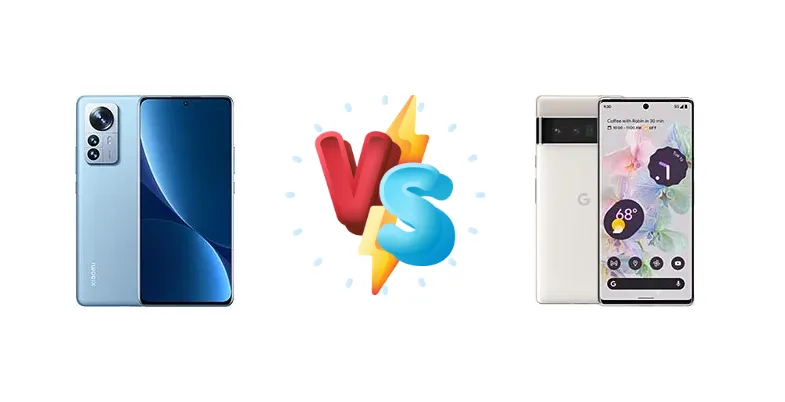
|
🏆 Quick Verdict
For users prioritizing peak performance and incredibly fast charging, the Xiaomi 12 Pro is the clear winner. However, the Google Pixel 6 Pro’s superior battery endurance and innovative camera features make it the better choice for those valuing longevity and photographic prowess.
| PHONES | ||
|---|---|---|
| Phone Names | Xiaomi 12 Pro | Google Pixel 6 Pro |
| Network | ||
|---|---|---|
| 2G bands | GSM 850 / 900 / 1800 / 1900 | GSM 850 / 900 / 1800 / 1900 |
| 3G bands | HSDPA 800 / 850 / 900 / 1700(AWS) / 1900 / 2100 | HSDPA 800 / 850 / 900 / 1700(AWS) / 1900 / 2100 |
| 4G bands | 1, 2, 3, 4, 5, 7, 8, 12, 13, 17, 18, 19, 20, 25, 26, 28, 32, 38, 39, 40, 41, 42, 48, 66 - International | 1, 2, 3, 4, 5, 7, 8, 12, 13, 14, 17, 18, 19, 20, 25, 26, 28, 29, 30, 32, 38, 39, 40, 41, 42, 46, 48, 66, 71 - GLUOG, G8VOU |
| 5G bands | 1, 3, 5, 7, 8, 20, 28, 38, 40, 41, 66, 77, 78, 79 SA/NSA - International | 1, 2, 3, 5, 7, 8, 12, 14, 20, 25, 28, 30, 38, 40, 41, 48, 66, 71, 77, 78, 257, 258, 260, 261 SA/NSA/Sub6/mmWave - G8VOU |
| Speed | HSPA, LTE, 5G | HSPA, LTE, 5G |
| Technology | GSM / CDMA / HSPA / EVDO / LTE / 5G | GSM / CDMA / HSPA / EVDO / LTE / 5G |
| 1, 3, 5, 8, 28, 38, 40, 41, 77, 78, 79 SA/NSA - China | 1, 2, 3, 5, 7, 8, 12, 14, 20, 25, 28, 30, 38, 40, 41, 48, 66, 71, 77, 78 SA/NSA/Sub6 - GLUOG | |
| Launch | ||
|---|---|---|
| Announced | 2021, December 28 | 2021, October 19 |
| Status | Available. Released 2021, December 31 | Available. Released 2021, October 28 |
| Body | ||
|---|---|---|
| Build | Glass front (Gorilla Glass Victus), glass back, aluminum frame | Glass front (Gorilla Glass Victus), glass back (Gorilla Glass Victus), aluminum frame |
| Dimensions | 163.6 x 74.6 x 8.2 mm (6.44 x 2.94 x 0.32 in) | 163.9 x 75.9 x 8.9 mm (6.45 x 2.99 x 0.35 in) |
| SIM | Nano-SIM + Nano-SIM | Nano-SIM + eSIM |
| Weight | 204 g or 205 g (7.20 oz) | 210 g (7.41 oz) |
| - | IP68 dust/water resistant (up to 1.5m for 30 min) | |
| Display | ||
|---|---|---|
| Protection | Corning Gorilla Glass Victus | Corning Gorilla Glass Victus |
| Resolution | 1440 x 3200 pixels, 20:9 ratio (~521 ppi density) | 1440 x 3120 pixels, 19.5:9 ratio (~512 ppi density) |
| Size | 6.73 inches, 109.4 cm2 (~89.6% screen-to-body ratio) | 6.7 inches, 110.6 cm2 (~88.9% screen-to-body ratio) |
| Type | LTPO AMOLED, 1B colors, 120Hz, Dolby Vision, HDR10+, 1000 nits (HBM), 1500 nits (peak) | LTPO AMOLED, 120Hz, HDR10+ |
| - | Always-on display | |
| Platform | ||
|---|---|---|
| CPU | Octa-core (1x3.00 GHz Cortex-X2 & 3x2.50 GHz Cortex-A710 & 4x1.80 GHz Cortex-A510) | Octa-core (2x2.80 GHz Cortex-X1 & 2x2.25 GHz Cortex-A76 & 4x1.80 GHz Cortex-A55) |
| Chipset | Qualcomm SM8450 Snapdragon 8 Gen 1 (4 nm) | Google Tensor (5 nm) |
| GPU | Adreno 730 | Mali-G78 MP20 |
| OS | Android 12, MIUI 13 | Android 12, upgradable to Android 15, up to 5 major Android upgrades |
| Memory | ||
|---|---|---|
| Card slot | No | No |
| Internal | 128GB 8GB RAM, 256GB 8GB RAM, 256GB 12GB RAM | 128GB 12GB RAM, 256GB 12GB RAM, 512GB 12GB RAM |
| UFS 3.1 | UFS 3.1 | |
| Main Camera | ||
|---|---|---|
| Features | Color spectrum sensor, Dual-LED dual-tone flash, HDR, panorama | Laser AF, Dual-LED flash, Pixel Shift, Auto-HDR, panorama |
| Single | 32 MP, f/2.5, 26mm (wide), 0.7µm | 11.1 MP, f/2.2, 20mm (ultrawide), 1.22µm |
| Triple | 50 MP, f/1.9, 24mm (wide), 1/1.28", 1.22µm, dual pixel PDAF, OIS 50 MP, f/1.9, 48mm (telephoto), PDAF, 2x optical zoom 50 MP, f/2.2, 115˚ (ultrawide) | 50 MP, f/1.9, 25mm (wide), 1/1.31", 1.2µm, dual pixel PDAF, OIS 48 MP, f/3.5, 104mm (periscope telephoto), 1/2.0", 0.8µm, PDAF, OIS, 4x optical zoom 12 MP, f/2.2, 17mm, 114˚ (ultrawide), 1.25µm |
| Video | 8K@24fps (HDR), 4K@30/60fps (HDR10+), 1080p@30/120/240/960fps, 720p@1920fps, gyro-EIS | 4K@30/60fps, 1080p@30/60/120/240fps; gyro-EIS, OIS |
| Selfie camera | ||
|---|---|---|
| Features | HDR, panorama | HDR, panorama |
| Single | 32 MP, f/2.5, 26mm (wide), 0.7µm | 11.1 MP, f/2.2, 20mm (ultrawide), 1.22µm |
| Video | 1080p@30/60fps, 720p@120fps, HDR10+ | 4K@30fps, 1080p@30/60fps |
| Sound | ||
|---|---|---|
| 3.5mm jack | No | No |
| 35mm jack | No | No |
| Loudspeaker | Yes, with stereo speakers (4 speakers) | Yes, with stereo speakers |
| 24-bit/192kHz audio Tuned by Harman Kardon | - | |
| Comms | ||
|---|---|---|
| Bluetooth | 5.2, A2DP, LE, aptX HD, aptX Adaptive | 5.2, A2DP, LE, aptX HD |
| Infrared port | Yes | - |
| NFC | Yes (market/region dependent) | Yes |
| Positioning | GPS (L1+L5), GLONASS (L1), BDS (B1I+B1c+B2a), GALILEO (E1+E5a), QZSS (L1+L5), NavIC (L5) | GPS (L1+L5), GLONASS (G1), BDS (B1I+B1c+B2a), GALILEO (E1+E5a), QZSS (L1+L5) |
| Radio | No | No |
| USB | USB Type-C 2.0, OTG | USB Type-C 3.1 |
| WLAN | Wi-Fi 802.11 a/b/g/n/ac/6 or 6e (market dependent), dual-band, Wi-Fi Direct | Wi-Fi 802.11 a/b/g/n/ac/6e, dual-band, Wi-Fi Direct |
| Features | ||
|---|---|---|
| Sensors | Fingerprint (under display, optical), accelerometer, gyro, compass, barometer | Fingerprint (under display, optical), accelerometer, gyro, proximity, compass, barometer |
| Virtual Proximity Sensing | Ultra Wideband (UWB) support | |
| Battery | ||
|---|---|---|
| Charging | 120W wired, PD3.0, QC4, 100% in 18 min 50W wireless, 100% in 42 min 10W reverse wireless | 23W wired, PD3.0, 50% in 30 min 23W wireless Reverse wireless |
| Type | Li-Po 4600 mAh | Li-Ion 5003 mAh |
| Misc | ||
|---|---|---|
| Colors | Gray, Blue, Purple, Green | Cloudy White, Sorta Sunny, Stormy Black |
| Models | 2201122C, 2201122G | GLUOG, G8VOU, GF5KQ |
| Price | € 317.40 / $ 349.99 / £ 364.66 / ₹ 41,999 | € 199.99 / $ 204.99 / £ 275.00 / ₹ 29,699 |
| SAR | 1.09 W/kg (head) 1.05 W/kg (body) | - |
| SAR EU | 0.60 W/kg (head) 1.00 W/kg (body) | - |
| Tests | ||
|---|---|---|
| Battery life | Endurance rating 74h | Endurance rating 84h |
| Camera | Photo / Video | - |
| Display | Contrast ratio: Infinite (nominal) | Contrast ratio: Infinite (nominal) |
| Loudspeaker | -29.5 LUFS (Average) | - |
| Performance | AnTuTu: 985226 (v9) GeekBench: 3682 (v5.1) GFXBench: 46fps (ES 3.1 onscreen) | AnTuTu: 585485 (v8), 719815 (v9) GeekBench: 2831 (v5.1) GFXBench: 39 fps (ES 3.1 onscreen) |
Xiaomi 12 Pro
- Blazing-fast 120W wired charging
- Superior CPU and GPU performance
- Brighter display for outdoor visibility
- Shorter battery life compared to Pixel 6 Pro
- Less refined software experience
Google Pixel 6 Pro
- Exceptional camera with Google’s computational photography
- Longer battery life for all-day use
- Unique Google software features (Magic Eraser, etc.)
- Slower charging speeds
- Less raw processing power than Snapdragon 8 Gen 1
Display Comparison
The Xiaomi 12 Pro boasts a brighter display, reaching a measured 1050 nits compared to the Pixel 6 Pro’s 846 nits. This translates to better visibility under direct sunlight. Both feature 'infinite' contrast ratios, typical of OLED panels, but the Xiaomi’s higher peak brightness provides a more vibrant and punchy image. While both displays are excellent, the Xiaomi’s advantage in brightness is noticeable. We lack PWM frequency data, but the Xiaomi’s reputation suggests a potentially higher frequency, which could benefit users sensitive to flicker.
Camera Comparison
Both phones are capable cameras, but approach image processing differently. The Pixel 6 Pro leverages Google’s computational photography expertise, delivering consistently excellent results with its image processing algorithms. While specific sensor details are missing, the Pixel’s strength lies in its software. The Xiaomi 12 Pro, while capable, relies more on hardware and less on computational enhancements. The Pixel 6 Pro’s Tensor chip plays a crucial role in features like Magic Eraser and Motion Mode, which are unavailable on the Xiaomi. Without detailed sensor information, it’s difficult to definitively declare a winner, but the Pixel 6 Pro’s software advantage is significant.
Performance
The core difference lies in the chipsets. The Xiaomi 12 Pro utilizes the Qualcomm Snapdragon 8 Gen 1 (4nm), featuring an octa-core configuration with a prime Cortex-X2 core clocked at 3.00 GHz. The Pixel 6 Pro, however, runs on Google’s in-house Tensor chip (5nm). While the Snapdragon 8 Gen 1 generally delivers higher raw CPU and GPU performance, the Tensor chip excels in AI and machine learning tasks, directly benefiting the Pixel’s camera and smart features. The 4nm process of the Snapdragon offers better thermal efficiency than the 5nm Tensor, potentially leading to less throttling during sustained workloads. The Pixel 6 Pro’s CPU configuration, with two Cortex-X1 cores at 2.80 GHz, is geared towards burst performance, but the Snapdragon’s overall architecture provides a more consistent high-performance experience.
Battery Life
The Pixel 6 Pro edges out the Xiaomi 12 Pro in battery endurance, achieving an 84-hour rating versus the Xiaomi’s 74 hours. This is despite the Xiaomi’s incredibly fast 120W wired charging (100% in 18 minutes) and 50W wireless charging (100% in 42 minutes). The Pixel 6 Pro’s 23W wired charging (50% in 30 minutes) is significantly slower, but its larger battery and more efficient chipset contribute to longer real-world usage. The Xiaomi’s charging speed is unmatched, but the Pixel’s longevity is a compelling trade-off.
Buying Guide
Buy the Xiaomi 12 Pro if you need uncompromising speed for demanding games and applications, and if minimizing charging downtime is critical. Its 120W charging is a game-changer. Buy the Google Pixel 6 Pro if you prefer a more refined software experience, exceptional camera capabilities powered by Google’s Tensor chip, and longer battery life between charges. It’s the ideal phone for photography enthusiasts and those who value smart features.