
Xiaomi 12 Pro vs. iPhone 13 Pro Max: A Deep Dive into Android and iOS Flagships
| Phones Images | |||||
|---|---|---|---|---|---|
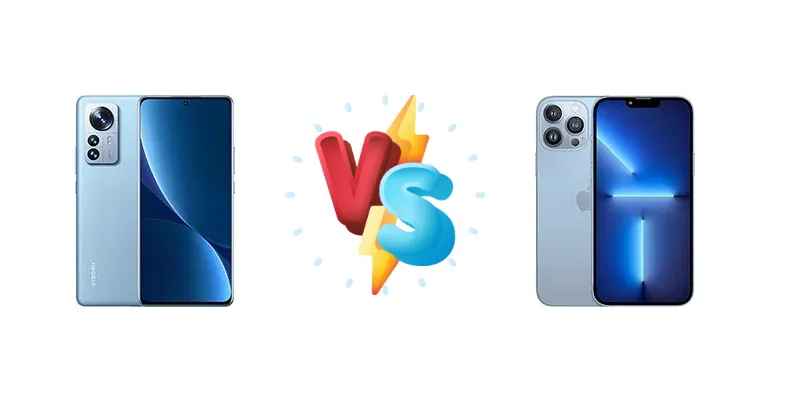
|
🏆 Quick Verdict
For the average user prioritizing long-term battery life and a refined software experience, the iPhone 13 Pro Max is the superior choice. However, the Xiaomi 12 Pro’s incredibly fast 120W charging and aggressive pricing make it a compelling option for those who value speed and aren't locked into the Apple ecosystem.
| PHONES | ||
|---|---|---|
| Phone Names | Xiaomi 12 Pro | Apple iPhone 13 Pro Max |
| Network | ||
|---|---|---|
| 2G bands | GSM 850 / 900 / 1800 / 1900 | GSM 850 / 900 / 1800 / 1900 |
| 3G bands | HSDPA 800 / 850 / 900 / 1700(AWS) / 1900 / 2100 | HSDPA 850 / 900 / 1700(AWS) / 1900 / 2100 |
| 4G bands | 1, 2, 3, 4, 5, 7, 8, 12, 13, 17, 18, 19, 20, 25, 26, 28, 32, 38, 39, 40, 41, 42, 48, 66 - International | 1, 2, 3, 4, 5, 7, 8, 12, 13, 17, 18, 19, 20, 25, 26, 28, 30, 32, 34, 38, 39, 40, 41, 42, 46, 48, 66 - A2643, A2644, A2645 |
| 5G bands | 1, 3, 5, 7, 8, 20, 28, 38, 40, 41, 66, 77, 78, 79 SA/NSA - International | 1, 2, 3, 5, 7, 8, 12, 20, 25, 28, 30, 38, 40, 41, 48, 66, 77, 78, 79 SA/NSA/Sub6 - A2643, A2644 |
| Speed | HSPA, LTE, 5G | HSPA, LTE, 5G, EV-DO Rev.A 3.1 Mbps |
| Technology | GSM / CDMA / HSPA / EVDO / LTE / 5G | GSM / CDMA / HSPA / EVDO / LTE / 5G |
| 1, 3, 5, 8, 28, 38, 40, 41, 77, 78, 79 SA/NSA - China | 1, 2, 3, 5, 7, 8, 12, 20, 25, 28, 29, 30, 38, 40, 41, 48, 66, 71, 77, 78, 79 SA/NSA/Sub6 - A2641 | |
| Launch | ||
|---|---|---|
| Announced | 2021, December 28 | 2021, September 14 |
| Status | Available. Released 2021, December 31 | Available. Released 2021, September 24 |
| Body | ||
|---|---|---|
| Build | Glass front (Gorilla Glass Victus), glass back, aluminum frame | Glass front, glass back, stainless steel frame |
| Dimensions | 163.6 x 74.6 x 8.2 mm (6.44 x 2.94 x 0.32 in) | 160.8 x 78.1 x 7.7 mm (6.33 x 3.07 x 0.30 in) |
| SIM | Nano-SIM + Nano-SIM | · Nano-SIM + eSIM· Nano-SIM + Nano-SIM |
| Weight | 204 g or 205 g (7.20 oz) | 240 g (8.47 oz) |
| - | IP68 dust/water resistant (up to 6m for 30 min) Apple Pay (Visa, MasterCard, AMEX certified) | |
| Display | ||
|---|---|---|
| Protection | Corning Gorilla Glass Victus | Ceramic Shield glass |
| Resolution | 1440 x 3200 pixels, 20:9 ratio (~521 ppi density) | 1284 x 2778 pixels, 19.5:9 ratio (~458 ppi density) |
| Size | 6.73 inches, 109.4 cm2 (~89.6% screen-to-body ratio) | 6.7 inches, 109.8 cm2 (~87.4% screen-to-body ratio) |
| Type | LTPO AMOLED, 1B colors, 120Hz, Dolby Vision, HDR10+, 1000 nits (HBM), 1500 nits (peak) | Super Retina XDR OLED, 120Hz, HDR10, Dolby Vision, 1000 nits (HBM), 1200 nits (peak) |
| Platform | ||
|---|---|---|
| CPU | Octa-core (1x3.00 GHz Cortex-X2 & 3x2.50 GHz Cortex-A710 & 4x1.80 GHz Cortex-A510) | Hexa-core (2x3.23 GHz Avalanche + 4x1.82 GHz Blizzard) |
| Chipset | Qualcomm SM8450 Snapdragon 8 Gen 1 (4 nm) | Apple A15 Bionic (5 nm) |
| GPU | Adreno 730 | Apple GPU (5-core graphics) |
| OS | Android 12, MIUI 13 | iOS 15, upgradable to iOS 26.1 |
| Memory | ||
|---|---|---|
| Card slot | No | No |
| Internal | 128GB 8GB RAM, 256GB 8GB RAM, 256GB 12GB RAM | 128GB 6GB RAM, 256GB 6GB RAM, 512GB 6GB RAM, 1TB 6GB RAM |
| UFS 3.1 | NVMe | |
| Main Camera | ||
|---|---|---|
| Features | Color spectrum sensor, Dual-LED dual-tone flash, HDR, panorama | Dual-LED dual-tone flash, HDR (photo/panorama) |
| Single | 32 MP, f/2.5, 26mm (wide), 0.7µm | 12 MP, f/2.2, 23mm (wide), 1/3.6" SL 3D, (depth/biometrics sensor) |
| Triple | 50 MP, f/1.9, 24mm (wide), 1/1.28", 1.22µm, dual pixel PDAF, OIS 50 MP, f/1.9, 48mm (telephoto), PDAF, 2x optical zoom 50 MP, f/2.2, 115˚ (ultrawide) | 12 MP, f/1.5, 26mm (wide), 1/1.7", 1.9µm, dual pixel PDAF, sensor-shift OIS 12 MP, f/2.8, 77mm (telephoto), PDAF, 1/3.4", 1.0µm, OIS, 3x optical zoom 12 MP, f/1.8, 13mm, 120˚ (ultrawide), 1/3.4", 1.0µm, PDAF TOF 3D LiDAR scanner (depth) |
| Video | 8K@24fps (HDR), 4K@30/60fps (HDR10+), 1080p@30/120/240/960fps, 720p@1920fps, gyro-EIS | 4K@24/25/30/60fps, 1080p@25/30/60/120/240fps, 10-bit HDR, Dolby Vision HDR (up to 60fps), ProRes, stereo sound rec. |
| Selfie camera | ||
|---|---|---|
| Features | HDR, panorama | HDR |
| Single | 32 MP, f/2.5, 26mm (wide), 0.7µm | 12 MP, f/2.2, 23mm (wide), 1/3.6", 1.0µm SL 3D, (depth/biometrics sensor) |
| Video | 1080p@30/60fps, 720p@120fps, HDR10+ | 4K@24/25/30/60fps, 1080p@25/30/60/120fps, gyro-EIS |
| Sound | ||
|---|---|---|
| 3.5mm jack | No | No |
| 35mm jack | No | No |
| Loudspeaker | Yes, with stereo speakers (4 speakers) | Yes, with stereo speakers |
| 24-bit/192kHz audio Tuned by Harman Kardon | - | |
| Comms | ||
|---|---|---|
| Bluetooth | 5.2, A2DP, LE, aptX HD, aptX Adaptive | 5.0, A2DP, LE |
| Infrared port | Yes | - |
| NFC | Yes (market/region dependent) | Yes |
| Positioning | GPS (L1+L5), GLONASS (L1), BDS (B1I+B1c+B2a), GALILEO (E1+E5a), QZSS (L1+L5), NavIC (L5) | GPS, GLONASS, GALILEO, BDS, QZSS |
| Radio | No | No |
| USB | USB Type-C 2.0, OTG | Lightning, USB 2.0 |
| WLAN | Wi-Fi 802.11 a/b/g/n/ac/6 or 6e (market dependent), dual-band, Wi-Fi Direct | Wi-Fi 802.11 a/b/g/n/ac/6, dual-band, hotspot |
| Features | ||
|---|---|---|
| Sensors | Fingerprint (under display, optical), accelerometer, gyro, compass, barometer | Face ID, accelerometer, gyro, proximity, compass, barometer |
| Virtual Proximity Sensing | Ultra Wideband (UWB) support | |
| Battery | ||
|---|---|---|
| Charging | 120W wired, PD3.0, QC4, 100% in 18 min 50W wireless, 100% in 42 min 10W reverse wireless | Wired, PD2.0, 50% in 30 min 15W wireless (MagSafe) 15W wireless (Qi2) - requires iOS 17.2 update |
| Type | Li-Po 4600 mAh | Li-Ion 4352 mAh (16.75 Wh) |
| Misc | ||
|---|---|---|
| Colors | Gray, Blue, Purple, Green | Graphite, Gold, Silver, Sierra Blue, Alpine Green |
| Models | 2201122C, 2201122G | A2643, A2484, A2641, A2644, A2645, iphone14,3 |
| Price | € 317.40 / $ 349.99 / £ 364.66 / ₹ 41,999 | € 423.38 / $ 394.86 / £ 355.00 |
| SAR | 1.09 W/kg (head) 1.05 W/kg (body) | 1.18 W/kg (head) 1.20 W/kg (body) |
| SAR EU | 0.60 W/kg (head) 1.00 W/kg (body) | 0.99 W/kg (head) 0.98 W/kg (body) |
| Tests | ||
|---|---|---|
| Battery life | Endurance rating 74h | Endurance rating 121h |
| Camera | Photo / Video | Photo / Video |
| Display | Contrast ratio: Infinite (nominal) | Contrast ratio: Infinite (nominal) |
| Loudspeaker | -29.5 LUFS (Average) | -24.0 LUFS (Very good) |
| Performance | AnTuTu: 985226 (v9) GeekBench: 3682 (v5.1) GFXBench: 46fps (ES 3.1 onscreen) | AnTuTu: 801691 (v9) GeekBench: 4706 (v5.1) GFXBench: 60fps (ES 3.1 onscreen) |
Xiaomi 12 Pro
- Incredibly fast 120W wired charging
- Powerful Snapdragon 8 Gen 1 processor
- Competitive price point
- Significantly shorter battery life than iPhone
- Software experience may not appeal to all users
- Camera processing can be inconsistent
Apple iPhone 13 Pro Max
- Exceptional battery life (121h endurance)
- Smooth and optimized iOS experience
- Industry-leading video recording capabilities
- Slower charging speeds compared to Xiaomi
- Higher price tag
- Less customization options
Display Comparison
Both the Xiaomi 12 Pro and iPhone 13 Pro Max boast impressive displays, both peaking at 1050 nits of measured brightness. This ensures excellent visibility even in direct sunlight. While both have an 'infinite' contrast ratio (typical for OLED panels), the underlying panel technology and calibration differ. Apple’s ProMotion technology (LTPO) dynamically adjusts the refresh rate up to 120Hz, offering smoother scrolling and animations, a feature also present on the Xiaomi 12 Pro. However, the Xiaomi's PWM dimming frequency isn't specified, potentially making it less comfortable for users sensitive to flicker compared to the iPhone's likely higher frequency.
Camera Comparison
Both phones excel in photography and videography, but approach it differently. While both are capable of excellent results, the iPhone 13 Pro Max is known for its cinematic mode and consistently accurate color science. The Xiaomi 12 Pro’s camera system, while capable, relies more heavily on software processing, which can sometimes lead to over-sharpening or unnatural colors. Details regarding sensor sizes and lens apertures are missing, but the iPhone’s reputation for video quality and computational photography gives it an edge. The absence of detailed camera specs for the Xiaomi makes a direct comparison difficult, but the iPhone’s established track record is a significant advantage.
Performance
The core of the performance difference lies in the chipsets. The Xiaomi 12 Pro utilizes the Qualcomm Snapdragon 8 Gen 1 (4nm), an octa-core processor designed for peak performance. The iPhone 13 Pro Max, however, is powered by Apple’s A15 Bionic (5nm). Despite having fewer cores (Hexa-core vs Octa-core), the A15 Bionic consistently outperforms the Snapdragon 8 Gen 1 in real-world tasks and benchmarks due to Apple’s superior chip design and software optimization. The 5nm process node of the A15 also contributes to better thermal efficiency, reducing the likelihood of throttling during sustained workloads. While the Snapdragon 8 Gen 1 offers raw power, the A15 delivers a more consistent and efficient experience.
Battery Life
Battery life is where the iPhone 13 Pro Max truly shines. Its endurance rating of 121 hours significantly surpasses the Xiaomi 12 Pro’s 74 hours. This difference is due to a combination of the A15 Bionic’s efficiency and likely a larger battery capacity (not specified in the data). However, the Xiaomi 12 Pro compensates with its revolutionary charging speeds. 120W wired charging can fully charge the phone in just 18 minutes, a massive advantage over the iPhone’s 30-minute 50% charge. The Xiaomi also offers 50W wireless charging, far exceeding the iPhone’s 15W MagSafe/Qi2 charging. The Xiaomi’s 10W reverse wireless charging is a useful addition for topping up accessories.
Buying Guide
Buy the Xiaomi 12 Pro if you need blazing-fast charging, prioritize raw processing power for demanding tasks, and prefer the flexibility of the Android operating system. Buy the Apple iPhone 13 Pro Max if you value exceptional battery endurance, a seamless user experience, and a consistently high-performing camera system with excellent video capabilities.