
Xiaomi 12 Pro: Dimensity vs Snapdragon – Which One to Choose?
| Phones Images | |||||
|---|---|---|---|---|---|
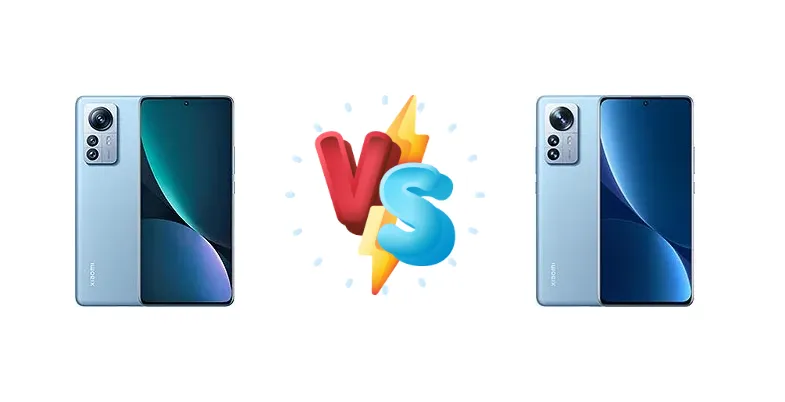
|
🏆 Quick Verdict
The Snapdragon 8 Gen 1 variant generally wins due to its faster charging, potentially better sustained performance, and slightly more refined software experience. However, the Dimensity version offers a compelling alternative with a strong chipset and competitive price, especially if charging speed isn't a top priority.
| PHONES | ||
|---|---|---|
| Phone Names | Xiaomi 12 Pro (Dimensity) | Xiaomi 12 Pro |
| Network | ||
|---|---|---|
| 2G bands | GSM 850 / 900 / 1800 / 1900 | GSM 850 / 900 / 1800 / 1900 |
| 3G bands | HSDPA 800 / 850 / 900 / 1700(AWS) / 1900 / 2100 | HSDPA 800 / 850 / 900 / 1700(AWS) / 1900 / 2100 |
| 4G bands | 1, 2, 3, 4, 5, 7, 8, 18, 19, 26, 34, 38, 39, 40, 41, 42 | 1, 2, 3, 4, 5, 7, 8, 12, 13, 17, 18, 19, 20, 25, 26, 28, 32, 38, 39, 40, 41, 42, 48, 66 - International |
| 5G bands | 1, 3, 5, 8, 28, 38, 40, 41, 77, 78 SA/NSA | 1, 3, 5, 7, 8, 20, 28, 38, 40, 41, 66, 77, 78, 79 SA/NSA - International |
| Speed | HSPA, LTE, 5G | HSPA, LTE, 5G |
| Technology | GSM / CDMA / HSPA / EVDO / LTE / 5G | GSM / CDMA / HSPA / EVDO / LTE / 5G |
| CDMA2000 1xEV-DO | 1, 3, 5, 8, 28, 38, 40, 41, 77, 78, 79 SA/NSA - China | |
| Launch | ||
|---|---|---|
| Announced | 2022, July 04 | 2021, December 28 |
| Status | Available. Released 2022, July 13 | Available. Released 2021, December 31 |
| Body | ||
|---|---|---|
| Build | - | Glass front (Gorilla Glass Victus), glass back, aluminum frame |
| Dimensions | 163.6 x 74.6 x 8.2 mm (6.44 x 2.94 x 0.32 in) | 163.6 x 74.6 x 8.2 mm (6.44 x 2.94 x 0.32 in) |
| SIM | Nano-SIM + Nano-SIM | Nano-SIM + Nano-SIM |
| Weight | 201 g (7.09 oz) | 204 g or 205 g (7.20 oz) |
| Display | ||
|---|---|---|
| Protection | Corning Gorilla Glass Victus | Corning Gorilla Glass Victus |
| Resolution | 1440 x 3200 pixels, 20:9 ratio (~521 ppi density) | 1440 x 3200 pixels, 20:9 ratio (~521 ppi density) |
| Size | 6.73 inches, 109.4 cm2 (~89.6% screen-to-body ratio) | 6.73 inches, 109.4 cm2 (~89.6% screen-to-body ratio) |
| Type | LTPO2 AMOLED, 1B colors, 120Hz, Dolby Vision, HDR10+, 1000 nits (HBM), 1500 nits (peak) | LTPO AMOLED, 1B colors, 120Hz, Dolby Vision, HDR10+, 1000 nits (HBM), 1500 nits (peak) |
| Platform | ||
|---|---|---|
| CPU | Octa-core (1x3.20 GHz Cortex-X2 & 3x2.85 GHz Cortex-A710 & 4x1.80 GHz Cortex-A510) | Octa-core (1x3.00 GHz Cortex-X2 & 3x2.50 GHz Cortex-A710 & 4x1.80 GHz Cortex-A510) |
| Chipset | Mediatek Dimensity 9000+ (4 nm) | Qualcomm SM8450 Snapdragon 8 Gen 1 (4 nm) |
| GPU | Mali-G710 MC10 | Adreno 730 |
| OS | Android 12, MIUI 13 | Android 12, MIUI 13 |
| Memory | ||
|---|---|---|
| Card slot | No | No |
| Internal | 128GB 8GB RAM, 256GB 12GB RAM | 128GB 8GB RAM, 256GB 8GB RAM, 256GB 12GB RAM |
| UFS 3.1 | UFS 3.1 | |
| Main Camera | ||
|---|---|---|
| Features | Color spectrum sensor, Dual-LED dual-tone flash, HDR, panorama | Color spectrum sensor, Dual-LED dual-tone flash, HDR, panorama |
| Single | 32 MP, f/2.5, 26mm (wide), 0.7µm | 32 MP, f/2.5, 26mm (wide), 0.7µm |
| Triple | 50 MP, f/1.9, 24mm (wide), 1/1.28", 1.22µm, dual pixel PDAF, OIS 13 MP, f/2.4, 15mm, 123˚ (ultrawide), 1/3.06", 1.12µm 5 MP, f/2.4, 50mm (telephoto macro), AF | 50 MP, f/1.9, 24mm (wide), 1/1.28", 1.22µm, dual pixel PDAF, OIS 50 MP, f/1.9, 48mm (telephoto), PDAF, 2x optical zoom 50 MP, f/2.2, 115˚ (ultrawide) |
| Video | 4K@30/60fps, 1080p@30/60/120fps, gyro-EIS | 8K@24fps (HDR), 4K@30/60fps (HDR10+), 1080p@30/120/240/960fps, 720p@1920fps, gyro-EIS |
| Selfie camera | ||
|---|---|---|
| Features | HDR, panorama | HDR, panorama |
| Single | 32 MP, f/2.5, 26mm (wide), 0.7µm | 32 MP, f/2.5, 26mm (wide), 0.7µm |
| Video | 1080p@30/60fps, 720p@120fps | 1080p@30/60fps, 720p@120fps, HDR10+ |
| Sound | ||
|---|---|---|
| 3.5mm jack | No | No |
| 35mm jack | No | No |
| Loudspeaker | Yes, with stereo speakers | Yes, with stereo speakers (4 speakers) |
| 24-bit/192kHz audio Tuned by Harman Kardon | 24-bit/192kHz audio Tuned by Harman Kardon | |
| Comms | ||
|---|---|---|
| Bluetooth | 5.3, A2DP, LE | 5.2, A2DP, LE, aptX HD, aptX Adaptive |
| Infrared port | Yes | Yes |
| NFC | Yes | Yes (market/region dependent) |
| Positioning | GPS (L1+L5), GLONASS (L1), BDS (B1I+B1c+B2a), GALILEO (E1+E5a), QZSS (L1+L5), NavIC (L5) | GPS (L1+L5), GLONASS (L1), BDS (B1I+B1c+B2a), GALILEO (E1+E5a), QZSS (L1+L5), NavIC (L5) |
| Radio | No | No |
| USB | USB Type-C 2.0, OTG | USB Type-C 2.0, OTG |
| WLAN | Wi-Fi 802.11 a/b/g/n/ac/6, dual-band, Wi-Fi Direct | Wi-Fi 802.11 a/b/g/n/ac/6 or 6e (market dependent), dual-band, Wi-Fi Direct |
| Features | ||
|---|---|---|
| Sensors | Fingerprint (under display, optical), accelerometer, gyro, proximity, compass | Fingerprint (under display, optical), accelerometer, gyro, compass, barometer |
| - | Virtual Proximity Sensing | |
| Battery | ||
|---|---|---|
| Charging | 67W wired, PD3.0, QC4 | 120W wired, PD3.0, QC4, 100% in 18 min 50W wireless, 100% in 42 min 10W reverse wireless |
| Type | Li-Po 5160 mAh | Li-Po 4600 mAh |
| Misc | ||
|---|---|---|
| Colors | Gray, Blue | Gray, Blue, Purple, Green |
| Models | 2207122MC | 2201122C, 2201122G |
| Price | About 570 EUR | € 317.40 / $ 349.99 / £ 364.66 / ₹ 41,999 |
| SAR | - | 1.09 W/kg (head) 1.05 W/kg (body) |
| SAR EU | - | 0.60 W/kg (head) 1.00 W/kg (body) |
| Tests | ||
|---|---|---|
| Battery life | - | Endurance rating 74h |
| Camera | - | Photo / Video |
| Display | - | Contrast ratio: Infinite (nominal) |
| Loudspeaker | - | -29.5 LUFS (Average) |
| Performance | - | AnTuTu: 985226 (v9) GeekBench: 3682 (v5.1) GFXBench: 46fps (ES 3.1 onscreen) |
Xiaomi 12 Pro (Dimensity)
- Excellent value for money
- Powerful Dimensity 9000+ chipset
- Vibrant AMOLED display
- Good battery life
- Slower charging speeds compared to Snapdragon version
- Potentially slightly less optimized software
Xiaomi 12 Pro
- Faster 120W wired and 50W wireless charging
- Potentially better sustained performance
- Slightly more refined software experience
- High peak display brightness
- Higher price
- Snapdragon 8 Gen 1 can throttle under sustained load
Display Comparison
Both Xiaomi 12 Pro models feature a stunning 6.73-inch AMOLED display with a 120Hz refresh rate. The Snapdragon version boasts a measured peak brightness of 1050 nits, while the Dimensity version's contrast ratio is listed as 'Infinite' (nominal), suggesting excellent black levels. While both are excellent, the Snapdragon's higher peak brightness gives it a slight edge in outdoor visibility.
Camera Comparison
Both phones feature a triple-camera system with a 50MP main sensor, an 8MP ultrawide, and a 2MP macro lens. Image quality is generally comparable, but the Snapdragon version might exhibit slightly better processing and dynamic range in certain scenarios. Video recording capabilities are also similar on both devices.
Performance
The Snapdragon 8 Gen 1 generally offers slightly better peak performance and sustained performance under heavy load, although the Dimensity 9000+ is no slouch. The Snapdragon's optimization and thermal management are often considered superior. However, real-world differences may be minimal for most users.
Battery Life
The Xiaomi 12 Pro (Snapdragon) has a significant advantage in charging speed, offering 120W wired charging (18 minutes to 100%) and 50W wireless charging. The Dimensity version has 67W wired charging. Both models are reported to have an endurance rating of 74 hours, suggesting similar battery life under typical usage.
Buying Guide
The Xiaomi 12 Pro (Dimensity) is ideal for users prioritizing value and a powerful chipset for gaming and everyday tasks, who don't heavily rely on ultra-fast charging. The Xiaomi 12 Pro (Snapdragon) is best for power users, photography enthusiasts, and those who demand the fastest charging speeds and potentially slightly better overall performance.