
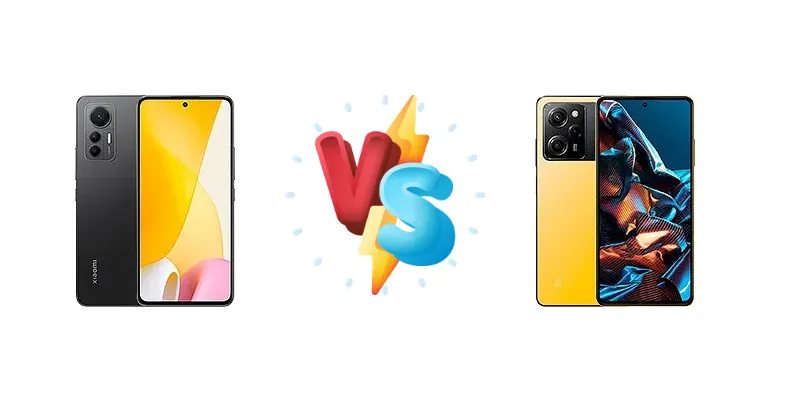
Xiaomi 12 Lite vs Poco X5 Pro: A Head-to-Head Comparison
| Phones Images | |||||
|---|---|---|---|---|---|
|
🏆 Quick Verdict
The Poco X5 Pro edges out the 12 Lite thanks to its superior battery life and faster charging. While the 12 Lite offers a slightly more refined design and potentially better selfie camera, the X5 Pro's overall value proposition is stronger for most users.
| PHONES | ||
|---|---|---|
| Phone Names | Xiaomi 12 Lite | Xiaomi Poco X5 Pro |
| Network | ||
|---|---|---|
| 2G bands | GSM 850 / 900 / 1800 / 1900 | GSM 850 / 900 / 1800 / 1900 |
| 3G bands | HSDPA 850 / 900 / 1700(AWS) / 1900 / 2100 | HSDPA 800 / 850 / 900 / 1700(AWS) / 1900 / 2100 - International |
| 4G bands | 1, 2, 3, 4, 5, 7, 8, 12, 13, 17, 18, 19, 20, 26, 28, 32, 38, 40, 41, 42, 48, 66 | 1, 2, 3, 4, 5, 7, 8, 20, 28, 38, 40, 41, 66 - International |
| 5G bands | 1, 3, 5, 7, 8, 20, 28, 38, 40, 41, 66, 77, 78 SA/NSA | 1, 3, 5, 7, 8, 20, 28, 38, 40, 41, 77, 78 SA/NSA/Sub6 - International |
| Speed | HSPA, LTE, 5G | HSPA, LTE, 5G |
| Technology | GSM / HSPA / LTE / 5G | GSM / HSPA / LTE / 5G |
| - | 1, 3, 5, 8, 28, 40, 78 SA/NSA - India | |
| Launch | ||
|---|---|---|
| Announced | 2022, July 09 | 2023, February 06 |
| Status | Available. Released 2022, July 11 | Available. Released 2023, February 07 |
| Body | ||
|---|---|---|
| Build | Glass front (Gorilla Glass 5), glass back, plastic frame | Glass front (Gorilla Glass 5), plastic back, plastic frame |
| Dimensions | 159.3 x 73.7 x 7.3 mm (6.27 x 2.90 x 0.29 in) | 162.9 x 76 x 7.9 mm (6.41 x 2.99 x 0.31 in) |
| SIM | Nano-SIM + Nano-SIM | Nano-SIM + Nano-SIM |
| Weight | 173 g (6.10 oz) | 181 g (6.38 oz) |
| - | IP53, dust and splash resistant | |
| Display | ||
|---|---|---|
| Protection | Corning Gorilla Glass 5 | Corning Gorilla Glass 5 |
| Resolution | 1080 x 2400 pixels, 20:9 ratio (~402 ppi density) | 1080 x 2400 pixels, 20:9 ratio (~395 ppi density) |
| Size | 6.55 inches, 103.6 cm2 (~88.2% screen-to-body ratio) | 6.67 inches, 107.4 cm2 (~86.8% screen-to-body ratio) |
| Type | AMOLED, 68B colors, 120Hz, Dolby Vision, HDR10+, 950 nits (peak) | AMOLED, 1B colors, 120Hz, Dolby Vision, HDR10+, 500 nits (typ), 900 nits (HBM) |
| Platform | ||
|---|---|---|
| CPU | Octa-core (1x2.4 GHz Cortex-A78 & 3x2.2 GHz Cortex-A78 & 4x1.9 GHz Cortex-A55) | Octa-core (1x2.4 GHz Cortex-A78 & 3x2.2 GHz Cortex-A78 & 4x1.9 GHz Cortex-A55) |
| Chipset | Qualcomm SM7325 Snapdragon 778G 5G (6 nm) | Qualcomm SM7325 Snapdragon 778G 5G (6 nm) |
| GPU | Adreno 642L | Adreno 642L |
| OS | Android 12, upgradable to Android 14, HyperOS | Android 12, upgradable to Android 13, MIUI 14 for POCO |
| Memory | ||
|---|---|---|
| Card slot | No | No |
| Internal | 128GB 6GB RAM, 128GB 8GB RAM, 256GB 8GB RAM | 128GB 6GB RAM, 256GB 8GB RAM |
| UFS 2.2 | UFS 2.2 | |
| Main Camera | ||
|---|---|---|
| Features | Dual-LED dual-tone flash, HDR, panorama | LED flash, HDR, panorama |
| Single | 32 MP, f/2.5, (wide), 1/2.8", 0.8µm, AF | - |
| Triple | 108 MP, f/1.9, 26mm (wide), 1/1.52", 0.7µm, PDAF 8 MP, f/2.2, 120˚ (ultrawide), 1/4.0", 1.12µm 2 MP (macro) | 108 MP, f/1.9, (wide), 1/1.52", 0.7µm, PDAF 8 MP, f/2.2, 120˚ (ultrawide), 1/4.0", 1.12µm 2 MP (macro) |
| Video | 4K@30fps, 1080p@30/60/120fps; gyro-EIS | 4K@30fps, 1080p@30/60/120fps, gyro-EIS |
| Selfie camera | ||
|---|---|---|
| Features | HDR, panorama | HDR, panorama |
| Single | 32 MP, f/2.5, (wide), 1/2.8", 0.8µm, AF | 16 MP, f/2.4, (wide), 1/3.06" 1.0µm |
| Video | 1080p@30/60fps, 720p@120fps | 1080p@30/60fps |
| Sound | ||
|---|---|---|
| 3.5mm jack | No | Yes |
| 35mm jack | No | Yes |
| Loudspeaker | Yes, with dual speakers | Yes, with stereo speakers |
| 24-bit/192kHz audio | 24-bit/192kHz audio | |
| Comms | ||
|---|---|---|
| Bluetooth | 5.2, A2DP, LE, aptX HD, aptX Adaptive | 5.2 (Intl), 5.1 (India), A2DP, LE |
| Infrared port | Yes | Yes |
| NFC | Yes (market/region dependent) | Yes (market/region dependent) |
| Positioning | GPS (L1), GLONASS (G1), BDS (B1I+B1c), GALILEO (E1), QZSS (L1) | GPS, GLONASS, BDS, GALILEO |
| Radio | No | No |
| USB | USB Type-C 2.0, OTG | USB Type-C 2.0, OTG |
| WLAN | Wi-Fi 802.11 a/b/g/n/ac/6, dual-band, Wi-Fi Direct | Wi-Fi 802.11 a/b/g/n/ac/6, dual-band, Wi-Fi DirectWi-Fi 802.11 a/b/g/n/ac, dual-band - India |
| Features | ||
|---|---|---|
| Sensors | Fingerprint (under display, optical), accelerometer, gyro, compass | Fingerprint (side-mounted), accelerometer, gyro, proximity, compass |
| Virtual proximity sensing | - | |
| Battery | ||
|---|---|---|
| Charging | 67W wired, PD3.0, QC4, 50% in 13 min | 67W wired, PD3.0, QC4, 100% in 45 min 5W reverse wired |
| Type | Li-Po 4300 mAh | Li-Po 5000 mAh |
| Misc | ||
|---|---|---|
| Colors | Black, Lite Green, Lite Pink | Astral Black, Horizon Blue, Poco Yellow |
| Models | 2203129G | 22101320G, 22101320I |
| Price | € 119.80 / $ 269.00 / £ 121.15 | € 156.00 / $ 221.33 / ₹ 22,490 |
| SAR | 1.09 W/kg (head) 0.73 W/kg (body) | - |
| SAR EU | 0.60 W/kg (head) 1.00 W/kg (body) | - |
| Tests | ||
|---|---|---|
| Battery life | Endurance rating 100h | Endurance rating 113h |
| Camera | Photo / Video | Photo / Video |
| Display | Contrast ratio: Infinite (nominal) | Contrast ratio: Infinite (nominal) |
| Loudspeaker | -25.2 LUFS (Very good) | -24.9 LUFS (Very good) |
| Performance | AnTuTu: 528905 (v9) GeekBench: 2943 (v5.1) GFXBench: 29fps (ES 3.1 onscreen) | AnTuTu: 531398 (v9) GeekBench: 2930 (v5.1) GFXBench: 28fps (ES 3.1 onscreen) |
Xiaomi 12 Lite
- Sleek and stylish design
- Vibrant AMOLED display
- Excellent selfie camera
- Lightweight and comfortable to hold
- Slightly shorter battery life
- Slower charging speed
- Macro camera is largely redundant
Xiaomi Poco X5 Pro
- Longer battery life
- Faster charging
- Versatile camera system
- More affordable price
- Less premium design
- Selfie camera not as impressive as 12 Lite
- Software can feel slightly less polished
Display Comparison
Both phones feature a 6.67-inch AMOLED display with a 120Hz refresh rate, ensuring smooth scrolling and vibrant visuals. However, the Poco X5 Pro boasts a slightly higher peak brightness of 912 nits compared to the 12 Lite's 824 nits, making it marginally better for outdoor visibility. Both have excellent contrast ratios.
Camera Comparison
The Xiaomi 12 Lite is often praised for its selfie camera, featuring a 20MP front-facing sensor. The Poco X5 Pro's main camera setup (108MP main, 8MP ultrawide, 2MP macro) offers more versatility, particularly in well-lit conditions. Video recording capabilities are comparable on both devices.
Performance
Powered by the Snapdragon 778G 5G chipset, both devices offer similar performance for everyday tasks and gaming. You'll experience smooth multitasking and responsive app loading on either phone. However, real-world performance can vary slightly based on software optimization.
Battery Life
The Poco X5 Pro takes a clear lead in battery life, offering an endurance rating of 113 hours compared to the 12 Lite's 100 hours. The X5 Pro also charges significantly faster, reaching 100% in 45 minutes with its 67W charger, while the 12 Lite takes around 13 minutes to reach 50%. The Poco X5 Pro also includes 5W reverse wired charging.
Buying Guide
The Xiaomi 12 Lite is ideal for users prioritizing a sleek design, a vibrant display for media consumption, and a good selfie camera. The Poco X5 Pro is a better choice for those who need long battery life, fast charging, and a more budget-friendly price point without sacrificing performance.