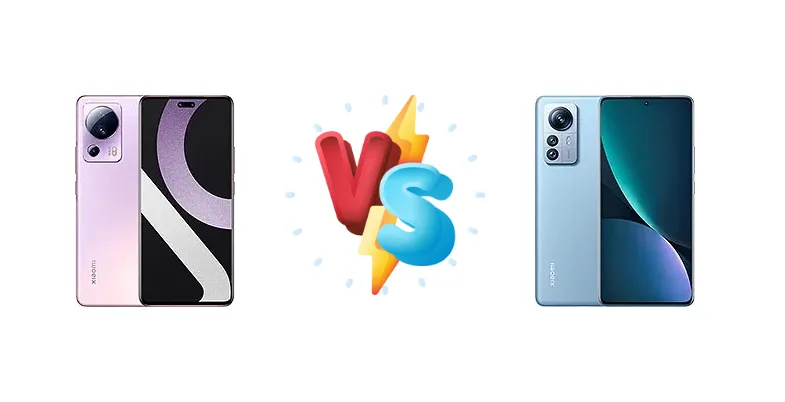
Xiaomi's 12 series offered a range of options, and the 12 Lite NE and 12 Pro (Dimensity) represent distinct approaches. The Lite NE aimed for a balance of style and affordability, while the 12 Pro (Dimensity) brought flagship-level performance to a wider audience with the Dimensity 9000+ chipset. This comparison dissects their key differences to help you determine which best suits your needs.
🏆 Quick Verdict
For most users, the Xiaomi 12 Pro (Dimensity) is the superior choice. Its Mediatek Dimensity 9000+ chipset delivers significantly faster performance, making it ideal for demanding tasks and gaming. While the 12 Lite NE offers a compelling value proposition, the performance gap is substantial enough to justify the price difference for power users.
| Network |
|---|
| 2G bands | GSM 850 / 900 / 1800 / 1900 | GSM 850 / 900 / 1800 / 1900 |
| 3G bands | HSDPA 800 / 850 / 900 / 1700(AWS) / 1900 / 2100 | HSDPA 800 / 850 / 900 / 1700(AWS) / 1900 / 2100 |
| 4G bands | LTE | 1, 2, 3, 4, 5, 7, 8, 18, 19, 26, 34, 38, 39, 40, 41, 42 |
| 5G bands | SA/NSA | 1, 3, 5, 8, 28, 38, 40, 41, 77, 78 SA/NSA |
| Speed | HSPA, LTE, 5G | HSPA, LTE, 5G |
| Technology | GSM / HSPA / LTE / 5G | GSM / CDMA / HSPA / EVDO / LTE / 5G |
| | - | CDMA2000 1xEV-DO |
| Launch |
|---|
| Announced | Not announced yet | 2022, July 04 |
| Status | Cancelled | Available. Released 2022, July 13 |
| Body |
|---|
| Build | Glass front (Gorilla Glass 5), glass back, aluminum frame | - |
| Dimensions | 159.2 x 72.7 x 7.2 mm (6.27 x 2.86 x 0.28 in) | 163.6 x 74.6 x 8.2 mm (6.44 x 2.94 x 0.32 in) |
| SIM | Nano-SIM + Nano-SIM | Nano-SIM + Nano-SIM |
| Weight | 171.8 g (6.07 oz) | 201 g (7.09 oz) |
| Display |
|---|
| Protection | Corning Gorilla Glass 5 | Corning Gorilla Glass Victus |
| Resolution | 1080 x 2400 pixels, 20:9 ratio (~402 ppi density) | 1440 x 3200 pixels, 20:9 ratio (~521 ppi density) |
| Size | 6.55 inches, 103.6 cm2 (~89.5% screen-to-body ratio) | 6.73 inches, 109.4 cm2 (~89.6% screen-to-body ratio) |
| Type | AMOLED, 1B colors, Dolby Vision, HDR10+, 120Hz, 1000 nits (peak) | LTPO2 AMOLED, 1B colors, 120Hz, Dolby Vision, HDR10+, 1000 nits (HBM), 1500 nits (peak) |
| Platform |
|---|
| CPU | Octa-core (1x2.4 GHz Cortex-A710 & 3x2.36 GHz Cortex-A710 & 4x1.8 GHz Cortex-A510) | Octa-core (1x3.20 GHz Cortex-X2 & 3x2.85 GHz Cortex-A710 & 4x1.80 GHz Cortex-A510) |
| Chipset | Qualcomm SM7450-AB Snapdragon 7 Gen 1 (4 nm) | Mediatek Dimensity 9000+ (4 nm) |
| GPU | Adreno 644 | Mali-G710 MC10 |
| OS | Android 12, MIUI 13 | Android 12, MIUI 13 |
| Memory |
|---|
| Card slot | No | No |
| Internal | 128GB 8GB RAM, 256GB 8GB RAM, 256GB 12GB RAM | 128GB 8GB RAM, 256GB 12GB RAM |
| | - | UFS 3.1 |
| Main Camera |
|---|
| Features | Color spectrum sensor, Dual-LED dual-tone flash, HDR, panorama | Color spectrum sensor, Dual-LED dual-tone flash, HDR, panorama |
| Single | - | 32 MP, f/2.5, 26mm (wide), 0.7µm |
| Triple | 50 MP, f/1.8, (wide), 1/1.56", 1.0µm, PDAF
20 MP, f/2.2, 115˚ (ultrawide), 1/2.78", 1.0µm
2 MP (macro) | 50 MP, f/1.9, 24mm (wide), 1/1.28", 1.22µm, dual pixel PDAF, OIS
13 MP, f/2.4, 15mm, 123˚ (ultrawide), 1/3.06", 1.12µm
5 MP, f/2.4, 50mm (telephoto macro), AF |
| Video | 4K@30fps, 1080p@30/60/120fps, 720p@960fps; gyro-EIS | 4K@30/60fps, 1080p@30/60/120fps, gyro-EIS |
| Selfie camera |
|---|
| Dual | 32 MP, f/2.0, (wide), 1/2.8", 0.8µm, AF
32 MP, 100˚ (ultrawide), 1/2.8", 0.8µm | - |
| Features | 2 Dual-LED dual-tone flash, HDR, panorama | HDR, panorama |
| Single | - | 32 MP, f/2.5, 26mm (wide), 0.7µm |
| Video | 1080p@30/60fps | 1080p@30/60fps, 720p@120fps |
| Sound |
|---|
| 3.5mm jack | - | No |
| 35mm jack | No | No |
| Loudspeaker | Yes | Yes, with stereo speakers |
| | - | 24-bit/192kHz audio
Tuned by Harman Kardon |
| Comms |
|---|
| Bluetooth | 5.2, A2DP, LE | 5.3, A2DP, LE |
| Infrared port | Yes | Yes |
| NFC | Yes | Yes |
| Positioning | GPS (L1), GLONASS (G1), BDS (B1I+B1c), GALILEO (E1), QZSS (L1) | GPS (L1+L5), GLONASS (L1), BDS (B1I+B1c+B2a), GALILEO (E1+E5a), QZSS (L1+L5), NavIC (L5) |
| Radio | No | No |
| USB | USB Type-C 2.0, OTG | USB Type-C 2.0, OTG |
| WLAN | Wi-Fi 802.11 a/b/g/n/ac/6, dual-band, Wi-Fi Direct | Wi-Fi 802.11 a/b/g/n/ac/6, dual-band, Wi-Fi Direct |
| Features |
|---|
| Sensors | Fingerprint (under display, optical), accelerometer, gyro, proximity, compass | Fingerprint (under display, optical), accelerometer, gyro, proximity, compass |
| Battery |
|---|
| Charging | 67W wired, PD3.0, 100% in 40 min | 67W wired, PD3.0, QC4 |
| Type | Li-Po 4500 mAh | Li-Po 5160 mAh |
| Misc |
|---|
| Colors | Black, Blue, Violet, Silver | Gray, Blue |
| Models | 2210129SG | 2207122MC |
| Price | - | About 570 EUR |
Xiaomi 12 Lite NE
- More affordable price point
- Lighter and potentially more stylish design
- Efficient Snapdragon 7 Gen 1 chipset for everyday tasks
- Significantly lower performance compared to the 12 Pro
- Potentially less capable camera system
- May struggle with demanding games and applications
Xiaomi 12 Pro (Dimensity)
- Flagship-level performance with the Dimensity 9000+
- Superior gaming capabilities
- Likely better camera quality and features
- Higher price tag
- Potentially shorter battery life due to power-hungry chipset
- May be heavier and less comfortable to hold
Display Comparison
While both phones likely feature AMOLED displays (based on Xiaomi's typical offerings), specific details like peak brightness and refresh rate aren't provided. However, the 12 Pro, being a flagship, likely boasts a higher peak brightness for better outdoor visibility. The 12 Lite NE's focus on aesthetics suggests a potentially smaller bezel design, but without concrete data, this remains speculative. Color accuracy is likely similar across both, given Xiaomi's calibration efforts.
Camera Comparison
Without detailed sensor information, a direct comparison is difficult. However, the 12 Pro, as a flagship, likely features a larger main sensor and more sophisticated image processing algorithms. While both phones likely offer similar features like night mode and portrait mode, the 12 Pro's superior processing power allows for faster image capture and potentially better low-light performance. The 12 Lite NE likely prioritizes a versatile camera setup for social media, while the 12 Pro aims for higher image quality and detail. Ignoring the likely presence of 2MP macro lenses on both, the main sensor size and OIS implementation will be key differentiators.
Performance
The core difference lies in the chipsets. The Xiaomi 12 Pro (Dimensity) utilizes the Mediatek Dimensity 9000+, featuring a 1x3.20 GHz Cortex-X2 prime core, 3x2.85 GHz Cortex-A710 performance cores, and 4x1.80 GHz Cortex-A510 efficiency cores. This is a significant step up from the Xiaomi 12 Lite NE’s Qualcomm SM7450-AB Snapdragon 7 Gen 1, which has a 1x2.4 GHz Cortex-A710 prime core, 3x2.36 GHz Cortex-A710 performance cores, and 4x1.8 GHz Cortex-A510 efficiency cores. The Dimensity 9000+'s Cortex-X2 core provides a substantial performance advantage in single-threaded tasks. Both use a 4nm process, but the Dimensity 9000+'s architecture is more advanced, resulting in superior overall performance and potentially better sustained performance due to improved thermal management. The 12 Pro will handle graphically intensive games and applications with greater ease.
Battery Life
Both devices support 67W wired charging, promising a full charge in around 40 minutes. The 12 Pro's more powerful chipset will likely consume more power, potentially offsetting any advantage gained from a larger battery (if present – data not provided). The efficiency of the Snapdragon 7 Gen 1 in the 12 Lite NE could translate to longer battery life during moderate usage. Both support PD3.0, but the 12 Pro also adds QC4 support, offering potentially wider compatibility with fast chargers.
Buying Guide
Buy the Xiaomi 12 Lite NE if you prioritize a lighter, more stylish design and are primarily focused on everyday tasks like social media, browsing, and casual photography. It's a great option for users who don't need the absolute fastest performance. Buy the Xiaomi 12 Pro (Dimensity) if you demand top-tier performance for gaming, video editing, or multitasking, and appreciate the benefits of a more powerful processor and potentially better camera capabilities.
Frequently Asked Questions
❓ Does the Dimensity 9000+ in the 12 Pro get hot during extended gaming sessions?
While the Dimensity 9000+ is a powerful chip, Xiaomi likely implemented thermal management solutions to mitigate overheating. However, sustained high performance will inevitably generate heat. Expect some throttling during prolonged, demanding gaming, but the 12 Pro's cooling system should prevent significant performance drops compared to the Snapdragon 7 Gen 1 in the 12 Lite NE.
❓ Is the camera on the Xiaomi 12 Pro (Dimensity) a significant upgrade over the 12 Lite NE for low-light photography?
Yes, the 12 Pro likely offers a substantial improvement in low-light photography. Its larger sensor (likely) and more advanced image processing algorithms will capture more light and detail, resulting in cleaner images with less noise. The Dimensity 9000+'s ISP (Image Signal Processor) also contributes to better low-light performance.
❓ Will the Xiaomi 12 Lite NE struggle with graphically intensive games like Genshin Impact or Call of Duty Mobile?
The Snapdragon 7 Gen 1 in the 12 Lite NE can run these games, but you'll likely need to lower the graphics settings to achieve a smooth frame rate. Expect some stuttering and potentially longer loading times compared to the 12 Pro (Dimensity), which can handle these games at higher settings with greater ease.