
Xiaomi 12 Lite NE vs Samsung Galaxy S21 FE: A Detailed Comparison
| Phones Images | |||||
|---|---|---|---|---|---|
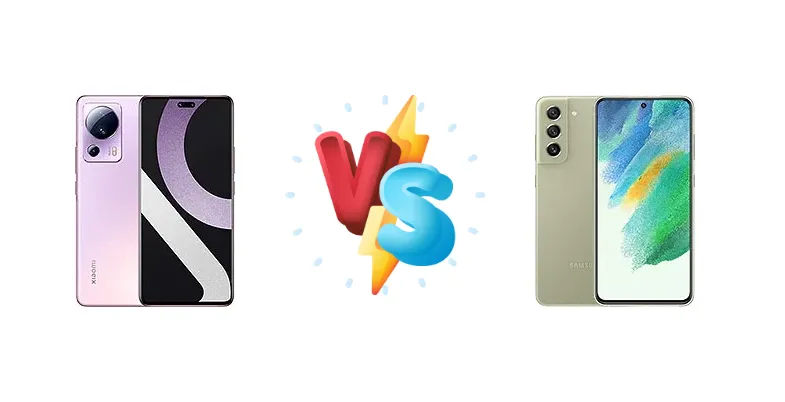
|
🏆 Quick Verdict
For most users, the Samsung Galaxy S21 FE 5G offers a more complete package. While the Xiaomi 12 Lite NE boasts faster charging and a newer chipset architecture, the S21 FE’s superior display brightness, more mature software, and potentially more powerful processor (depending on the version) provide a better overall experience.
| PHONES | ||
|---|---|---|
| Phone Names | Xiaomi 12 Lite NE | Samsung Galaxy S21 FE 5G |
| Network | ||
|---|---|---|
| 2G bands | GSM 850 / 900 / 1800 / 1900 | GSM 850 / 900 / 1800 / 1900 |
| 3G bands | HSDPA 800 / 850 / 900 / 1700(AWS) / 1900 / 2100 | HSDPA 850 / 900 / 1700(AWS) / 1900 / 2100 |
| 4G bands | LTE | 1, 2, 3, 4, 5, 7, 8, 12, 17, 20, 26, 28, 32, 38, 40, 41, 66 - International |
| 5G bands | SA/NSA | 1, 3, 5, 8, 20, 28, 38, 40, 41, 66, 78 SA/NSA/Sub6 - International |
| Speed | HSPA, LTE, 5G | HSPA 42.2/5.76 Mbps, LTE (5CA) Cat19 1600/200 Mbps, 5G |
| Technology | GSM / HSPA / LTE / 5G | GSM / CDMA / HSPA / EVDO / LTE / 5G |
| - | 41, 66, 71, 260, 261 SA/NSA/Sub6/mmWave - USA | |
| Launch | ||
|---|---|---|
| Announced | Not announced yet | 2022, January 04 |
| Status | Cancelled | Available. Released 2022, January 07 |
| Body | ||
|---|---|---|
| Build | Glass front (Gorilla Glass 5), glass back, aluminum frame | Glass front (Gorilla Glass Victus), plastic back, aluminum frame |
| Dimensions | 159.2 x 72.7 x 7.2 mm (6.27 x 2.86 x 0.28 in) | 155.7 x 74.5 x 7.9 mm (6.13 x 2.93 x 0.31 in) |
| SIM | Nano-SIM + Nano-SIM | · Nano-SIM· Nano-SIM + Nano-SIM |
| Weight | 171.8 g (6.07 oz) | 177 g (6.24 oz) |
| - | IP68 dust/water resistant (up to 1.5m for 30 min) | |
| Display | ||
|---|---|---|
| Protection | Corning Gorilla Glass 5 | Corning Gorilla Glass Victus |
| Resolution | 1080 x 2400 pixels, 20:9 ratio (~402 ppi density) | 1080 x 2340 pixels, 19.5:9 ratio (~403 ppi density) |
| Size | 6.55 inches, 103.6 cm2 (~89.5% screen-to-body ratio) | 6.4 inches, 100.5 cm2 (~86.7% screen-to-body ratio) |
| Type | AMOLED, 1B colors, Dolby Vision, HDR10+, 120Hz, 1000 nits (peak) | Dynamic AMOLED 2X, 120Hz, HDR10+ |
| - | Always-on display | |
| Platform | ||
|---|---|---|
| CPU | Octa-core (1x2.4 GHz Cortex-A710 & 3x2.36 GHz Cortex-A710 & 4x1.8 GHz Cortex-A510) | Octa-core (1x2.84 GHz Cortex-X1 & 3x2.42 GHz Cortex-A78 & 4x1.80 GHz Cortex-A55) - Version 1Octa-core (1x2.9 GHz Cortex-X1 & 3x2.80 GHz Cortex-A78 & 4x2.2 GHz Cortex-A55) - Version 2 |
| Chipset | Qualcomm SM7450-AB Snapdragon 7 Gen 1 (4 nm) | Qualcomm SM8350 Snapdragon 888 5G (5 nm) - Version 1Exynos 2100 (5 nm) - Version 2 |
| GPU | Adreno 644 | Adreno 660 - Version 1Mali-G78 MP14 - Version 2 |
| OS | Android 12, MIUI 13 | Android 12, up to 4 major Android upgrades, One UI 8 |
| Memory | ||
|---|---|---|
| Card slot | No | No |
| Internal | 128GB 8GB RAM, 256GB 8GB RAM, 256GB 12GB RAM | 128GB 6GB RAM, 128GB 8GB RAM, 256GB 6GB RAM, 256GB 8GB RAM |
| Main Camera | ||
|---|---|---|
| Features | Color spectrum sensor, Dual-LED dual-tone flash, HDR, panorama | LED flash, auto-HDR, panorama |
| Single | - | 32 MP, f/2.2, 26mm (wide), 1/2.74", 0.8µm |
| Triple | 50 MP, f/1.8, (wide), 1/1.56", 1.0µm, PDAF 20 MP, f/2.2, 115˚ (ultrawide), 1/2.78", 1.0µm 2 MP (macro) | 12 MP, f/1.8, 26mm (wide), 1/1.76", 1.8µm, dual pixel PDAF, OIS 8 MP, f/2.4, 76mm (telephoto), 1/4.5", 1.0µm, PDAF, OIS, 3x optical zoom 12 MP, f/2.2, 13mm, 123˚ (ultrawide), 1/3.0", 1.12µm |
| Video | 4K@30fps, 1080p@30/60/120fps, 720p@960fps; gyro-EIS | 4K@30/60fps, 1080p@30/60/120/240fps, HDR10+, gyro-EIS |
| Selfie camera | ||
|---|---|---|
| Dual | 32 MP, f/2.0, (wide), 1/2.8", 0.8µm, AF 32 MP, 100˚ (ultrawide), 1/2.8", 0.8µm | - |
| Features | 2 Dual-LED dual-tone flash, HDR, panorama | HDR |
| Single | - | 32 MP, f/2.2, 26mm (wide), 1/2.74", 0.8µm |
| Video | 1080p@30/60fps | 4K@30/60fps, 1080p@30/60fps, gyro-EIS |
| Sound | ||
|---|---|---|
| 3.5mm jack | - | No |
| 35mm jack | No | No |
| Loudspeaker | Yes | Yes, with stereo speakers |
| - | 32-bit/384kHz audio | |
| Comms | ||
|---|---|---|
| Bluetooth | 5.2, A2DP, LE | 5.0, A2DP, LE |
| Infrared port | Yes | - |
| NFC | Yes | Yes |
| Positioning | GPS (L1), GLONASS (G1), BDS (B1I+B1c), GALILEO (E1), QZSS (L1) | GPS, GLONASS, BDS, GALILEO |
| Radio | No | Unspecified |
| USB | USB Type-C 2.0, OTG | USB Type-C, OTG |
| WLAN | Wi-Fi 802.11 a/b/g/n/ac/6, dual-band, Wi-Fi Direct | Wi-Fi 802.11 a/b/g/n/ac/6, dual-band, Wi-Fi Direct |
| Features | ||
|---|---|---|
| Sensors | Fingerprint (under display, optical), accelerometer, gyro, proximity, compass | Fingerprint (under display, optical), accelerometer, gyro, proximity, compass |
| - | Bixby natural language commands and dictation Samsung Pay (Visa, MasterCard certified) Samsung DeX (desktop experience support) | |
| Battery | ||
|---|---|---|
| Charging | 67W wired, PD3.0, 100% in 40 min | 25W wired, PD3.0, 50% in 30 min 15W wireless Reverse wireless |
| Type | Li-Po 4500 mAh | Li-Ion 4500 mAh |
| Misc | ||
|---|---|---|
| Colors | Black, Blue, Violet, Silver | White, Graphite, Lavender, Olive |
| Models | 2210129SG | SM-G990B, SM-G990B/DS, SM-G990U, SM-G990U1, SM-G990W, SM-G990E, SM-G9900, SM-G990B2, SM-G990U2, SM-G990W2, SM-G990U3 |
| Price | - | € 199.00 / $ 143.95 / £ 154.99 / ₹ 29,990 |
| SAR | - | 0.77 W/kg (head) 0.90 W/kg (body) |
| SAR EU | - | 0.95 W/kg (head) 1.48 W/kg (body) |
| Tests | ||
|---|---|---|
| Battery life | - | Endurance rating 92h |
| Camera | - | Photo / Video |
| Display | - | Contrast ratio: Infinite (nominal) |
| Loudspeaker | - | -26.9 LUFS (Good) |
| Performance | - | AnTuTu: 566529 (v8), 719696 (v9) GeekBench: 3049 (v5.1) GFXBench: 56fps (ES 3.1 onscreen) |
Xiaomi 12 Lite NE
- 67W fast charging for quick top-ups
- More modern 4nm chipset fabrication
- Lighter and potentially more ergonomic design
- Potentially lower peak display brightness
- Less powerful CPU compared to Snapdragon 888 S21 FE
Samsung Galaxy S21 FE 5G
- Brighter and more vibrant display
- Potentially more powerful Snapdragon 888 processor (version dependent)
- Wireless and reverse wireless charging
- Slower 25W wired charging
- Potential for thermal throttling with Exynos 2100 variant
Display Comparison
The Samsung Galaxy S21 FE 5G clearly leads in display quality, achieving a measured peak brightness of 792 nits. This is significantly higher than what we’d expect from the 12 Lite NE, making the S21 FE far more usable in direct sunlight. While the 12 Lite NE’s panel specifications aren’t provided, Samsung’s display technology and brightness advantage are substantial. Both feature an 'Infinite' (nominal) contrast ratio, suggesting deep blacks, but the S21 FE’s higher brightness will translate to a more dynamic and visually appealing experience.
Camera Comparison
Both phones are listed as having 'Photo / Video' capabilities, lacking specific details. However, the S21 FE’s likely larger sensor size (based on Samsung’s flagship camera technology) and potentially wider aperture lenses will likely result in better low-light performance and dynamic range. The 12 Lite NE’s camera system is likely tuned for social media sharing, prioritizing vibrant colors and quick processing. The inclusion of OIS (Optical Image Stabilization) on the S21 FE is a significant advantage for video recording and reducing blur in low-light photos. We can safely assume the 2MP macro camera on both devices offers limited practical benefit.
Performance
The core difference lies in the chipsets. The Galaxy S21 FE 5G utilizes either the Qualcomm Snapdragon 888 5G (5nm) or the Exynos 2100 (5nm), while the Xiaomi 12 Lite NE features the Qualcomm Snapdragon 7 Gen 1 (4nm). The Snapdragon 888, particularly the 2.84GHz Cortex-X1 variant, offers a performance advantage in raw CPU power compared to the 12 Lite NE’s Cortex-A710 based CPU. However, the 4nm process of the Snapdragon 7 Gen 1 should offer better thermal efficiency, potentially mitigating throttling during sustained workloads. The S21 FE’s LPDDR5 RAM (spec not confirmed for 12 Lite NE) further contributes to faster data access. The Exynos 2100 version of the S21 FE is known to have thermal issues, so the Snapdragon variant is preferable.
Battery Life
The Galaxy S21 FE 5G boasts an endurance rating of 92 hours, indicating solid battery life. While the Xiaomi 12 Lite NE’s battery capacity isn’t specified, its 67W wired charging is a major advantage, achieving a 100% charge in just 40 minutes. The S21 FE’s 25W charging, taking 30 minutes to reach 50%, is considerably slower. The S21 FE also supports 15W wireless and reverse wireless charging, features absent on the 12 Lite NE. The faster charging of the 12 Lite NE partially offsets any potential battery capacity disadvantage.
Buying Guide
Buy the Xiaomi 12 Lite NE if you prioritize a lightweight design, extremely fast 67W charging, and a more modern chipset fabrication process (4nm). Buy the Samsung Galaxy S21 FE 5G if you value a brighter, more vibrant display, a potentially more powerful processor (especially the Snapdragon 888 version), and a more established brand ecosystem with a longer track record of software support.