
Xiaomi 11T vs Xiaomi 12 Lite: A Detailed Comparison
| Phones Images | |||||
|---|---|---|---|---|---|
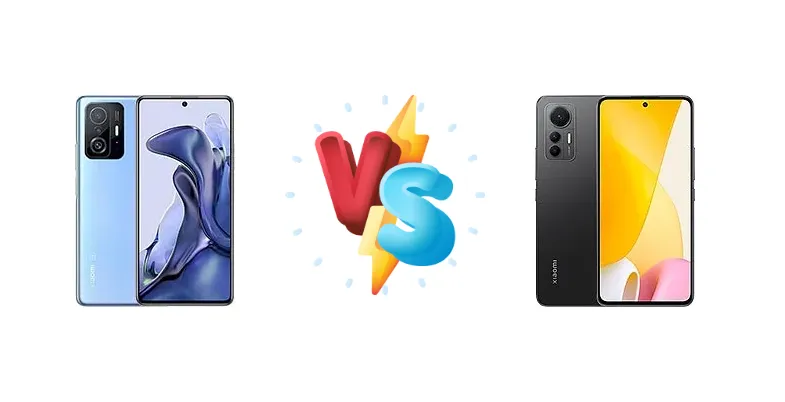
|
🏆 Quick Verdict
The Xiaomi 12 Lite edges out the 11T thanks to its slightly brighter display, more modern chipset, and faster charging. However, the 11T remains a strong contender, especially if you prioritize raw performance and a slightly larger screen. Ultimately, the 12 Lite offers a more refined and contemporary experience.
| PHONES | ||
|---|---|---|
| Phone Names | Xiaomi 11T | Xiaomi 12 Lite |
| Network | ||
|---|---|---|
| 2G bands | GSM 850 / 900 / 1800 / 1900 | GSM 850 / 900 / 1800 / 1900 |
| 3G bands | HSDPA 850 / 900 / 1700(AWS) / 1900 / 2100 | HSDPA 850 / 900 / 1700(AWS) / 1900 / 2100 |
| 4G bands | 1, 2, 3, 4, 5, 7, 8, 12, 13, 17, 18, 19, 20, 26, 28, 32, 38, 40, 41, 42, 66 | 1, 2, 3, 4, 5, 7, 8, 12, 13, 17, 18, 19, 20, 26, 28, 32, 38, 40, 41, 42, 48, 66 |
| 5G bands | 1, 3, 5, 7, 8, 20, 28, 38, 40, 41, 66, 77, 78 SA/NSA | 1, 3, 5, 7, 8, 20, 28, 38, 40, 41, 66, 77, 78 SA/NSA |
| Speed | HSPA, LTE, 5G | HSPA, LTE, 5G |
| Technology | GSM / HSPA / LTE / 5G | GSM / HSPA / LTE / 5G |
| Launch | ||
|---|---|---|
| Announced | 2021, September 15 | 2022, July 09 |
| Status | Available. Released 2021, October 05 | Available. Released 2022, July 11 |
| Body | ||
|---|---|---|
| Build | Glass front (Gorilla Glass Victus), aluminum frame, glass back | Glass front (Gorilla Glass 5), glass back, plastic frame |
| Dimensions | 164.1 x 76.9 x 8.8 mm (6.46 x 3.03 x 0.35 in) | 159.3 x 73.7 x 7.3 mm (6.27 x 2.90 x 0.29 in) |
| SIM | Nano-SIM + Nano-SIM | Nano-SIM + Nano-SIM |
| Weight | 203 g (7.16 oz) | 173 g (6.10 oz) |
| IP53, dust and splash resistant | - | |
| Display | ||
|---|---|---|
| Protection | Corning Gorilla Glass Victus | Corning Gorilla Glass 5 |
| Resolution | 1080 x 2400 pixels, 20:9 ratio (~395 ppi density) | 1080 x 2400 pixels, 20:9 ratio (~402 ppi density) |
| Size | 6.67 inches, 107.4 cm2 (~85.1% screen-to-body ratio) | 6.55 inches, 103.6 cm2 (~88.2% screen-to-body ratio) |
| Type | AMOLED, 1B colors, 120Hz, HDR10+, 800 nits (typ), 1000 nits (peak) | AMOLED, 68B colors, 120Hz, Dolby Vision, HDR10+, 950 nits (peak) |
| Platform | ||
|---|---|---|
| CPU | Octa-core (1x3.0 GHz Cortex-A78 & 3x2.6 GHz Cortex-A78 & 4x2.0 GHz Cortex-A55) | Octa-core (1x2.4 GHz Cortex-A78 & 3x2.2 GHz Cortex-A78 & 4x1.9 GHz Cortex-A55) |
| Chipset | Mediatek Dimensity 1200 (6 nm) | Qualcomm SM7325 Snapdragon 778G 5G (6 nm) |
| GPU | Mali-G77 MC9 | Adreno 642L |
| OS | Android 11, upgradable to Android 13, MIUI 14 | Android 12, upgradable to Android 14, HyperOS |
| Memory | ||
|---|---|---|
| Card slot | No | No |
| Internal | 128GB 8GB RAM, 256GB 8GB RAM | 128GB 6GB RAM, 128GB 8GB RAM, 256GB 8GB RAM |
| UFS 3.1 | UFS 2.2 | |
| Main Camera | ||
|---|---|---|
| Features | Dual-LED dual-tone flash, HDR, panorama | Dual-LED dual-tone flash, HDR, panorama |
| Single | 16 MP, f/2.5, (wide), 1/3.06", 1.0µm | 32 MP, f/2.5, (wide), 1/2.8", 0.8µm, AF |
| Triple | 108 MP, f/1.8, 26mm (wide), 1/1.52", 0.7µm, PDAF 8 MP, f/2.2, 120˚ (ultrawide), 1/4.0", 1.12µm 5 MP, f/2.4, 50mm (telephoto macro), 1/5.0", 1.12µm, AF | 108 MP, f/1.9, 26mm (wide), 1/1.52", 0.7µm, PDAF 8 MP, f/2.2, 120˚ (ultrawide), 1/4.0", 1.12µm 2 MP (macro) |
| Video | 4K@30fps, 1080p@30/60/120, gyro-EIS | 4K@30fps, 1080p@30/60/120fps; gyro-EIS |
| Selfie camera | ||
|---|---|---|
| Features | - | HDR, panorama |
| Single | 16 MP, f/2.5, (wide), 1/3.06", 1.0µm | 32 MP, f/2.5, (wide), 1/2.8", 0.8µm, AF |
| Video | 1080p@30fps | 1080p@30/60fps, 720p@120fps |
| Sound | ||
|---|---|---|
| 3.5mm jack | No | No |
| 35mm jack | No | No |
| Loudspeaker | Yes, with stereo speakers | Yes, with dual speakers |
| - | 24-bit/192kHz audio | |
| Comms | ||
|---|---|---|
| Bluetooth | 5.2, A2DP, LE, aptX HD, aptX Adaptive | 5.2, A2DP, LE, aptX HD, aptX Adaptive |
| Infrared port | Yes | Yes |
| NFC | Yes | Yes (market/region dependent) |
| Positioning | GPS (L1+L5), GLONASS (G1), BDS (B1), GALILEO (E1+E5a), QZSS (L1+L5) | GPS (L1), GLONASS (G1), BDS (B1I+B1c), GALILEO (E1), QZSS (L1) |
| Radio | No | No |
| USB | USB Type-C 2.0, OTG | USB Type-C 2.0, OTG |
| WLAN | Wi-Fi 802.11 a/b/g/n/ac/6, dual-band, Wi-Fi Direct | Wi-Fi 802.11 a/b/g/n/ac/6, dual-band, Wi-Fi Direct |
| Features | ||
|---|---|---|
| Sensors | Fingerprint (side-mounted), accelerometer, gyro, proximity, compass | Fingerprint (under display, optical), accelerometer, gyro, compass |
| - | Virtual proximity sensing | |
| Battery | ||
|---|---|---|
| Charging | 67W wired, 100% in 36 min | 67W wired, PD3.0, QC4, 50% in 13 min |
| Type | Li-Po 5000 mAh | Li-Po 4300 mAh |
| Misc | ||
|---|---|---|
| Colors | Meteorite Gray, Moonlight White, Celestial Blue | Black, Lite Green, Lite Pink |
| Models | 21081111RG | 2203129G |
| Price | € 119.00 / £ 275.00 | € 119.80 / $ 269.00 / £ 121.15 |
| SAR | 1.09 W/kg (head) 0.83 W/kg (body) | 1.09 W/kg (head) 0.73 W/kg (body) |
| SAR EU | 0.55 W/kg (head) 0.95 W/kg (body) | 0.60 W/kg (head) 1.00 W/kg (body) |
| Tests | ||
|---|---|---|
| Battery life | Endurance rating 98h | Endurance rating 100h |
| Camera | Photo / Video | Photo / Video |
| Display | Contrast ratio: Infinite (nominal) | Contrast ratio: Infinite (nominal) |
| Loudspeaker | -27.6 LUFS (Good) | -25.2 LUFS (Very good) |
| Performance | AnTuTu: 590837 (v9) GeekBench: 2834 (v5.1) GFXBench: 40fps (ES 3.1 onscreen) | AnTuTu: 528905 (v9) GeekBench: 2943 (v5.1) GFXBench: 29fps (ES 3.1 onscreen) |
Xiaomi 11T
- Powerful Mediatek Dimensity 1200 chipset
- Larger display (6.67 inches)
- Fast 67W charging
- Excellent value for money
- Slightly less efficient chipset
- Design feels a bit dated
- Charging speed slower than 12 Lite
Xiaomi 12 Lite
- Brighter and more color-accurate display
- More efficient Snapdragon 778G 5G chipset
- Faster charging (PD3.0, QC4)
- Stylish and modern design
- Better front-facing camera
- Slightly smaller battery capacity
- Potentially less raw gaming power than 11T
Display Comparison
The Xiaomi 12 Lite boasts a slightly brighter display at 824 nits compared to the 11T's 798 nits. Both offer excellent contrast ratios (infinite nominal), resulting in vibrant colors and deep blacks. The 12 Lite's display also tends to be more color accurate. Both use AMOLED panels with 120Hz refresh rates for smooth scrolling.
Camera Comparison
Both phones offer versatile camera setups. The 11T generally produces slightly more saturated images, while the 12 Lite aims for more natural colors. Low-light performance is comparable. Video recording capabilities are similar on both devices, supporting up to 4K resolution. The 12 Lite's front-facing camera is generally considered superior.
Performance
The Xiaomi 11T utilizes the Mediatek Dimensity 1200, a powerful chipset. However, the Xiaomi 12 Lite's Snapdragon 778G 5G offers improved efficiency and a more modern architecture. While the 11T might have a slight edge in raw gaming performance, the 12 Lite provides a smoother, more responsive experience for everyday tasks. The 12 Lite's chipset also benefits from better software optimization.
Battery Life
Both phones offer excellent battery life, with endurance ratings of 98h and 100h respectively. The Xiaomi 12 Lite charges significantly faster, reaching 50% in just 13 minutes thanks to its 67W PD3.0/QC4 charging, compared to the 11T's 36 minutes.
Buying Guide
Who should buy the Xiaomi 11T? Users seeking a powerful phone for gaming and demanding tasks, and who appreciate a larger display. Who should buy the Xiaomi 12 Lite? Those prioritizing a stylish design, a vibrant display, and a more efficient chipset for everyday use and photography.