
Xiaomi 11T vs Samsung Galaxy S21 FE 5G: Which Budget Flagship Reigns Supreme?
| Phones Images | |||||
|---|---|---|---|---|---|
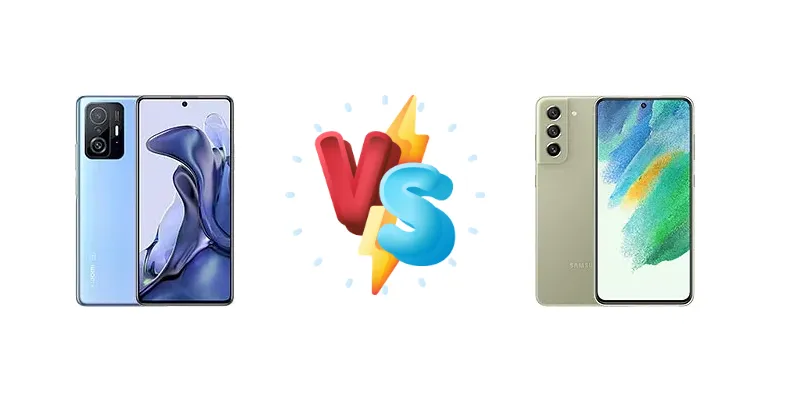
|
🏆 Quick Verdict
For most users, the Xiaomi 11T emerges as the stronger value proposition. Its significantly faster 67W charging, coupled with comparable performance from the Dimensity 1200, outweighs the S21 FE’s slightly more refined software and potential for a Snapdragon variant. However, the S21 FE remains a solid choice for those deeply embedded in the Samsung ecosystem.
| PHONES | ||
|---|---|---|
| Phone Names | Xiaomi 11T | Samsung Galaxy S21 FE 5G |
| Network | ||
|---|---|---|
| 2G bands | GSM 850 / 900 / 1800 / 1900 | GSM 850 / 900 / 1800 / 1900 |
| 3G bands | HSDPA 850 / 900 / 1700(AWS) / 1900 / 2100 | HSDPA 850 / 900 / 1700(AWS) / 1900 / 2100 |
| 4G bands | 1, 2, 3, 4, 5, 7, 8, 12, 13, 17, 18, 19, 20, 26, 28, 32, 38, 40, 41, 42, 66 | 1, 2, 3, 4, 5, 7, 8, 12, 17, 20, 26, 28, 32, 38, 40, 41, 66 - International |
| 5G bands | 1, 3, 5, 7, 8, 20, 28, 38, 40, 41, 66, 77, 78 SA/NSA | 1, 3, 5, 8, 20, 28, 38, 40, 41, 66, 78 SA/NSA/Sub6 - International |
| Speed | HSPA, LTE, 5G | HSPA 42.2/5.76 Mbps, LTE (5CA) Cat19 1600/200 Mbps, 5G |
| Technology | GSM / HSPA / LTE / 5G | GSM / CDMA / HSPA / EVDO / LTE / 5G |
| - | 41, 66, 71, 260, 261 SA/NSA/Sub6/mmWave - USA | |
| Launch | ||
|---|---|---|
| Announced | 2021, September 15 | 2022, January 04 |
| Status | Available. Released 2021, October 05 | Available. Released 2022, January 07 |
| Body | ||
|---|---|---|
| Build | Glass front (Gorilla Glass Victus), aluminum frame, glass back | Glass front (Gorilla Glass Victus), plastic back, aluminum frame |
| Dimensions | 164.1 x 76.9 x 8.8 mm (6.46 x 3.03 x 0.35 in) | 155.7 x 74.5 x 7.9 mm (6.13 x 2.93 x 0.31 in) |
| SIM | Nano-SIM + Nano-SIM | · Nano-SIM· Nano-SIM + Nano-SIM |
| Weight | 203 g (7.16 oz) | 177 g (6.24 oz) |
| IP53, dust and splash resistant | IP68 dust/water resistant (up to 1.5m for 30 min) | |
| Display | ||
|---|---|---|
| Protection | Corning Gorilla Glass Victus | Corning Gorilla Glass Victus |
| Resolution | 1080 x 2400 pixels, 20:9 ratio (~395 ppi density) | 1080 x 2340 pixels, 19.5:9 ratio (~403 ppi density) |
| Size | 6.67 inches, 107.4 cm2 (~85.1% screen-to-body ratio) | 6.4 inches, 100.5 cm2 (~86.7% screen-to-body ratio) |
| Type | AMOLED, 1B colors, 120Hz, HDR10+, 800 nits (typ), 1000 nits (peak) | Dynamic AMOLED 2X, 120Hz, HDR10+ |
| - | Always-on display | |
| Platform | ||
|---|---|---|
| CPU | Octa-core (1x3.0 GHz Cortex-A78 & 3x2.6 GHz Cortex-A78 & 4x2.0 GHz Cortex-A55) | Octa-core (1x2.84 GHz Cortex-X1 & 3x2.42 GHz Cortex-A78 & 4x1.80 GHz Cortex-A55) - Version 1Octa-core (1x2.9 GHz Cortex-X1 & 3x2.80 GHz Cortex-A78 & 4x2.2 GHz Cortex-A55) - Version 2 |
| Chipset | Mediatek Dimensity 1200 (6 nm) | Qualcomm SM8350 Snapdragon 888 5G (5 nm) - Version 1Exynos 2100 (5 nm) - Version 2 |
| GPU | Mali-G77 MC9 | Adreno 660 - Version 1Mali-G78 MP14 - Version 2 |
| OS | Android 11, upgradable to Android 13, MIUI 14 | Android 12, up to 4 major Android upgrades, One UI 8 |
| Memory | ||
|---|---|---|
| Card slot | No | No |
| Internal | 128GB 8GB RAM, 256GB 8GB RAM | 128GB 6GB RAM, 128GB 8GB RAM, 256GB 6GB RAM, 256GB 8GB RAM |
| UFS 3.1 | - | |
| Main Camera | ||
|---|---|---|
| Features | Dual-LED dual-tone flash, HDR, panorama | LED flash, auto-HDR, panorama |
| Single | 16 MP, f/2.5, (wide), 1/3.06", 1.0µm | 32 MP, f/2.2, 26mm (wide), 1/2.74", 0.8µm |
| Triple | 108 MP, f/1.8, 26mm (wide), 1/1.52", 0.7µm, PDAF 8 MP, f/2.2, 120˚ (ultrawide), 1/4.0", 1.12µm 5 MP, f/2.4, 50mm (telephoto macro), 1/5.0", 1.12µm, AF | 12 MP, f/1.8, 26mm (wide), 1/1.76", 1.8µm, dual pixel PDAF, OIS 8 MP, f/2.4, 76mm (telephoto), 1/4.5", 1.0µm, PDAF, OIS, 3x optical zoom 12 MP, f/2.2, 13mm, 123˚ (ultrawide), 1/3.0", 1.12µm |
| Video | 4K@30fps, 1080p@30/60/120, gyro-EIS | 4K@30/60fps, 1080p@30/60/120/240fps, HDR10+, gyro-EIS |
| Selfie camera | ||
|---|---|---|
| Features | - | HDR |
| Single | 16 MP, f/2.5, (wide), 1/3.06", 1.0µm | 32 MP, f/2.2, 26mm (wide), 1/2.74", 0.8µm |
| Video | 1080p@30fps | 4K@30/60fps, 1080p@30/60fps, gyro-EIS |
| Sound | ||
|---|---|---|
| 3.5mm jack | No | No |
| 35mm jack | No | No |
| Loudspeaker | Yes, with stereo speakers | Yes, with stereo speakers |
| - | 32-bit/384kHz audio | |
| Comms | ||
|---|---|---|
| Bluetooth | 5.2, A2DP, LE, aptX HD, aptX Adaptive | 5.0, A2DP, LE |
| Infrared port | Yes | - |
| NFC | Yes | Yes |
| Positioning | GPS (L1+L5), GLONASS (G1), BDS (B1), GALILEO (E1+E5a), QZSS (L1+L5) | GPS, GLONASS, BDS, GALILEO |
| Radio | No | Unspecified |
| USB | USB Type-C 2.0, OTG | USB Type-C, OTG |
| WLAN | Wi-Fi 802.11 a/b/g/n/ac/6, dual-band, Wi-Fi Direct | Wi-Fi 802.11 a/b/g/n/ac/6, dual-band, Wi-Fi Direct |
| Features | ||
|---|---|---|
| Sensors | Fingerprint (side-mounted), accelerometer, gyro, proximity, compass | Fingerprint (under display, optical), accelerometer, gyro, proximity, compass |
| - | Bixby natural language commands and dictation Samsung Pay (Visa, MasterCard certified) Samsung DeX (desktop experience support) | |
| Battery | ||
|---|---|---|
| Charging | 67W wired, 100% in 36 min | 25W wired, PD3.0, 50% in 30 min 15W wireless Reverse wireless |
| Type | Li-Po 5000 mAh | Li-Ion 4500 mAh |
| Misc | ||
|---|---|---|
| Colors | Meteorite Gray, Moonlight White, Celestial Blue | White, Graphite, Lavender, Olive |
| Models | 21081111RG | SM-G990B, SM-G990B/DS, SM-G990U, SM-G990U1, SM-G990W, SM-G990E, SM-G9900, SM-G990B2, SM-G990U2, SM-G990W2, SM-G990U3 |
| Price | € 119.00 / £ 275.00 | € 199.00 / $ 143.95 / £ 154.99 / ₹ 29,990 |
| SAR | 1.09 W/kg (head) 0.83 W/kg (body) | 0.77 W/kg (head) 0.90 W/kg (body) |
| SAR EU | 0.55 W/kg (head) 0.95 W/kg (body) | 0.95 W/kg (head) 1.48 W/kg (body) |
| Tests | ||
|---|---|---|
| Battery life | Endurance rating 98h | Endurance rating 92h |
| Camera | Photo / Video | Photo / Video |
| Display | Contrast ratio: Infinite (nominal) | Contrast ratio: Infinite (nominal) |
| Loudspeaker | -27.6 LUFS (Good) | -26.9 LUFS (Good) |
| Performance | AnTuTu: 590837 (v9) GeekBench: 2834 (v5.1) GFXBench: 40fps (ES 3.1 onscreen) | AnTuTu: 566529 (v8), 719696 (v9) GeekBench: 3049 (v5.1) GFXBench: 56fps (ES 3.1 onscreen) |
Xiaomi 11T
- Significantly faster 67W charging
- Longer battery life (98h endurance)
- Strong performance from Dimensity 1200
- No wireless charging
- Less refined software experience compared to Samsung
Samsung Galaxy S21 FE 5G
- Samsung’s One UI software
- Potential for Snapdragon 888 variant
- Wireless and reverse wireless charging
- Slower 25W charging
- Shorter battery life (92h endurance)
- Exynos variant may suffer from thermal throttling
Display Comparison
Both devices feature displays with an 'Infinite' contrast ratio, suggesting excellent black levels. However, the measured peak brightness is nearly identical at 798 nits for the Xiaomi 11T and 792 nits for the S21 FE, meaning real-world visibility won’t differ significantly. Neither manufacturer specifies refresh rate or panel technology, but both are likely 120Hz AMOLEDs. The S21 FE’s smaller size (6.4” vs 6.67”) may appeal to users who prefer a more manageable device.
Camera Comparison
Both phones offer capable camera systems, but detailed specifications are limited to 'Photo / Video' in the provided data. The S21 FE’s potential for a more sophisticated image processing pipeline, typical of Samsung flagships, could give it an edge in image quality. However, without sensor size or aperture information, it’s difficult to make a definitive judgment. The presence of OIS on either device is unknown, but crucial for stable video recording. The 2MP macro camera on the S21 FE is likely a marketing feature with limited practical utility.
Performance
The chipset is where the biggest divergence lies. The Xiaomi 11T utilizes the Mediatek Dimensity 1200 (6nm), while the S21 FE comes in two versions: a Snapdragon 888 5G (5nm) and an Exynos 2100 (5nm). The Snapdragon 888 generally offers a slight performance edge over the Dimensity 1200 in GPU-intensive tasks, but the Dimensity 1200’s CPU configuration – with its prime Cortex-A78 core clocked at 3.0 GHz – provides strong multi-core performance. The Exynos 2100 variant of the S21 FE is often reported to have thermal throttling issues, potentially impacting sustained performance. The 5nm process node of the Snapdragon 888 and Exynos 2100 theoretically offers better efficiency than the Dimensity 1200’s 6nm node, but real-world results depend on thermal management.
Battery Life
The Xiaomi 11T boasts a superior endurance rating of 98 hours compared to the S21 FE’s 92 hours. This, combined with the 11T’s blazing-fast 67W wired charging (0-100% in 36 minutes), is a significant advantage. The S21 FE’s 25W charging, while supporting PD3.0 and offering 15W wireless charging, is considerably slower. The S21 FE’s wireless and reverse wireless charging capabilities are absent on the 11T, offering added convenience for some users.
Buying Guide
Buy the Xiaomi 11T if you prioritize charging speed, extended battery life (98h endurance), and raw performance for the price. It’s ideal for power users and gamers who need a phone that can keep up with their demands. Buy the Samsung Galaxy S21 FE 5G if you prefer Samsung’s One UI, a more compact form factor, and the potential for a Snapdragon 888 variant, understanding you’ll trade off charging speed and overall endurance.