
Xiaomi 11T vs Samsung Galaxy A52s 5G: A Deep Dive Comparison
| Phones Images | |||||
|---|---|---|---|---|---|
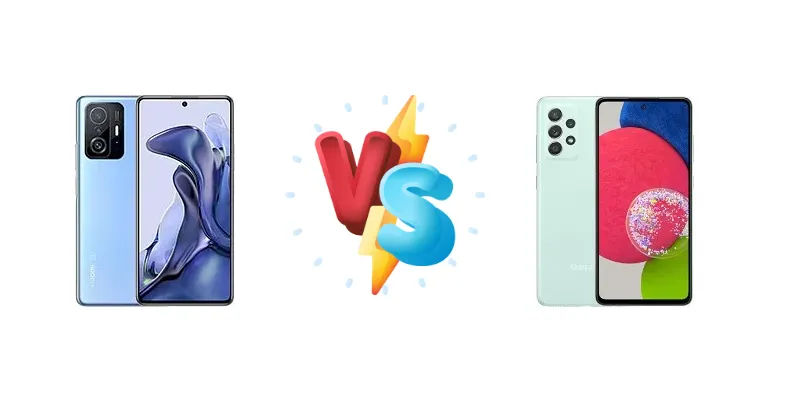
|
🏆 Quick Verdict
For users prioritizing raw performance and incredibly fast charging, the Xiaomi 11T is the clear winner. However, the Samsung Galaxy A52s 5G offers superior battery endurance and a slightly brighter display, making it a better choice for those who value longevity and outdoor visibility.
| PHONES | ||
|---|---|---|
| Phone Names | Xiaomi 11T | Samsung Galaxy A52s 5G |
| Network | ||
|---|---|---|
| 2G bands | GSM 850 / 900 / 1800 / 1900 | GSM 850 / 900 / 1800 / 1900 |
| 3G bands | HSDPA 850 / 900 / 1700(AWS) / 1900 / 2100 | HSDPA 850 / 900 / 1700(AWS) / 1900 / 2100 |
| 4G bands | 1, 2, 3, 4, 5, 7, 8, 12, 13, 17, 18, 19, 20, 26, 28, 32, 38, 40, 41, 42, 66 | 1, 2, 3, 4, 5, 7, 8, 12, 17, 20, 26, 28, 32, 38, 40, 41, 66 |
| 5G bands | 1, 3, 5, 7, 8, 20, 28, 38, 40, 41, 66, 77, 78 SA/NSA | 1, 3, 5, 7, 8, 20, 28, 38, 40, 41, 66, 78 SA/NSA/Sub6 |
| Speed | HSPA, LTE, 5G | HSPA 42.2/5.76 Mbps, LTE Cat18 1200/150 Mbps, 5G |
| Technology | GSM / HSPA / LTE / 5G | GSM / HSPA / LTE / 5G |
| Launch | ||
|---|---|---|
| Announced | 2021, September 15 | 2021, August 17 |
| Status | Available. Released 2021, October 05 | Available. Released 2021, September 01 |
| Body | ||
|---|---|---|
| Build | Glass front (Gorilla Glass Victus), aluminum frame, glass back | Glass front (Gorilla Glass 5), plastic back |
| Dimensions | 164.1 x 76.9 x 8.8 mm (6.46 x 3.03 x 0.35 in) | 159.9 x 75.1 x 8.4 mm (6.30 x 2.96 x 0.33 in) |
| SIM | Nano-SIM + Nano-SIM | · Nano-SIM· Nano-SIM + Nano-SIM |
| Weight | 203 g (7.16 oz) | 189 g (6.67 oz) |
| IP53, dust and splash resistant | IP67 dust/water resistant (up to 1m for 30 min) | |
| Display | ||
|---|---|---|
| Protection | Corning Gorilla Glass Victus | Corning Gorilla Glass 5 |
| Resolution | 1080 x 2400 pixels, 20:9 ratio (~395 ppi density) | 1080 x 2400 pixels, 20:9 ratio (~405 ppi density) |
| Size | 6.67 inches, 107.4 cm2 (~85.1% screen-to-body ratio) | 6.5 inches, 102.0 cm2 (~84.9% screen-to-body ratio) |
| Type | AMOLED, 1B colors, 120Hz, HDR10+, 800 nits (typ), 1000 nits (peak) | Super AMOLED, 120Hz, 800 nits (HBM) |
| Platform | ||
|---|---|---|
| CPU | Octa-core (1x3.0 GHz Cortex-A78 & 3x2.6 GHz Cortex-A78 & 4x2.0 GHz Cortex-A55) | Octa-core (1x2.4 GHz Cortex-A78 & 3x2.2 GHz Cortex-A78 & 4x1.9 GHz Cortex-A55) |
| Chipset | Mediatek Dimensity 1200 (6 nm) | Qualcomm SM7325 Snapdragon 778G 5G (6 nm) |
| GPU | Mali-G77 MC9 | Adreno 642L |
| OS | Android 11, upgradable to Android 13, MIUI 14 | Android 11, upgradable to Android 14, One UI 6 |
| Memory | ||
|---|---|---|
| Card slot | No | microSDXC (uses shared SIM slot) |
| Internal | 128GB 8GB RAM, 256GB 8GB RAM | 128GB 4GB RAM, 128GB 6GB RAM, 128GB 8GB RAM, 256GB 6GB RAM, 256GB 8GB RAM |
| UFS 3.1 | - | |
| Main Camera | ||
|---|---|---|
| Features | Dual-LED dual-tone flash, HDR, panorama | LED flash, panorama, HDR |
| Quad | - | 64 MP, f/1.8, 26mm (wide), 1/1.7", 0.8µm, PDAF, OIS 12 MP, f/2.2, 123˚ (ultrawide), 1.12µm 5 MP (macro) Auxiliary lens |
| Single | 16 MP, f/2.5, (wide), 1/3.06", 1.0µm | 32 MP, f/2.2, 26mm (wide), 1/2.8", 0.8µm |
| Triple | 108 MP, f/1.8, 26mm (wide), 1/1.52", 0.7µm, PDAF 8 MP, f/2.2, 120˚ (ultrawide), 1/4.0", 1.12µm 5 MP, f/2.4, 50mm (telephoto macro), 1/5.0", 1.12µm, AF | - |
| Video | 4K@30fps, 1080p@30/60/120, gyro-EIS | 4K@30fps, 1080p@30/60fps; gyro-EIS |
| Selfie camera | ||
|---|---|---|
| Features | - | HDR |
| Single | 16 MP, f/2.5, (wide), 1/3.06", 1.0µm | 32 MP, f/2.2, 26mm (wide), 1/2.8", 0.8µm |
| Video | 1080p@30fps | 4K@30fps, 1080p@30/60fps |
| Sound | ||
|---|---|---|
| 3.5mm jack | No | Yes |
| 35mm jack | No | Yes |
| Loudspeaker | Yes, with stereo speakers | Yes, with stereo speakers |
| Comms | ||
|---|---|---|
| Bluetooth | 5.2, A2DP, LE, aptX HD, aptX Adaptive | 5.0, A2DP, LE |
| Infrared port | Yes | - |
| NFC | Yes | Yes (market/region dependent) |
| Positioning | GPS (L1+L5), GLONASS (G1), BDS (B1), GALILEO (E1+E5a), QZSS (L1+L5) | GPS, GLONASS, GALILEO, BDS, QZSS |
| Radio | No | No |
| USB | USB Type-C 2.0, OTG | USB Type-C 2.0, OTG |
| WLAN | Wi-Fi 802.11 a/b/g/n/ac/6, dual-band, Wi-Fi Direct | Wi-Fi 802.11 a/b/g/n/ac/6, dual-band, Wi-Fi Direct |
| Features | ||
|---|---|---|
| Sensors | Fingerprint (side-mounted), accelerometer, gyro, proximity, compass | Fingerprint (under display, optical), accelerometer, gyro, compass |
| - | Virtual Proximity Sensing | |
| Battery | ||
|---|---|---|
| Charging | 67W wired, 100% in 36 min | 25W wired |
| Type | Li-Po 5000 mAh | Li-Ion 4500 mAh |
| Misc | ||
|---|---|---|
| Colors | Meteorite Gray, Moonlight White, Celestial Blue | Awesome Black, Awesome White, Awesome Purple, Awesome Mint |
| Models | 21081111RG | SM-A528B, SM-A528B/DS, SM-A528N |
| Price | € 119.00 / £ 275.00 | £ 112.98 / € 249.47 |
| SAR | 1.09 W/kg (head) 0.83 W/kg (body) | 0.72 W/kg (head) |
| SAR EU | 0.55 W/kg (head) 0.95 W/kg (body) | 0.88 W/kg (head) 0.84 W/kg (body) |
| Tests | ||
|---|---|---|
| Battery life | Endurance rating 98h | Endurance rating 113h |
| Camera | Photo / Video | Photo / Video |
| Display | Contrast ratio: Infinite (nominal) | Contrast ratio: Infinite (nominal) |
| Loudspeaker | -27.6 LUFS (Good) | -27.5 LUFS (Good) |
| Performance | AnTuTu: 590837 (v9) GeekBench: 2834 (v5.1) GFXBench: 40fps (ES 3.1 onscreen) | AnTuTu: 429675 (v8), 506432(v9) GeekBench: 11060 (v4.4), 2801 (v5.1) GFXBench: 28fps (ES 3.1 onscreen) |
Xiaomi 11T
- Faster processor for demanding tasks
- Significantly faster 67W charging
- Potentially higher peak gaming performance
- Shorter battery life compared to A52s 5G
- Image processing may not appeal to all users
Samsung Galaxy A52s 5G
- Longer battery life for all-day use
- Slightly brighter display for outdoor visibility
- Samsung's established software ecosystem
- Slower processor compared to Dimensity 1200
- Significantly slower 25W charging
Display Comparison
Both the Xiaomi 11T and Samsung Galaxy A52s 5G feature displays with an 'Infinite' contrast ratio, suggesting deep blacks typical of AMOLED panels. However, the A52s 5G edges out the 11T with a measured peak brightness of 800 nits compared to the 11T’s 798 nits. While the difference is subtle, it translates to slightly better visibility under direct sunlight. Both likely employ similar PWM dimming strategies, but without specific data, it's difficult to assess which is more comfortable for users sensitive to flicker. The 11T's display is likely tuned for vibrant colors, while Samsung typically aims for more natural color reproduction.
Camera Comparison
Both phones are equipped with capable camera systems, but detailed sensor information is lacking. Assuming similar primary sensor resolutions, the image processing algorithms will be the key differentiator. Samsung’s image processing typically prioritizes vibrant colors and strong contrast, while Xiaomi often aims for a more natural look. The presence of OIS (Optical Image Stabilization) on either device would be a significant advantage for video recording and low-light photography, but this isn't specified in the provided data. The usefulness of any 2MP macro lenses on either phone is questionable, offering limited detail and often inferior image quality compared to the main sensor.
Performance
The core difference between these two phones lies in their chipsets. The Xiaomi 11T boasts the Mediatek Dimensity 1200 (6nm), featuring a more complex CPU configuration with a 3.0 GHz Cortex-A78 prime core, alongside three 2.6 GHz Cortex-A78 cores and four 2.0 GHz Cortex-A55 cores. This contrasts with the Samsung Galaxy A52s 5G’s Qualcomm Snapdragon 778G 5G (6nm), which has a 2.4 GHz Cortex-A78 prime core, three 2.2 GHz Cortex-A78 cores, and four 1.9 GHz Cortex-A55 cores. The Dimensity 1200’s higher clock speeds and core count translate to demonstrably faster performance in CPU-intensive tasks and gaming. While both are 6nm chips, the Dimensity 1200’s architecture provides a performance advantage, though potentially at the cost of slightly higher power consumption.
Battery Life
The Samsung Galaxy A52s 5G takes a clear lead in battery endurance with a measured 113 hours, compared to the Xiaomi 11T’s 98 hours. This suggests more efficient power management or a larger battery capacity (though the exact mAh isn't provided). However, the 11T compensates with its significantly faster 67W wired charging, achieving a full charge in just 36 minutes. The A52s 5G’s 25W charging is considerably slower. This trade-off means the A52s 5G will last longer between charges, while the 11T can quickly top up when needed.
Buying Guide
Buy the Xiaomi 11T if you need a phone capable of handling demanding tasks like gaming and video editing, and if minimizing charging time is a priority. Its Mediatek Dimensity 1200 chipset provides a significant performance edge. Buy the Samsung Galaxy A52s 5G if you prefer a phone that lasts longer on a single charge and offers a consistently bright display, even in direct sunlight. It’s ideal for everyday use and media consumption without constantly seeking a power outlet.