
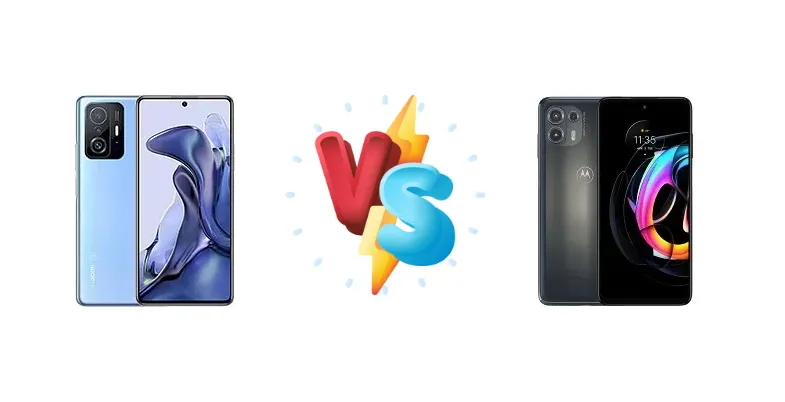
Xiaomi 11T vs Motorola Edge 20 Fusion: A Deep Dive into Performance and Value
| Phones Images | |||||
|---|---|---|---|---|---|
|
🏆 Quick Verdict
For most users, the Xiaomi 11T emerges as the stronger choice. Its Mediatek Dimensity 1200 chipset delivers significantly superior performance, and the 67W fast charging is a game-changer, offsetting any potential battery capacity differences. While the Edge 20 Fusion offers a respectable experience, it can't match the 11T's overall speed and convenience.
| PHONES | ||
|---|---|---|
| Phone Names | Xiaomi 11T | Motorola Edge 20 Fusion |
| Network | ||
|---|---|---|
| 2G bands | GSM 850 / 900 / 1800 / 1900 | GSM 850 / 900 / 1800 / 1900 |
| 3G bands | HSDPA 850 / 900 / 1700(AWS) / 1900 / 2100 | HSDPA 850 / 900 / 1700(AWS) / 1900 / 2100 |
| 4G bands | 1, 2, 3, 4, 5, 7, 8, 12, 13, 17, 18, 19, 20, 26, 28, 32, 38, 40, 41, 42, 66 | 1, 2, 3, 4, 5, 7, 8, 12, 13, 17, 18, 19, 20, 26, 28, 32, 34, 38, 39, 40, 41, 42, 43, 66 |
| 5G bands | 1, 3, 5, 7, 8, 20, 28, 38, 40, 41, 66, 77, 78 SA/NSA | 1, 3, 5, 7, 8, 20, 28, 38, 40, 41, 77, 78, 66 SA/NSA/Sub6 |
| Speed | HSPA, LTE, 5G | HSPA 42.2/5.76 Mbps, LTE Cat18 1200/150 Mbps, 5G |
| Technology | GSM / HSPA / LTE / 5G | GSM / HSPA / LTE / 5G |
| Launch | ||
|---|---|---|
| Announced | 2021, September 15 | 2021, August 17 |
| Status | Available. Released 2021, October 05 | Available. Released 2021, August 27 |
| Body | ||
|---|---|---|
| Build | Glass front (Gorilla Glass Victus), aluminum frame, glass back | Glass front |
| Dimensions | 164.1 x 76.9 x 8.8 mm (6.46 x 3.03 x 0.35 in) | 166 x 76 x 8.3 mm (6.54 x 2.99 x 0.33 in) |
| SIM | Nano-SIM + Nano-SIM | Nano-SIM + Nano-SIM |
| Weight | 203 g (7.16 oz) | 185 g (6.53 oz) |
| IP53, dust and splash resistant | Water-repellent design | |
| Display | ||
|---|---|---|
| Protection | Corning Gorilla Glass Victus | - |
| Resolution | 1080 x 2400 pixels, 20:9 ratio (~395 ppi density) | 1080 x 2400 pixels, 20:9 ratio (~393 ppi density) |
| Size | 6.67 inches, 107.4 cm2 (~85.1% screen-to-body ratio) | 6.7 inches, 108.4 cm2 (~85.9% screen-to-body ratio) |
| Type | AMOLED, 1B colors, 120Hz, HDR10+, 800 nits (typ), 1000 nits (peak) | OLED, 1B colors, 90Hz, HDR10+ |
| Platform | ||
|---|---|---|
| CPU | Octa-core (1x3.0 GHz Cortex-A78 & 3x2.6 GHz Cortex-A78 & 4x2.0 GHz Cortex-A55) | Octa-core (2x2.4 GHz Cortex-A76 & 6x2.0 GHz Cortex-A55) |
| Chipset | Mediatek Dimensity 1200 (6 nm) | Mediatek Dimensity 800U (7 nm) |
| GPU | Mali-G77 MC9 | Mali-G57 MC3 |
| OS | Android 11, upgradable to Android 13, MIUI 14 | Android 11 |
| Memory | ||
|---|---|---|
| Card slot | No | microSDXC |
| Internal | 128GB 8GB RAM, 256GB 8GB RAM | 128GB 6GB RAM, 128GB 8GB RAM |
| UFS 3.1 | - | |
| Main Camera | ||
|---|---|---|
| Features | Dual-LED dual-tone flash, HDR, panorama | LED flash, HDR, panorama |
| Single | 16 MP, f/2.5, (wide), 1/3.06", 1.0µm | - |
| Triple | 108 MP, f/1.8, 26mm (wide), 1/1.52", 0.7µm, PDAF 8 MP, f/2.2, 120˚ (ultrawide), 1/4.0", 1.12µm 5 MP, f/2.4, 50mm (telephoto macro), 1/5.0", 1.12µm, AF | 108 MP, f/1.9, (wide), 1/1.52", 0.7µm, PDAF 8 MP, f/2.2, 118˚ (ultrawide) Auxiliary lens |
| Video | 4K@30fps, 1080p@30/60/120, gyro-EIS | 4K@30fps, 1080p@30/60/120fps, gyro-EIS |
| Selfie camera | ||
|---|---|---|
| Features | - | HDR |
| Single | 16 MP, f/2.5, (wide), 1/3.06", 1.0µm | 32 MP, f/2.3, (wide), 0.7µm |
| Video | 1080p@30fps | 1080p@30fps |
| Sound | ||
|---|---|---|
| 3.5mm jack | No | Yes |
| 35mm jack | No | Yes |
| Loudspeaker | Yes, with stereo speakers | Yes |
| Comms | ||
|---|---|---|
| Bluetooth | 5.2, A2DP, LE, aptX HD, aptX Adaptive | 5.0, A2DP, LE |
| Infrared port | Yes | - |
| NFC | Yes | Yes |
| Positioning | GPS (L1+L5), GLONASS (G1), BDS (B1), GALILEO (E1+E5a), QZSS (L1+L5) | GPS, GLONASS, GALILEO |
| Radio | No | FM radio |
| USB | USB Type-C 2.0, OTG | USB Type-C 2.0 |
| WLAN | Wi-Fi 802.11 a/b/g/n/ac/6, dual-band, Wi-Fi Direct | Wi-Fi 802.11 a/b/g/n/ac, dual-band, Wi-Fi Direct |
| Features | ||
|---|---|---|
| Sensors | Fingerprint (side-mounted), accelerometer, gyro, proximity, compass | Fingerprint (side-mounted), accelerometer, gyro, proximity, compass |
| Battery | ||
|---|---|---|
| Charging | 67W wired, 100% in 36 min | 30W wired |
| Type | Li-Po 5000 mAh | Li-Po 5000 mAh |
| Misc | ||
|---|---|---|
| Colors | Meteorite Gray, Moonlight White, Celestial Blue | Electric Graphite, Cyber Teal |
| Models | 21081111RG | - |
| Price | € 119.00 / £ 275.00 | About 250 EUR |
| SAR | 1.09 W/kg (head) 0.83 W/kg (body) | - |
| SAR EU | 0.55 W/kg (head) 0.95 W/kg (body) | - |
| Tests | ||
|---|---|---|
| Battery life | Endurance rating 98h | - |
| Camera | Photo / Video | - |
| Display | Contrast ratio: Infinite (nominal) | - |
| Loudspeaker | -27.6 LUFS (Good) | - |
| Performance | AnTuTu: 590837 (v9) GeekBench: 2834 (v5.1) GFXBench: 40fps (ES 3.1 onscreen) | - |
Xiaomi 11T
- Significantly faster processor (Dimensity 1200)
- Ultra-fast 67W charging (36 minutes to full)
- Excellent battery endurance (98h rating)
- Software experience can be more cluttered (MIUI)
- May run warmer under sustained load
Motorola Edge 20 Fusion
- More efficient chipset (Dimensity 800U) for basic tasks
- Potentially cleaner software experience (Motorola's near-stock Android)
- Generally more affordable
- Slower processor for demanding applications
- Significantly slower 30W charging
- Likely lower peak display brightness
Display Comparison
The Xiaomi 11T boasts a measured peak brightness of 798 nits, suggesting a vibrant and easily viewable display in most conditions. While the Edge 20 Fusion’s display specs aren’t provided, Motorola typically focuses on color accuracy in this segment. The 11T’s 'Infinite' contrast ratio (nominal) indicates a typical AMOLED panel, offering deep blacks. Without specific details on the Edge 20 Fusion’s panel type or brightness, the 11T holds a clear advantage in raw display performance, particularly for outdoor visibility.
Camera Comparison
Both phones are listed as having 'Photo / Video' capabilities, but lack specific details. Given the market positioning, it’s likely the 11T benefits from a more sophisticated image processing pipeline. Without sensor size or aperture information, it’s difficult to make a definitive judgment. However, Xiaomi generally prioritizes camera features in its 'T' series, suggesting a more feature-rich camera experience on the 11T. The Edge 20 Fusion likely offers a competent camera for everyday use, but may lack the advanced features and image quality of the 11T.
Performance
The core difference lies in the chipsets. The Xiaomi 11T’s Mediatek Dimensity 1200 (6nm) is a substantial upgrade over the Motorola Edge 20 Fusion’s Dimensity 800U (7nm). The 1200 features a more powerful CPU configuration – an octa-core setup with a 3.0 GHz Cortex-A78 prime core, alongside three 2.6 GHz Cortex-A78 cores and four 2.0 GHz Cortex-A55 cores – compared to the 800U’s 2x2.4 GHz Cortex-A76 and 6x2.0 GHz Cortex-A55. The 6nm process node of the Dimensity 1200 also contributes to better power efficiency and sustained performance under load. This translates to noticeably faster app loading times, smoother multitasking, and a superior gaming experience on the 11T.
Battery Life
The Xiaomi 11T achieves an impressive endurance rating of 98 hours, indicating excellent battery life. Crucially, it supports 67W wired charging, achieving a full charge in just 36 minutes. The Motorola Edge 20 Fusion, with its 30W charging, will take considerably longer to fully replenish. While the Edge 20 Fusion’s battery capacity isn’t specified, the 11T’s faster charging speed significantly mitigates any potential capacity disadvantage. Users who frequently need to top up their phones will greatly appreciate the 11T’s charging capabilities.
Buying Guide
Buy the Xiaomi 11T if you prioritize demanding tasks like gaming, video editing, or heavy multitasking and value incredibly fast charging. You'll benefit from the extra processing headroom and reduced downtime. Buy the Motorola Edge 20 Fusion if you prefer a more efficient chipset for everyday tasks, and a cleaner software experience is paramount. It's a solid choice for users who don't push their phones to the limit.