
Xiaomi 11T vs Google Pixel 6a: A Detailed Comparison for the Discerning Buyer
| Phones Images | |||||
|---|---|---|---|---|---|
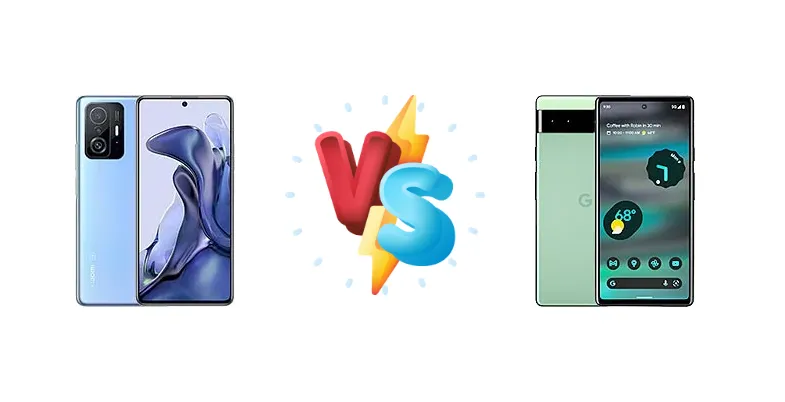
|
🏆 Quick Verdict
For the average user prioritizing a vibrant display and blazing-fast 67W charging, the Xiaomi 11T is the better value. However, those deeply invested in the Google ecosystem and prioritizing computational photography will find the Pixel 6a’s Tensor chip and software integration more appealing.
| PHONES | ||
|---|---|---|
| Phone Names | Xiaomi 11T | Google Pixel 6a |
| Network | ||
|---|---|---|
| 2G bands | GSM 850 / 900 / 1800 / 1900 | GSM 850 / 900 / 1800 / 1900 |
| 3G bands | HSDPA 850 / 900 / 1700(AWS) / 1900 / 2100 | HSDPA 800 / 850 / 900 / 1700(AWS) / 1900 / 2100 |
| 4G bands | 1, 2, 3, 4, 5, 7, 8, 12, 13, 17, 18, 19, 20, 26, 28, 32, 38, 40, 41, 42, 66 | 1, 2, 3, 4, 5, 7, 8, 12, 13, 14, 17, 18, 19, 20, 25, 26, 28, 29, 30, 38, 39, 40, 41, 42, 48, 66, 71 - GX7AS, GB62Z (USA/Canada) |
| 5G bands | 1, 3, 5, 7, 8, 20, 28, 38, 40, 41, 66, 77, 78 SA/NSA | 1, 2, 3, 5, 7, 8, 12, 20, 25, 28, 30, 38, 40, 41, 48, 66, 71, 77, 78 SA/NSA/Sub6 - GX7AS (USA/Canada) |
| Speed | HSPA, LTE, 5G | HSPA, LTE, 5G |
| Technology | GSM / HSPA / LTE / 5G | GSM / HSPA / LTE / 5G |
| - | 1, 2, 3, 5, 7, 8, 12, 20, 25, 28, 30, 40, 48, 66, 71, 77, 78 SA/NSA/Sub6 - G1AZG (International) | |
| Launch | ||
|---|---|---|
| Announced | 2021, September 15 | 2022, May 11 |
| Status | Available. Released 2021, October 05 | Available. Released 2022, July 21 |
| Body | ||
|---|---|---|
| Build | Glass front (Gorilla Glass Victus), aluminum frame, glass back | Glass front (Gorilla Glass 3), aluminum frame, plastic back |
| Dimensions | 164.1 x 76.9 x 8.8 mm (6.46 x 3.03 x 0.35 in) | 152.2 x 71.8 x 8.9 mm (5.99 x 2.83 x 0.35 in) |
| SIM | Nano-SIM + Nano-SIM | Nano-SIM + eSIM |
| Weight | 203 g (7.16 oz) | 178 g (6.28 oz) |
| IP53, dust and splash resistant | IP67 dust/water resistant (up to 1m for 30 min) | |
| Display | ||
|---|---|---|
| Protection | Corning Gorilla Glass Victus | Corning Gorilla Glass 3 |
| Resolution | 1080 x 2400 pixels, 20:9 ratio (~395 ppi density) | 1080 x 2400 pixels, 20:9 ratio (~429 ppi density) |
| Size | 6.67 inches, 107.4 cm2 (~85.1% screen-to-body ratio) | 6.1 inches, 90.7 cm2 (~83.0% screen-to-body ratio) |
| Type | AMOLED, 1B colors, 120Hz, HDR10+, 800 nits (typ), 1000 nits (peak) | OLED, HDR |
| - | Always-on display | |
| Platform | ||
|---|---|---|
| CPU | Octa-core (1x3.0 GHz Cortex-A78 & 3x2.6 GHz Cortex-A78 & 4x2.0 GHz Cortex-A55) | Octa-core (2x2.80 GHz Cortex-X1 & 2x2.25 GHz Cortex-A76 & 4x1.80 GHz Cortex-A55) |
| Chipset | Mediatek Dimensity 1200 (6 nm) | Google Tensor (5 nm) |
| GPU | Mali-G77 MC9 | Mali-G78 MP20 |
| OS | Android 11, upgradable to Android 13, MIUI 14 | Android 12, upgradable to Android 15, up to 5 major Android upgrades |
| Memory | ||
|---|---|---|
| Card slot | No | No |
| Internal | 128GB 8GB RAM, 256GB 8GB RAM | 128GB 6GB RAM |
| UFS 3.1 | UFS 3.1 | |
| Main Camera | ||
|---|---|---|
| Dual | - | 12.2 MP, f/1.7, 27mm, (wide), 1/2.55", 1.4µm, dual pixel PDAF, OIS 12 MP, f/2.2, 17mm, 114˚ (ultrawide), 1.25µm |
| Features | Dual-LED dual-tone flash, HDR, panorama | Dual-LED flash, Pixel Shift, Auto-HDR, panorama |
| Single | 16 MP, f/2.5, (wide), 1/3.06", 1.0µm | 8 MP, f/2.0, 24mm (wide), 1.12µm |
| Triple | 108 MP, f/1.8, 26mm (wide), 1/1.52", 0.7µm, PDAF 8 MP, f/2.2, 120˚ (ultrawide), 1/4.0", 1.12µm 5 MP, f/2.4, 50mm (telephoto macro), 1/5.0", 1.12µm, AF | - |
| Video | 4K@30fps, 1080p@30/60/120, gyro-EIS | 4K@30/60fps, 1080p@30/60/120/240fps; gyro-EIS, OIS |
| Selfie camera | ||
|---|---|---|
| Features | - | HDR, panorama |
| Single | 16 MP, f/2.5, (wide), 1/3.06", 1.0µm | 8 MP, f/2.0, 24mm (wide), 1.12µm |
| Video | 1080p@30fps | 1080p@30fps |
| Sound | ||
|---|---|---|
| 3.5mm jack | No | No |
| 35mm jack | No | No |
| Loudspeaker | Yes, with stereo speakers | Yes, with stereo speakers |
| Comms | ||
|---|---|---|
| Bluetooth | 5.2, A2DP, LE, aptX HD, aptX Adaptive | 5.2, A2DP, LE |
| Infrared port | Yes | - |
| NFC | Yes | Yes |
| Positioning | GPS (L1+L5), GLONASS (G1), BDS (B1), GALILEO (E1+E5a), QZSS (L1+L5) | GPS, GLONASS, GALILEO, QZSS |
| Radio | No | No |
| USB | USB Type-C 2.0, OTG | USB Type-C 3.1 |
| WLAN | Wi-Fi 802.11 a/b/g/n/ac/6, dual-band, Wi-Fi Direct | Wi-Fi 802.11 a/b/g/n/ac/6e, dual-band, Wi-Fi Direct |
| Features | ||
|---|---|---|
| Sensors | Fingerprint (side-mounted), accelerometer, gyro, proximity, compass | Fingerprint (under display, optical), accelerometer, gyro, proximity, compass, barometer |
| Battery | ||
|---|---|---|
| Charging | 67W wired, 100% in 36 min | 18W wired, PD3.0 |
| Type | Li-Po 5000 mAh | Li-Po 4410 mAh |
| Misc | ||
|---|---|---|
| Colors | Meteorite Gray, Moonlight White, Celestial Blue | Chalk, Charcoal, Sage |
| Models | 21081111RG | GX7AS, GB62Z, G1AZG, GB17L |
| Price | € 119.00 / £ 275.00 | $ 138.99 / C$ 228.74 / ₹ 23,999 |
| SAR | 1.09 W/kg (head) 0.83 W/kg (body) | - |
| SAR EU | 0.55 W/kg (head) 0.95 W/kg (body) | - |
| Tests | ||
|---|---|---|
| Battery life | Endurance rating 98h | Endurance rating 94h |
| Camera | Photo / Video | - |
| Display | Contrast ratio: Infinite (nominal) | Contrast ratio: Infinite (nominal) |
| Loudspeaker | -27.6 LUFS (Good) | - |
| Performance | AnTuTu: 590837 (v9) GeekBench: 2834 (v5.1) GFXBench: 40fps (ES 3.1 onscreen) | - |
Xiaomi 11T
- Significantly faster 67W charging
- Brighter display for outdoor visibility
- Potentially higher raw CPU performance
- Less optimized software experience
- Camera likely lacks Pixel 6a’s computational photography prowess
Google Pixel 6a
- Superior camera image processing and features
- Google Tensor chip optimized for AI and machine learning
- Clean and streamlined Android experience
- Significantly slower 18W charging
- Lower peak display brightness
Display Comparison
The Pixel 6a boasts a significantly brighter display, reaching 876 nits compared to the Xiaomi 11T’s 798 nits. This translates to superior visibility under direct sunlight. Both displays share an 'Infinite' (nominal) contrast ratio, suggesting excellent black levels. While neither specifies refresh rate, the brightness difference is a key advantage for the Pixel 6a, particularly for outdoor use. The 11T’s lower peak brightness may be noticeable when viewing HDR content.
Camera Comparison
Both phones offer capable camera systems, but approach image processing differently. The Pixel 6a leverages Google’s renowned computational photography, excelling in dynamic range and low-light performance. While specific sensor details are missing, the Pixel 6a’s image processing is a significant strength. The Xiaomi 11T’s camera is described as capable for both photo and video, but lacks the specific details to assess its strengths. The Tensor chip’s dedicated image signal processor (ISP) gives the Pixel 6a an edge in post-processing capabilities, offering features like Magic Eraser and Real Tone. The absence of detailed sensor information for the 11T makes a direct comparison difficult, but the Pixel 6a’s software advantage is substantial.
Performance
The chipset choice is a defining factor. The Xiaomi 11T utilizes the Mediatek Dimensity 1200 (6nm), featuring a tri-cluster configuration with a high-clocked Cortex-A78 core at 3.0 GHz. The Pixel 6a, however, employs Google’s in-house Tensor chip (5nm). The 5nm process node of the Tensor generally offers better power efficiency and thermal performance than the 6nm Dimensity 1200, potentially leading to less throttling during sustained workloads. While the Dimensity 1200’s CPU clock speeds appear higher on paper, the Tensor’s architecture is optimized for machine learning tasks, impacting camera processing and AI-driven features. The Pixel 6a’s Tensor chip is designed for a different kind of performance – prioritizing smart features over raw CPU power.
Battery Life
The Xiaomi 11T boasts a 67W wired charging capability, achieving a full charge in just 36 minutes – a significant advantage over the Pixel 6a’s 18W charging with PD3.0. While the Pixel 6a has a slightly better endurance rating of 94 hours versus the 11T’s 98 hours, the 11T’s charging speed mitigates any concerns about slightly lower battery endurance. The faster charging of the 11T is a game-changer for users who frequently need to top up their battery quickly.
Buying Guide
Buy the Xiaomi 11T if you need a phone that can be fully charged in under 40 minutes, enjoy media consumption on a bright screen, and value raw performance for demanding tasks. Buy the Google Pixel 6a if you prefer a streamlined Android experience, prioritize exceptional still photography, and appreciate Google’s exclusive software features like Magic Eraser.