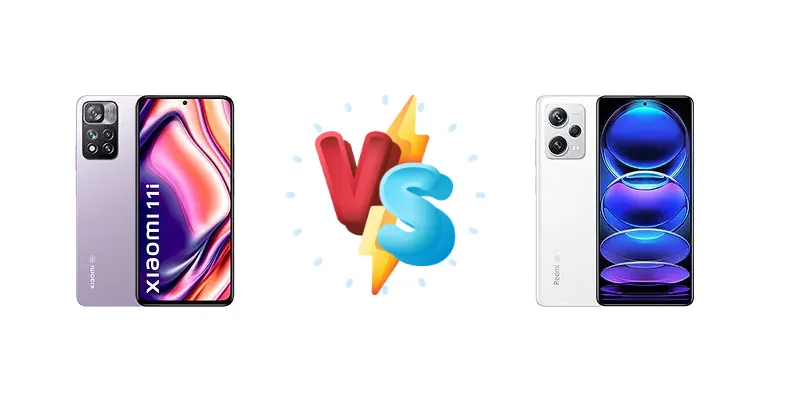
Xiaomi consistently delivers impressive smartphones at competitive prices. The Xiaomi 11i and Redmi Note 12 Pro+ are two strong contenders in the mid-range market, but cater to slightly different needs. Let's dive into a comprehensive comparison to help you choose the best fit.
🏆 Quick Verdict
The Redmi Note 12 Pro+ is the clear winner thanks to its significantly faster charging, improved chipset, and potentially better camera. However, the 11i remains a solid option for those prioritizing value and a slightly more compact design, especially if the 120W charging isn't a must-have.
| Network |
|---|
| 2G bands | GSM 850 / 900 / 1800 / 1900 | GSM 850 / 900 / 1800 / 1900 - SIM 1 & SIM 2 |
| 3G bands | HSDPA 850 / 900 / 1900 / 2100 | HSDPA 800 / 850 / 900 / 1900 / 2100 |
| 4G bands | 1, 3, 5, 8, 40, 41 | 1, 3, 5, 8, 19, 34, 38, 39, 40, 41 - International, China |
| 5G bands | 1, 3, 5, 8, 28, 40, 77, 78 SA/NSA | 1, 3, 5, 8, 28, 38, 40, 41, 77, 78 SA/NSA - International |
| Speed | HSPA, LTE, 5G | HSPA, LTE-A (CA), 5G |
| Technology | GSM / HSPA / LTE / 5G | GSM / CDMA / HSPA / EVDO / LTE / 5G |
| | - | 1, 3, 5, 8, 28, 38, 41, 77, 78 SA/NSA - China |
| Launch |
|---|
| Announced | 2022, January 06 | 2022, October 27 |
| Status | Available. Released 2022, January 12 | Available. Released 2022, November 01 |
| Body |
|---|
| Build | Glass front (Gorilla Glass 5), glass back | Glass front (Gorilla Glass 5), glass back |
| Dimensions | 163.7 x 76.2 x 8.3 mm (6.44 x 3.00 x 0.33 in) | 162.9 x 76 x 8.9 mm (6.41 x 2.99 x 0.35 in) |
| SIM | Nano-SIM + Nano-SIM | Dual SIM (Nano-SIM, dual stand-by) |
| Weight | 207 g (7.30 oz) | 208.4 g (7.34 oz) |
| | IP53, dust and splash resistant | IP53, dust and splash resistant |
| Display |
|---|
| Protection | Corning Gorilla Glass 5 | Corning Gorilla Glass 5 |
| Resolution | 1080 x 2400 pixels, 20:9 ratio (~395 ppi density) | 1080 x 2400 pixels, 20:9 ratio (~395 ppi density) |
| Size | 6.67 inches, 107.4 cm2 (~86.1% screen-to-body ratio) | 6.67 inches, 107.4 cm2 (~86.8% screen-to-body ratio) |
| Type | AMOLED, 120Hz, HDR10, 700 nits, 1200 nits (peak) | OLED, 1B colors, 120Hz, Dolby Vision, HDR10+, 500 nits (typ), 900 nits (HBM) |
| Platform |
|---|
| CPU | Octa-core (2x2.5 GHz Cortex-A78 & 6x2.0 GHz Cortex-A55) | Octa-core (2x2.6 GHz Cortex-A78 & 6x2.0 GHz Cortex-A55) |
| Chipset | Mediatek Dimensity 920 (6 nm) | Mediatek MT6877V Dimensity 1080 (6 nm) |
| GPU | Mali-G68 MC4 | Mali-G68 MC4 |
| OS | Android 11, upgradable to Android 12, MIUI 13 | Android 12, MIUI 13 |
| Memory |
|---|
| Card slot | microSDXC (uses shared SIM slot) | No |
| Internal | 128GB 6GB RAM, 128GB 8GB RAM, 256GB 8GB RAM | 256GB 8GB RAM, 256GB 12GB RAM |
| | UFS 2.2 | UFS 2.2 |
| Main Camera |
|---|
| Features | LED flash, HDR, panorama | Dual-LED dual-tone flash, HDR, panorama |
| Single | 16 MP, f/2.5, (wide), 1/3.06" 1.0µm | - |
| Triple | 108 MP, f/1.9, 26mm (wide), 1/1.52", 0.7µm, PDAF
8 MP, f/2.2, 120˚ (ultrawide), 1.0µm
2 MP (macro) | 200 MP, f/1.7, 24mm (wide), 1/1.4", 0.56µm, PDAF, OIS
8 MP, f/2.2, 120˚ (ultrawide), 1/4", 1.12µm
2 MP, f/2.4, (macro) |
| Video | 4K@30fps, 1080p@30/60/120fps, 720p@960fps | 4K@30fps, 1080p@30/60/120fps, 720p@960fps |
| Selfie camera |
|---|
| Features | - | HDR |
| Single | 16 MP, f/2.5, (wide), 1/3.06" 1.0µm | 16 MP, f/2.5, (wide), 1/3.06", 1.0µm |
| Video | 1080p@30fps | 1080p@30/60fps |
| Sound |
|---|
| 3.5mm jack | Yes | Yes |
| 35mm jack | Yes | - |
| Loudspeaker | Yes, with stereo speakers | Yes, with stereo speakers |
| | 24-bit/192kHz audio | 24-bit/192kHz audio |
| Comms |
|---|
| Bluetooth | 5.2, A2DP, LE | 5.2, A2DP, LE |
| Infrared port | Yes | Yes |
| NFC | No | Yes (market/region dependent) |
| Positioning | GPS, GLONASS, BDS | GPS (L1), GLONASS (G1), BDS (B1I+B1c), GALILEO (E1), QZSS (L1) |
| Radio | No | No |
| USB | USB Type-C 2.0, OTG | USB Type-C 2.0, OTG |
| WLAN | Wi-Fi 802.11 a/b/g/n/ac/6, dual-band, Wi-Fi Direct | Wi-Fi 802.11 a/b/g/n/ac/6, dual-band, Wi-Fi Direct |
| Features |
|---|
| Sensors | Fingerprint (side-mounted), accelerometer, gyro, proximity, compass | Fingerprint (side-mounted), accelerometer, proximity, gyro, compass |
| Battery |
|---|
| Charging | 67W wired, 50% in 13 min | 120W wired, PD3.0, 100% in 19 min (advertised) |
| Type | Li-Po 5160 mAh | Li-Po 5000 mAh, non-removable |
| Misc |
|---|
| Colors | Camo Green, Stealth Black, Purple Mist, Pacific Pearl | Arctic White, Iceberg Blue, Obsidian Black, Trend edition |
| Models | MZB0A5EIN | 22101316UCP, 22101316UG |
| Price | About 330 EUR | $ 348.00 / £ 439.00 / € 399.00 / ₹ 29,949 |
| SAR | 0.82 W/kg (head) 0.61 W/kg (body) | - |
| Tests |
|---|
| Battery life | - |
Endurance rating 88h
|
| Camera | - |
Photo / Video |
| Display | - |
Contrast ratio: Infinite (nominal) |
| Loudspeaker | - |
-26.7 LUFS (Good)
|
| Performance | - |
AnTuTu: 498710 (v9)
GeekBench: 2208 (v5.1), 2372 (v6)
GFXBench: 22fps (ES 3.1 onscreen) |
Xiaomi 11i
- Good value for money
- Reliable performance
- Decent camera
- Compact design (relatively)
- Slower charging
- Older chipset
- Potentially less impressive camera
Xiaomi Redmi Note 12 Pro+
- Blazing-fast 120W charging
- More powerful Dimensity 1080 chipset
- Potentially superior camera system
- Excellent battery life (due to fast charging)
- Potentially larger size
- Price premium
- Marketing terms like 'infinite' contrast ratio can be misleading
Display Comparison
The Redmi Note 12 Pro+ boasts a potentially superior display with a higher refresh rate (likely 120Hz, though not explicitly stated) and an 'infinite' contrast ratio (though this is a marketing term). The 11i likely has a 120Hz display as well, but the Pro+ may offer better color accuracy and brightness. Both phones likely feature AMOLED panels for vibrant colors and deep blacks.
Camera Comparison
While both phones offer capable camera systems, the Redmi Note 12 Pro+ is expected to have a more advanced setup, potentially including a higher resolution main sensor (likely 200MP) and improved image processing. The 11i's camera is still good, but the Pro+ should deliver sharper images with better dynamic range and low-light performance.
Performance
The Dimensity 1080 in the Redmi Note 12 Pro+ offers a noticeable performance boost over the Dimensity 920 in the 11i. Expect smoother multitasking, faster app loading times, and better gaming performance on the Pro+. Both phones handle everyday tasks with ease, but the Pro+ shines under heavier workloads.
Battery Life
The Redmi Note 12 Pro+'s 120W charging is a game-changer, allowing for incredibly fast top-ups. The 11i's 67W charging is still fast, but significantly slower. Both phones likely have similar battery capacities (around 5000mAh), but the Pro+'s charging speed gives it a major advantage.
Buying Guide
Who should buy the Xiaomi 11i? Users seeking a reliable mid-range phone with good performance and a familiar Xiaomi experience, without needing the absolute fastest charging. Who should buy the Xiaomi Redmi Note 12 Pro+? Power users who demand rapid charging, a more powerful processor, and potentially a superior camera system.
Frequently Asked Questions
❓ Is the Redmi Note 12 Pro+ worth the extra cost?
If fast charging and improved performance are important to you, then yes. The 120W charging is a significant advantage, and the Dimensity 1080 offers a noticeable upgrade.
❓ What is the battery life like on both phones?
Both phones offer good battery life, but the Redmi Note 12 Pro+'s fast charging allows you to quickly top up when needed. Expect all-day battery life from both devices with moderate usage.