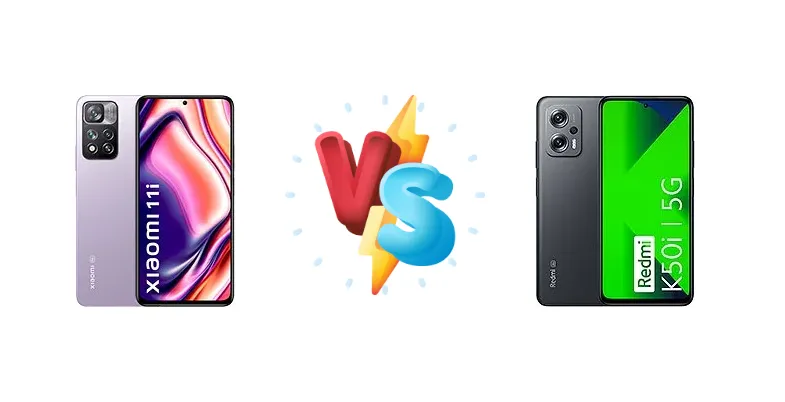
Xiaomi offers a plethora of mid-range smartphones, making it tough to pick the right one. The Xiaomi 11i and Redmi K50i are two compelling options, each with its strengths. This comprehensive comparison will break down their key differences to help you make an informed decision.
🏆 Quick Verdict
The Redmi K50i emerges as the clear winner thanks to its significantly more powerful Dimensity 8100 chipset, offering superior performance and efficiency. While the 11i has its merits, the K50i's processing power and slightly faster charging make it the better overall value.
| Network |
|---|
| 2G bands | GSM 850 / 900 / 1800 / 1900 | GSM 850 / 900 / 1800 / 1900 |
| 3G bands | HSDPA 850 / 900 / 1900 / 2100 | HSDPA 850 / 900 / 1700(AWS) / 1900 / 2100 |
| 4G bands | 1, 3, 5, 8, 40, 41 | 1, 2, 3, 4, 5, 7, 8, 20, 28, 38, 40, 41 |
| 5G bands | 1, 3, 5, 8, 28, 40, 77, 78 SA/NSA | 1, 3, 5, 7, 8, 20, 28, 38, 40, 41, 77, 78 SA/NSA |
| Speed | HSPA, LTE, 5G | HSPA, LTE, 5G |
| Technology | GSM / HSPA / LTE / 5G | GSM / HSPA / LTE / 5G |
| Launch |
|---|
| Announced | 2022, January 06 | 2022, July 20 |
| Status | Available. Released 2022, January 12 | Available. Released 2022, July 23 |
| Body |
|---|
| Build | Glass front (Gorilla Glass 5), glass back | - |
| Dimensions | 163.7 x 76.2 x 8.3 mm (6.44 x 3.00 x 0.33 in) | 163.6 x 74.3 x 8.9 mm (6.44 x 2.93 x 0.35 in) |
| SIM | Nano-SIM + Nano-SIM | Nano-SIM + Nano-SIM |
| Weight | 207 g (7.30 oz) | 200 g (7.05 oz) |
| | IP53, dust and splash resistant | - |
| Display |
|---|
| Protection | Corning Gorilla Glass 5 | Corning Gorilla Glass 5 |
| Resolution | 1080 x 2400 pixels, 20:9 ratio (~395 ppi density) | 1080 x 2460 pixels (~407 ppi density) |
| Size | 6.67 inches, 107.4 cm2 (~86.1% screen-to-body ratio) | 6.6 inches, 103.4 cm2 (~85.1% screen-to-body ratio) |
| Type | AMOLED, 120Hz, HDR10, 700 nits, 1200 nits (peak) | FFS LCD, 144Hz, HDR10, Dolby Vision, 500 nits (typ), 650 nits (HBM) |
| Platform |
|---|
| CPU | Octa-core (2x2.5 GHz Cortex-A78 & 6x2.0 GHz Cortex-A55) | Octa-core (4x2.85 GHz Cortex-A78 & 4x2.0 GHz Cortex-A55) |
| Chipset | Mediatek Dimensity 920 (6 nm) | Mediatek Dimensity 8100 (5 nm) |
| GPU | Mali-G68 MC4 | Mali-G610 MC6 |
| OS | Android 11, upgradable to Android 12, MIUI 13 | Android 12, upgradable to Android 13, MIUI 14 |
| Memory |
|---|
| Card slot | microSDXC (uses shared SIM slot) | No |
| Internal | 128GB 6GB RAM, 128GB 8GB RAM, 256GB 8GB RAM | 128GB 6GB RAM, 128GB 8GB RAM, 256GB 8GB RAM |
| | UFS 2.2 | - |
| Main Camera |
|---|
| Features | LED flash, HDR, panorama | Color spectrum sensor, LED flash, HDR, panorama |
| Single | 16 MP, f/2.5, (wide), 1/3.06" 1.0µm | - |
| Triple | 108 MP, f/1.9, 26mm (wide), 1/1.52", 0.7µm, PDAF
8 MP, f/2.2, 120˚ (ultrawide), 1.0µm
2 MP (macro) | 64 MP, f/1.9, (wide), 1/1.72", 0.8µm, PDAF
8 MP, f/2.2, 120˚, (ultrawide)
2 MP (macro) |
| Video | 4K@30fps, 1080p@30/60/120fps, 720p@960fps | 4K@30fps, 1080p@30/60fps |
| Selfie camera |
|---|
| Single | 16 MP, f/2.5, (wide), 1/3.06" 1.0µm | 16 MP, f/2.5, (wide) |
| Video | 1080p@30fps | 1080p@30fps |
| Sound |
|---|
| 3.5mm jack | Yes | - |
| 35mm jack | Yes | Yes |
| Loudspeaker | Yes, with stereo speakers | Yes, with stereo speakers |
| | 24-bit/192kHz audio | - |
| Comms |
|---|
| Bluetooth | 5.2, A2DP, LE | 5.3, A2DP, LE |
| Infrared port | Yes | Yes |
| NFC | No | No |
| Positioning | GPS, GLONASS, BDS | GPS (L1), GLONASS (L1), BDS (B1I+B1c), GALILEO (E1), QZSS (L1) |
| Radio | No | No |
| USB | USB Type-C 2.0, OTG | USB Type-C 2.0, OTG |
| WLAN | Wi-Fi 802.11 a/b/g/n/ac/6, dual-band, Wi-Fi Direct | Wi-Fi 802.11 a/b/g/n/ac/6, dual-band, Wi-Fi Direct |
| Features |
|---|
| Sensors | Fingerprint (side-mounted), accelerometer, gyro, proximity, compass | Fingerprint (side-mounted), accelerometer, proximity, gyro, compass |
| Battery |
|---|
| Charging | 67W wired, 50% in 13 min | 67W wired, 50% in 15 min, 100% in 46 min |
| Type | Li-Po 5160 mAh | Li-Po 5080 mAh |
| Misc |
|---|
| Colors | Camo Green, Stealth Black, Purple Mist, Pacific Pearl | Phantom Blue, Stealth Black, Quick Silver |
| Models | MZB0A5EIN | 22041216I |
| Price | About 330 EUR | About 320 EUR |
| SAR | 0.82 W/kg (head) 0.61 W/kg (body) | - |
Xiaomi 11i
- Slightly more compact design
- Potentially better color accuracy on display
- 108MP main camera
- Less powerful chipset
- Slightly slower charging
- Can get warm under load
Xiaomi Redmi K50i
- Significantly more powerful Dimensity 8100 chipset
- Better gaming performance
- Slightly better battery life
- Faster charging (marginally)
- Larger footprint
- 64MP main camera (though still good)
Display Comparison
Both phones feature a 6.67-inch FHD+ AMOLED display with a 120Hz refresh rate, offering vibrant colors and smooth scrolling. The 11i might have slightly better color accuracy, but the difference is minimal. The K50i's display is generally well-regarded for its brightness and viewing angles.
Camera Comparison
The Xiaomi 11i boasts a 108MP main camera, while the Redmi K50i features a 64MP main camera. While megapixels aren't everything, the 11i's larger sensor *could* potentially capture slightly more detail in ideal lighting conditions. However, the K50i's image processing is generally excellent, and low-light performance is competitive. Both offer decent ultrawide and macro lenses.
Performance
This is where the K50i truly shines. The Dimensity 8100 is a substantial upgrade over the Dimensity 920. Expect noticeably faster app loading times, smoother multitasking, and significantly improved gaming performance on the K50i. The 920 is still capable, but it falls short in demanding tasks.
Battery Life
Both phones have a 5000mAh battery. The K50i's more efficient Dimensity 8100 chipset allows it to deliver slightly better battery life. While both support 67W fast charging, the K50i charges a bit faster (15 min to 50% vs 13 min for the 11i).
Buying Guide
The Xiaomi 11i is a good choice for users prioritizing a slightly more compact design and a potentially better camera experience (though this is marginal). The Redmi K50i is ideal for gamers, power users, and anyone who values raw performance and efficient battery life.
Frequently Asked Questions
❓ Is the Dimensity 8100 chipset a big upgrade?
Yes, the Dimensity 8100 is a significant upgrade over the Dimensity 920, offering noticeably better performance in all areas, especially gaming and multitasking.
❓ Which phone is better for gaming?
The Redmi K50i is the clear winner for gaming due to its more powerful chipset and efficient thermal management.
❓ Do both phones have 5G connectivity?
Yes, both the Xiaomi 11i and Redmi K50i support 5G connectivity.
❓ What is the RAM and storage options available for each phone?
Both phones typically come in configurations of 6GB/128GB, 8GB/256GB, and 12GB/256GB. However, availability may vary by region.