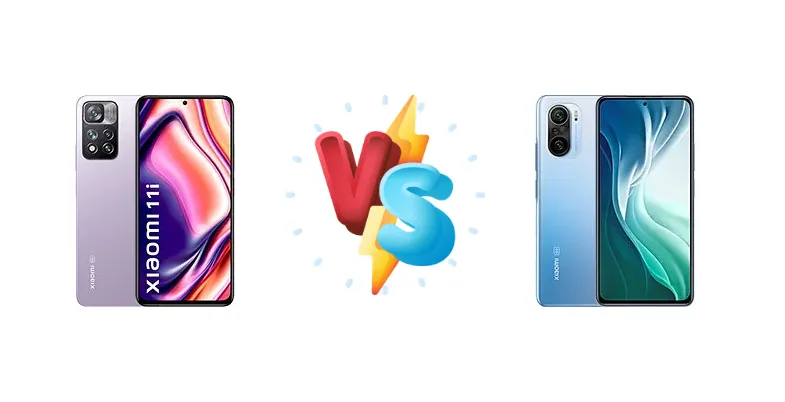
Xiaomi offers a plethora of smartphones, and the 11i and Mi 11i are two popular choices. Both offer compelling features, but cater to slightly different needs. This comprehensive comparison will break down the key differences to help you determine which phone is the right fit for you.
🏆 Quick Verdict
The Xiaomi Mi 11i emerges as the overall winner thanks to its significantly more powerful Snapdragon 888 chipset, brighter display, and faster charging. While the 11i offers a competitive price and speedy 67W charging, the Mi 11i's performance and display quality give it the edge.
| Network |
|---|
| 2G bands | GSM 850 / 900 / 1800 / 1900 | GSM 850 / 900 / 1800 / 1900 |
| 3G bands | HSDPA 850 / 900 / 1900 / 2100 | HSDPA 850 / 900 / 1700(AWS) / 1900 / 2100 |
| 4G bands | 1, 3, 5, 8, 40, 41 | 1, 2, 3, 4, 5, 7, 8, 12, 17, 20, 28, 38, 40, 41, 66 |
| 5G bands | 1, 3, 5, 8, 28, 40, 77, 78 SA/NSA | 1, 3, 5, 7, 8, 20, 28, 38, 41, 77, 78 SA/NSA |
| Speed | HSPA, LTE, 5G | HSPA, LTE, 5G |
| Technology | GSM / HSPA / LTE / 5G | GSM / HSPA / LTE / 5G |
| Launch |
|---|
| Announced | 2022, January 06 | 2021, March 29 |
| Status | Available. Released 2022, January 12 | Available. Released 2021, May 31 |
| Body |
|---|
| Build | Glass front (Gorilla Glass 5), glass back | - |
| Dimensions | 163.7 x 76.2 x 8.3 mm (6.44 x 3.00 x 0.33 in) | 163.7 x 76.4 x 7.8 mm (6.44 x 3.01 x 0.31 in) |
| SIM | Nano-SIM + Nano-SIM | Nano-SIM + Nano-SIM |
| Weight | 207 g (7.30 oz) | 196 g (6.91 oz) |
| | IP53, dust and splash resistant | IP53, dust and splash resistant |
| Display |
|---|
| Protection | Corning Gorilla Glass 5 | Corning Gorilla Glass 5 |
| Resolution | 1080 x 2400 pixels, 20:9 ratio (~395 ppi density) | 1080 x 2400 pixels, 20:9 ratio (~395 ppi density) |
| Size | 6.67 inches, 107.4 cm2 (~86.1% screen-to-body ratio) | 6.67 inches, 107.4 cm2 (~85.9% screen-to-body ratio) |
| Type | AMOLED, 120Hz, HDR10, 700 nits, 1200 nits (peak) | Super AMOLED, 120Hz, HDR10+, 900 nits (HBM), 1300 nits (peak) |
| Platform |
|---|
| CPU | Octa-core (2x2.5 GHz Cortex-A78 & 6x2.0 GHz Cortex-A55) | Octa-core (1x2.84 GHz Cortex-X1 & 3x2.42 GHz Cortex-A78 & 4x1.80 GHz Cortex-A55) |
| Chipset | Mediatek Dimensity 920 (6 nm) | Qualcomm SM8350 Snapdragon 888 5G (5 nm) |
| GPU | Mali-G68 MC4 | Adreno 660 |
| OS | Android 11, upgradable to Android 12, MIUI 13 | Android 11, MIUI 12 |
| Memory |
|---|
| Card slot | microSDXC (uses shared SIM slot) | No |
| Internal | 128GB 6GB RAM, 128GB 8GB RAM, 256GB 8GB RAM | 128GB 8GB RAM, 256GB 8GB RAM |
| | UFS 2.2 | UFS 3.1 |
| Main Camera |
|---|
| Features | LED flash, HDR, panorama | Color spectrum sensor, LED flash, HDR, panorama |
| Single | 16 MP, f/2.5, (wide), 1/3.06" 1.0µm | 20 MP, f/2.5, (wide), 1/3.4", 0.8µm |
| Triple | 108 MP, f/1.9, 26mm (wide), 1/1.52", 0.7µm, PDAF
8 MP, f/2.2, 120˚ (ultrawide), 1.0µm
2 MP (macro) | 108 MP, f/1.8, 26mm (wide), 1/1.52", 0.7µm, PDAF
8 MP, f/2.2, 119˚ (ultrawide)
5 MP, f/2.4, 50mm (telephoto macro), 1/5.0", 1.12µm, AF |
| Video | 4K@30fps, 1080p@30/60/120fps, 720p@960fps | 8K@30fps, 4K@30/60fps, 1080p@30/60/120/240/960fps, gyro-EIS, HDR10+ |
| Selfie camera |
|---|
| Features | - | HDR |
| Single | 16 MP, f/2.5, (wide), 1/3.06" 1.0µm | 20 MP, f/2.5, (wide), 1/3.4", 0.8µm |
| Video | 1080p@30fps | 1080p@30fps, 720p@120fps |
| Sound |
|---|
| 3.5mm jack | Yes | No |
| 35mm jack | Yes | No |
| Loudspeaker | Yes, with stereo speakers | Yes, with stereo speakers |
| | 24-bit/192kHz audio | 24-bit/192kHz audio |
| Comms |
|---|
| Bluetooth | 5.2, A2DP, LE | 5.2, A2DP, LE |
| Infrared port | Yes | Yes |
| NFC | No | Yes (market/region dependent) |
| Positioning | GPS, GLONASS, BDS | GPS (L1+L5), GLONASS (L1), BDS (B1I+B1c+B2a), GALILEO (E1+E5a), QZSS (L1+L5), NavIC (L5) |
| Radio | No | No |
| USB | USB Type-C 2.0, OTG | USB Type-C 2.0, OTG |
| WLAN | Wi-Fi 802.11 a/b/g/n/ac/6, dual-band, Wi-Fi Direct | Wi-Fi 802.11 a/b/g/n/ac/6, dual-band, Wi-Fi Direct |
| Features |
|---|
| Sensors | Fingerprint (side-mounted), accelerometer, gyro, proximity, compass | Fingerprint (side-mounted), accelerometer, gyro, proximity, compass, barometer |
| Battery |
|---|
| Charging | 67W wired, 50% in 13 min | 33W wired, PD3.0, QC3, 100% in 52 min |
| Type | Li-Po 5160 mAh | Li-Po 4520 mAh |
| Misc |
|---|
| Colors | Camo Green, Stealth Black, Purple Mist, Pacific Pearl | Celestial Silver, Frosty White, Cosmic Black |
| Models | MZB0A5EIN | M2012K11G |
| Price | About 330 EUR | About 230 EUR |
| SAR | 0.82 W/kg (head) 0.61 W/kg (body) | 0.95 W/kg (head) 0.74 W/kg (body) |
| SAR EU | - | 0.57 W/kg (head) 0.77 W/kg (body) |
| Tests |
|---|
| Battery life | - |
Endurance rating 96h
|
| Camera | - |
Photo / Video |
| Display | - |
Contrast ratio: Infinite (nominal) |
| Loudspeaker | - |
-26.0 LUFS (Very good)
|
| Performance | - |
AnTuTu: 690021 (v8)
GeekBench: 3641 (v5.1) |
Xiaomi 11i
- Faster Charging (67W)
- Competitive Price
- Decent Performance
- Good Value
- Less Powerful Chipset
- Unspecified Display Brightness
- Potentially Inferior Camera Processing
Xiaomi Mi 11i
- Flagship Snapdragon 888 Chipset
- Brighter Display (939 nits)
- Premium Feel
- Excellent Battery Life
- Slower Charging (33W)
- Higher Price
- Older Model
Display Comparison
The Xiaomi Mi 11i boasts a significantly brighter display, reaching 939 nits peak brightness compared to the 11i's unspecified brightness. The Mi 11i's 'Infinite' contrast ratio (nominal) suggests excellent image quality. Both likely feature AMOLED panels with vibrant colors and deep blacks, but the Mi 11i's brightness advantage is noticeable in outdoor conditions.
Camera Comparison
Both phones offer capable camera systems, but detailed camera comparisons require more in-depth testing. The Mi 11i likely benefits from Qualcomm's image processing capabilities, potentially resulting in slightly better image quality and video recording. Both likely feature a main sensor, ultrawide, and macro lens.
Performance
Here's where the Mi 11i truly shines. Its Snapdragon 888 chipset is a substantial upgrade over the 11i's Dimensity 920. Expect smoother multitasking, faster app loading times, and better performance in demanding games on the Mi 11i. The 11i is still capable, but the Mi 11i offers a noticeably more premium experience.
Battery Life
Both phones are reported to have excellent battery life, with an endurance rating of 96 hours. However, the charging speeds differ significantly. The 11i's 67W charging is faster than the Mi 11i's 33W charging, allowing for quicker top-ups.
Buying Guide
The Xiaomi 11i is a great option for budget-conscious users who prioritize fast charging and a decent overall experience. The Xiaomi Mi 11i is ideal for those who demand flagship-level performance, a vibrant display, and a more premium feel, even if it comes at a slightly higher price.
Frequently Asked Questions
❓ Is the Xiaomi 11i worth buying if I'm on a budget?
Yes, the Xiaomi 11i offers excellent value for money, providing a good balance of features and performance at a more affordable price point.
❓ Which phone is better for gaming, the 11i or the Mi 11i?
The Xiaomi Mi 11i is significantly better for gaming due to its more powerful Snapdragon 888 chipset.
❓ Does the Mi 11i receive software updates anymore?
As an older model, software update support for the Mi 11i may be limited compared to the 11i. Check Xiaomi's official website for the latest update information.