
Xiaomi 11i vs Samsung Galaxy S20 FE 5G: A Head-to-Head Showdown
| Phones Images | |||||
|---|---|---|---|---|---|
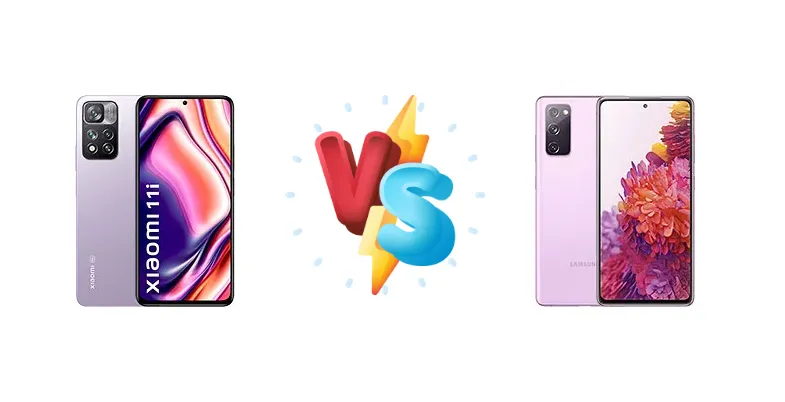
|
🏆 Quick Verdict
The Galaxy S20 FE 5G generally wins thanks to its superior chipset (Snapdragon 865), better camera capabilities, and wireless charging. However, the Xiaomi 11i offers significantly faster charging and a potentially more attractive price point, making it a strong contender for budget-conscious buyers.
| PHONES | ||
|---|---|---|
| Phone Names | Xiaomi 11i | Samsung Galaxy S20 FE 5G |
| Network | ||
|---|---|---|
| 2G bands | GSM 850 / 900 / 1800 / 1900 | GSM 850 / 900 / 1800 / 1900 |
| 3G bands | HSDPA 850 / 900 / 1900 / 2100 | HSDPA 850 / 900 / 1700(AWS) / 1900 / 2100 |
| 4G bands | 1, 3, 5, 8, 40, 41 | 1, 2, 3, 4, 5, 7, 8, 12, 13, 14, 20, 25, 26, 28, 29, 30, 38, 39, 40, 41, 46, 66, 71 - USA |
| 5G bands | 1, 3, 5, 8, 28, 40, 77, 78 SA/NSA | 2, 5, 41, 66, 71 Sub6 - USA |
| Speed | HSPA, LTE, 5G | HSPA 42.2/5.76 Mbps, LTE (5CA) Cat19 1800/200 Mbps, 5G |
| Technology | GSM / HSPA / LTE / 5G | GSM / CDMA / HSPA / EVDO / LTE / 5G |
| - | 1, 3, 5, 7, 8, 28, 40, 41, 78 Sub6 - International | |
| Launch | ||
|---|---|---|
| Announced | 2022, January 06 | 2020, September 23 |
| Status | Available. Released 2022, January 12 | Available. Released 2020, October 02 |
| Body | ||
|---|---|---|
| Build | Glass front (Gorilla Glass 5), glass back | Glass front (Gorilla Glass 3), plastic back, aluminum frame |
| Dimensions | 163.7 x 76.2 x 8.3 mm (6.44 x 3.00 x 0.33 in) | 159.8 x 74.5 x 8.4 mm (6.29 x 2.93 x 0.33 in) |
| SIM | Nano-SIM + Nano-SIM | · Nano-SIM· Nano-SIM + Nano-SIM |
| Weight | 207 g (7.30 oz) | 190 g (6.70 oz) |
| IP53, dust and splash resistant | IP68 dust/water resistant (up to 1.5m for 30 min) | |
| Display | ||
|---|---|---|
| Protection | Corning Gorilla Glass 5 | Corning Gorilla Glass 3 |
| Resolution | 1080 x 2400 pixels, 20:9 ratio (~395 ppi density) | 1080 x 2400 pixels, 20:9 ratio (~407 ppi density) |
| Size | 6.67 inches, 107.4 cm2 (~86.1% screen-to-body ratio) | 6.5 inches, 101.0 cm2 (~84.8% screen-to-body ratio) |
| Type | AMOLED, 120Hz, HDR10, 700 nits, 1200 nits (peak) | Super AMOLED, 120Hz, HDR10+ |
| - | Always-on display | |
| Platform | ||
|---|---|---|
| CPU | Octa-core (2x2.5 GHz Cortex-A78 & 6x2.0 GHz Cortex-A55) | Octa-core (1x2.84 GHz Cortex-A77 & 3x2.42 GHz Cortex-A77 & 4x1.80 GHz Cortex-A55) |
| Chipset | Mediatek Dimensity 920 (6 nm) | Qualcomm SM8250 Snapdragon 865 5G (7 nm+) |
| GPU | Mali-G68 MC4 | Adreno 650 |
| OS | Android 11, upgradable to Android 12, MIUI 13 | Android 10, upgradable to Android 13, One UI 5.1 |
| Memory | ||
|---|---|---|
| Card slot | microSDXC (uses shared SIM slot) | microSDXC (uses shared SIM slot) |
| Internal | 128GB 6GB RAM, 128GB 8GB RAM, 256GB 8GB RAM | 128GB 6GB RAM, 128GB 8GB RAM, 256GB 6GB RAM, 256GB 8GB RAM |
| UFS 2.2 | UFS 3.1 | |
| Main Camera | ||
|---|---|---|
| Features | LED flash, HDR, panorama | LED flash, auto-HDR, panorama |
| Single | 16 MP, f/2.5, (wide), 1/3.06" 1.0µm | 2 MP |
| Triple | 108 MP, f/1.9, 26mm (wide), 1/1.52", 0.7µm, PDAF 8 MP, f/2.2, 120˚ (ultrawide), 1.0µm 2 MP (macro) | 12 MP, f/1.8, 26mm (wide), 1/1.76", 1.8µm, dual pixel PDAF, OIS 8 MP, f/2.4, 76mm (telephoto), 1/4.5", 1.0µm, PDAF, OIS, 3x optical zoom 12 MP, f/2.2, 13mm, 123˚ (ultrawide), 1/3.0", 1.12µm |
| Video | 4K@30fps, 1080p@30/60/120fps, 720p@960fps | 4K@30/60fps, 1080p@30/60fps, gyro-EIS |
| Selfie camera | ||
|---|---|---|
| Features | - | HDR |
| Single | 16 MP, f/2.5, (wide), 1/3.06" 1.0µm | 32 MP, f/2.2, 26mm (wide), 1/2.74", 0.8µm |
| Video | 1080p@30fps | 4K@30/60fps, 1080p@30/60fps, gyro-EIS |
| Sound | ||
|---|---|---|
| 3.5mm jack | Yes | No |
| 35mm jack | Yes | No |
| Loudspeaker | Yes, with stereo speakers | Yes, with stereo speakers |
| 24-bit/192kHz audio | 32-bit/384kHz audio Tuned by AKG | |
| Comms | ||
|---|---|---|
| Bluetooth | 5.2, A2DP, LE | 5.0, A2DP, LE |
| Infrared port | Yes | - |
| NFC | No | Yes |
| Positioning | GPS, GLONASS, BDS | GPS, GLONASS, BDS, GALILEO |
| Radio | No | No |
| USB | USB Type-C 2.0, OTG | USB Type-C 3.2, OTG |
| WLAN | Wi-Fi 802.11 a/b/g/n/ac/6, dual-band, Wi-Fi Direct | Wi-Fi 802.11 a/b/g/n/ac/6, dual-band, Wi-Fi Direct |
| Features | ||
|---|---|---|
| Browser | - | HTTP / WAP 2.0 |
| Sensors | Fingerprint (side-mounted), accelerometer, gyro, proximity, compass | Fingerprint (under display, optical), accelerometer, gyro, compass |
| - | Virtual proximity sensing Bixby natural language commands and dictation Samsung Pay (Visa, MasterCard certified) | |
| Battery | ||
|---|---|---|
| Charging | 67W wired, 50% in 13 min | 25W wired, PD3.0 15W wireless (Qi) 4.5W reverse wireless |
| Stand-by | - | Up to 300 h |
| Talk time | - | Up to 5 h |
| Type | Li-Po 5160 mAh | Li-Ion 4500 mAh |
| Misc | ||
|---|---|---|
| Colors | Camo Green, Stealth Black, Purple Mist, Pacific Pearl | Cloud Lavender, Cloud Mint, Cloud Navy, Cloud White, Cloud Red, Cloud Orange |
| Models | MZB0A5EIN | SM-G781B, SM-G781B/DS, SM-G781U, SM-G781U1, SM-G781W, SM-G7810, SM-G781N, SM-G781V |
| Price | About 330 EUR | $ 137.00 / C$ 531.23 / £ 169.00 / € 199.00 |
| SAR | 0.82 W/kg (head) 0.61 W/kg (body) | 0.70 W/kg (head) 0.82 W/kg (body) |
| SAR EU | - | 0.50 W/kg (head) 1.35 W/kg (body) |
| Pricing | ||
|---|---|---|
| 128GB 6GB RAM | - | $ 361.99 |
| 128GB 8GB RAM | - | $ 589.97 |
| 256GB 8GB RAM | - | $ 769.99 |
| Tests | ||
|---|---|---|
| Battery life | - | Endurance rating 110h |
| Camera | - | Photo / Video |
| Display | - | Contrast ratio: Infinite (nominal) |
| Loudspeaker | - | -26.3 LUFS (Good) |
| Performance | - | AnTuTu: 543986 (v8) GeekBench: 3296 (v5.1) GFXBench: 45fps (ES 3.1 onscreen) |
Xiaomi 11i
- Faster Charging (67W)
- Sleek Design
- Competitive Price
- Good Display
- Less Powerful Chipset
- Less Versatile Camera
- No Wireless Charging
Samsung Galaxy S20 FE 5G
- Powerful Snapdragon 865 Chipset
- Versatile Camera System
- Wireless Charging
- Excellent Battery Life
- Slower Charging (25W)
- Higher Price
- Older Model
Display Comparison
Both phones feature AMOLED displays, offering vibrant colors and deep blacks. The Galaxy S20 FE 5G boasts a measured peak brightness of 822 nits, giving it a slight edge in outdoor visibility. The Xiaomi 11i's display is also excellent, but lacks specific brightness measurements. Resolution and refresh rates are comparable, providing a smooth viewing experience on both devices.
Camera Comparison
The Galaxy S20 FE 5G generally offers a more versatile camera system. While both phones have capable main sensors, the S20 FE 5G's additional lenses (ultrawide and telephoto) provide greater flexibility in different shooting scenarios. Image processing and low-light performance are also typically better on the S20 FE 5G. The Xiaomi 11i's camera is still good, but lacks the same level of refinement.
Performance
The Samsung Galaxy S20 FE 5G's Snapdragon 865 chipset is noticeably more powerful than the Xiaomi 11i's Dimensity 920. This translates to smoother multitasking, faster app loading times, and better performance in demanding games. While the Xiaomi 11i is capable, it may struggle with more intensive tasks. The S20 FE 5G's CPU architecture (1x Cortex-A77 + 3x Cortex-A77 + 4x Cortex-A55) also provides a more balanced performance profile.
Battery Life
The Samsung Galaxy S20 FE 5G boasts an impressive endurance rating of 110 hours, suggesting excellent battery life. The Xiaomi 11i, while not explicitly stated, typically offers good battery performance. However, the Xiaomi 11i's standout feature is its 67W wired charging, which can charge the phone to 50% in just 13 minutes – significantly faster than the S20 FE 5G's 25W charging.
Buying Guide
The Xiaomi 11i is ideal for users prioritizing fast charging and a sleek design on a tighter budget. The Samsung Galaxy S20 FE 5G is a better choice for those who value performance, a more versatile camera system, and the convenience of wireless charging, even if it comes at a higher price.