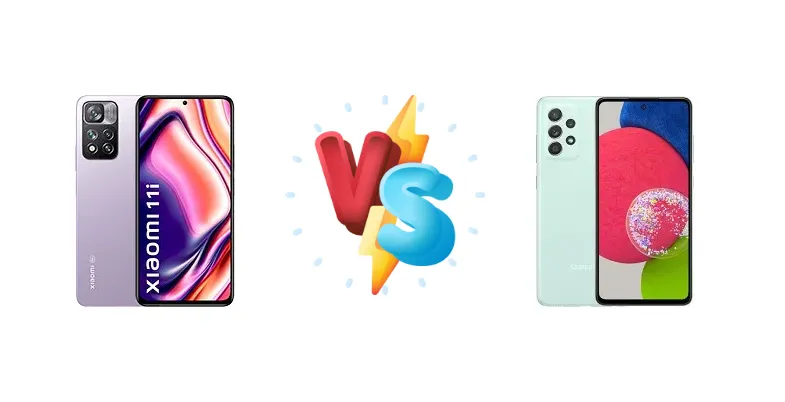
The Xiaomi 11i and Samsung Galaxy A52s 5G represent compelling options in the increasingly competitive mid-range smartphone market. Both devices aim to deliver 5G connectivity and a smooth user experience without breaking the bank, but they take different approaches to achieving this. The 11i prioritizes raw speed with its Dimensity 920, while the A52s 5G focuses on a balanced package with the Snapdragon 778G and a well-regarded display.
🏆 Quick Verdict
For users prioritizing peak performance and incredibly fast charging, the Xiaomi 11i is the clear winner. However, the Samsung Galaxy A52s 5G offers a more refined experience with its brighter display and proven battery endurance, making it the better all-rounder for the average user.
| Network |
|---|
| 2G bands | GSM 850 / 900 / 1800 / 1900 | GSM 850 / 900 / 1800 / 1900 |
| 3G bands | HSDPA 850 / 900 / 1900 / 2100 | HSDPA 850 / 900 / 1700(AWS) / 1900 / 2100 |
| 4G bands | 1, 3, 5, 8, 40, 41 | 1, 2, 3, 4, 5, 7, 8, 12, 17, 20, 26, 28, 32, 38, 40, 41, 66 |
| 5G bands | 1, 3, 5, 8, 28, 40, 77, 78 SA/NSA | 1, 3, 5, 7, 8, 20, 28, 38, 40, 41, 66, 78 SA/NSA/Sub6 |
| Speed | HSPA, LTE, 5G | HSPA 42.2/5.76 Mbps, LTE Cat18 1200/150 Mbps, 5G |
| Technology | GSM / HSPA / LTE / 5G | GSM / HSPA / LTE / 5G |
| Launch |
|---|
| Announced | 2022, January 06 | 2021, August 17 |
| Status | Available. Released 2022, January 12 | Available. Released 2021, September 01 |
| Body |
|---|
| Build | Glass front (Gorilla Glass 5), glass back | Glass front (Gorilla Glass 5), plastic back |
| Dimensions | 163.7 x 76.2 x 8.3 mm (6.44 x 3.00 x 0.33 in) | 159.9 x 75.1 x 8.4 mm (6.30 x 2.96 x 0.33 in) |
| SIM | Nano-SIM + Nano-SIM | · Nano-SIM· Nano-SIM + Nano-SIM |
| Weight | 207 g (7.30 oz) | 189 g (6.67 oz) |
| | IP53, dust and splash resistant | IP67 dust/water resistant (up to 1m for 30 min) |
| Display |
|---|
| Protection | Corning Gorilla Glass 5 | Corning Gorilla Glass 5 |
| Resolution | 1080 x 2400 pixels, 20:9 ratio (~395 ppi density) | 1080 x 2400 pixels, 20:9 ratio (~405 ppi density) |
| Size | 6.67 inches, 107.4 cm2 (~86.1% screen-to-body ratio) | 6.5 inches, 102.0 cm2 (~84.9% screen-to-body ratio) |
| Type | AMOLED, 120Hz, HDR10, 700 nits, 1200 nits (peak) | Super AMOLED, 120Hz, 800 nits (HBM) |
| Platform |
|---|
| CPU | Octa-core (2x2.5 GHz Cortex-A78 & 6x2.0 GHz Cortex-A55) | Octa-core (1x2.4 GHz Cortex-A78 & 3x2.2 GHz Cortex-A78 & 4x1.9 GHz Cortex-A55) |
| Chipset | Mediatek Dimensity 920 (6 nm) | Qualcomm SM7325 Snapdragon 778G 5G (6 nm) |
| GPU | Mali-G68 MC4 | Adreno 642L |
| OS | Android 11, upgradable to Android 12, MIUI 13 | Android 11, upgradable to Android 14, One UI 6 |
| Memory |
|---|
| Card slot | microSDXC (uses shared SIM slot) | microSDXC (uses shared SIM slot) |
| Internal | 128GB 6GB RAM, 128GB 8GB RAM, 256GB 8GB RAM | 128GB 4GB RAM, 128GB 6GB RAM, 128GB 8GB RAM, 256GB 6GB RAM, 256GB 8GB RAM |
| | UFS 2.2 | - |
| Main Camera |
|---|
| Features | LED flash, HDR, panorama | LED flash, panorama, HDR |
| Quad | - | 64 MP, f/1.8, 26mm (wide), 1/1.7", 0.8µm, PDAF, OIS
12 MP, f/2.2, 123˚ (ultrawide), 1.12µm
5 MP (macro)
Auxiliary lens |
| Single | 16 MP, f/2.5, (wide), 1/3.06" 1.0µm | 32 MP, f/2.2, 26mm (wide), 1/2.8", 0.8µm |
| Triple | 108 MP, f/1.9, 26mm (wide), 1/1.52", 0.7µm, PDAF
8 MP, f/2.2, 120˚ (ultrawide), 1.0µm
2 MP (macro) | - |
| Video | 4K@30fps, 1080p@30/60/120fps, 720p@960fps | 4K@30fps, 1080p@30/60fps; gyro-EIS |
| Selfie camera |
|---|
| Features | - | HDR |
| Single | 16 MP, f/2.5, (wide), 1/3.06" 1.0µm | 32 MP, f/2.2, 26mm (wide), 1/2.8", 0.8µm |
| Video | 1080p@30fps | 4K@30fps, 1080p@30/60fps |
| Sound |
|---|
| 3.5mm jack | Yes | Yes |
| 35mm jack | Yes | Yes |
| Loudspeaker | Yes, with stereo speakers | Yes, with stereo speakers |
| | 24-bit/192kHz audio | - |
| Comms |
|---|
| Bluetooth | 5.2, A2DP, LE | 5.0, A2DP, LE |
| Infrared port | Yes | - |
| NFC | No | Yes (market/region dependent) |
| Positioning | GPS, GLONASS, BDS | GPS, GLONASS, GALILEO, BDS, QZSS |
| Radio | No | No |
| USB | USB Type-C 2.0, OTG | USB Type-C 2.0, OTG |
| WLAN | Wi-Fi 802.11 a/b/g/n/ac/6, dual-band, Wi-Fi Direct | Wi-Fi 802.11 a/b/g/n/ac/6, dual-band, Wi-Fi Direct |
| Features |
|---|
| Sensors | Fingerprint (side-mounted), accelerometer, gyro, proximity, compass | Fingerprint (under display, optical), accelerometer, gyro, compass |
| | - | Virtual Proximity Sensing |
| Battery |
|---|
| Charging | 67W wired, 50% in 13 min | 25W wired |
| Type | Li-Po 5160 mAh | Li-Ion 4500 mAh |
| Misc |
|---|
| Colors | Camo Green, Stealth Black, Purple Mist, Pacific Pearl | Awesome Black, Awesome White, Awesome Purple, Awesome Mint |
| Models | MZB0A5EIN | SM-A528B, SM-A528B/DS, SM-A528N |
| Price | About 330 EUR | £ 112.98 / € 249.47 |
| SAR | 0.82 W/kg (head) 0.61 W/kg (body) | 0.72 W/kg (head) |
| SAR EU | - | 0.88 W/kg (head) 0.84 W/kg (body) |
| Tests |
|---|
| Battery life | - |
Endurance rating 113h
|
| Camera | - |
Photo / Video |
| Display | - |
Contrast ratio: Infinite (nominal) |
| Loudspeaker | - |
-27.5 LUFS (Good)
|
| Performance | - |
AnTuTu: 429675 (v8), 506432(v9)
GeekBench: 11060 (v4.4), 2801 (v5.1)
GFXBench: 28fps (ES 3.1 onscreen) |
Xiaomi 11i
- Significantly faster 67W charging
- Potentially higher peak CPU performance
- Likely stronger GPU performance for gaming
- Display brightness and quality are unknown and potentially inferior
- Battery life potentially lower than A52s 5G
Samsung Galaxy A52s 5G
- Brighter 800 nit display for outdoor visibility
- Excellent 113-hour battery endurance
- Established Samsung software and support
- Slower 25W charging
- CPU performance may be slightly lower in bursty tasks
Display Comparison
The Samsung Galaxy A52s 5G boasts a significant advantage in display quality, achieving a measured peak brightness of 800 nits. While the Xiaomi 11i’s display specs are not provided, this brightness level ensures excellent visibility even under direct sunlight. The A52s 5G’s ‘Infinite’ contrast ratio (nominal) suggests a strong AMOLED panel, delivering deep blacks and vibrant colors. Without comparable display data for the 11i, it’s difficult to assess its color accuracy or viewing angles, but the A52s 5G sets a high bar.
Camera Comparison
Both phones offer photo and video capabilities, but detailed sensor information is limited. The A52s 5G likely benefits from Samsung’s established image processing algorithms, known for producing vibrant and shareable photos. Without knowing the main sensor resolution or aperture of the 11i, it’s difficult to assess its low-light performance. The inclusion of OIS (Optical Image Stabilization) on the A52s 5G would be a significant advantage for video recording and reducing blur in low-light conditions. The presence of a 2MP macro camera on either device is largely inconsequential, offering limited practical benefit.
Performance
Both the Xiaomi 11i and Samsung Galaxy A52s 5G utilize 6nm chipsets, but their architectures differ. The Xiaomi 11i’s Mediatek Dimensity 920 features a dual-cluster CPU with two high-performance Cortex-A78 cores clocked at 2.5 GHz, paired with six efficiency-focused Cortex-A55 cores at 2.0 GHz. The A52s 5G’s Snapdragon 778G 5G employs a single 2.4 GHz Cortex-A78 core, three additional Cortex-A78 cores at 2.2 GHz, and four Cortex-A55 cores at 1.9 GHz. This configuration suggests the Snapdragon 778G may offer more sustained multi-core performance, while the 11i could excel in bursty, single-threaded tasks. The 11i’s GPU is also likely to provide a slight edge in graphics-intensive applications.
Battery Life
The Samsung Galaxy A52s 5G achieves an impressive endurance rating of 113 hours, indicating excellent battery life. While the Xiaomi 11i’s battery capacity is unknown, its 67W wired charging capability is a standout feature, promising a 50% charge in just 13 minutes. This rapid charging significantly mitigates any potential battery capacity disadvantage. The A52s 5G’s 25W charging is considerably slower, requiring more time to fully replenish the battery. The A52s 5G’s endurance rating suggests a larger battery capacity, but the 11i’s charging speed offers a different kind of convenience.
Buying Guide
Buy the Xiaomi 11i if you frequently engage in demanding tasks like mobile gaming or video editing and value the ability to rapidly recharge your device with its 67W charging. Buy the Samsung Galaxy A52s 5G if you prioritize a consistently bright and clear display for outdoor use, long-lasting battery life, and a more established software ecosystem with Samsung’s One UI.
Frequently Asked Questions
❓ Does the Xiaomi 11i’s Dimensity 920 chipset throttle under sustained gaming loads?
While the Dimensity 920 is a capable chipset, throttling is a common concern with mid-range phones. The 6nm process helps mitigate this, but prolonged gaming sessions at maximum settings may lead to reduced performance. The A52s 5G’s Snapdragon 778G, while slightly less powerful on paper, may exhibit more consistent performance due to its different core configuration and potentially better thermal management.
❓ How does the 25W charging on the Samsung Galaxy A52s 5G compare to the 67W charging on the Xiaomi 11i in real-world usage?
The difference is substantial. The Xiaomi 11i can gain 50% charge in just 13 minutes, while the A52s 5G will take considerably longer – likely over an hour to reach the same level. This makes the 11i ideal for users who frequently need a quick power boost, while the A52s 5G requires more planning around charging times.
❓ Is the Samsung Galaxy A52s 5G still receiving software updates?
Samsung typically provides several years of software support for its A-series devices. As of late 2023/early 2024, the A52s 5G is still receiving security updates, and is likely to receive at least one more major Android version update. Xiaomi’s update policy can be less consistent, so it’s important to check the current software support status before purchasing.