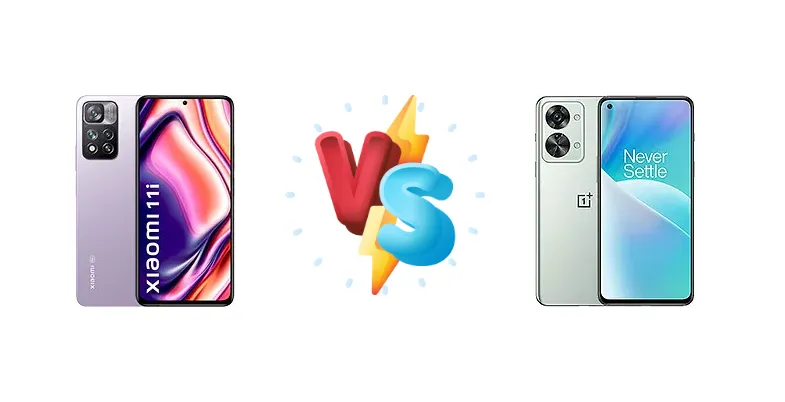
The Xiaomi 11i and OnePlus Nord 2T represent compelling options in the increasingly competitive mid-range smartphone market. Both leverage MediaTek's Dimensity series, but target slightly different priorities. The 11i initially aimed for aggressive value, while the Nord 2T builds on OnePlus's reputation for a refined user experience and faster charging. This comparison dissects their key differences to help you choose.
🏆 Quick Verdict
For most users, the OnePlus Nord 2T emerges as the stronger choice. Its Dimensity 1300 chipset offers a noticeable performance uplift, and the 80W SuperVOOC charging is significantly faster than the Xiaomi 11i’s 67W. While both boast 100-hour endurance ratings, the Nord 2T’s overall package delivers a more polished experience.
| Network |
|---|
| 2G bands | GSM 850 / 900 / 1800 / 1900 | GSM 850 / 900 / 1800 / 1900 |
| 3G bands | HSDPA 850 / 900 / 1900 / 2100 | HSDPA 800 / 850 / 900 / 1700(AWS) / 1800 / 1900 / 2100 |
| 4G bands | 1, 3, 5, 8, 40, 41 | 1, 2, 3, 4, 5, 7, 8, 12, 17, 18, 19, 20, 26, 28, 32, 34, 38, 39, 40, 41, 66 |
| 5G bands | 1, 3, 5, 8, 28, 40, 77, 78 SA/NSA | 1, 3, 7, 8, 20, 28, 38, 41, 78 SA/NSA |
| Speed | HSPA, LTE, 5G | HSPA 42.2/5.76 Mbps, LTE Cat18 1200/150 Mbps, 5G |
| Technology | GSM / HSPA / LTE / 5G | GSM / HSPA / LTE / 5G |
| Launch |
|---|
| Announced | 2022, January 06 | 2022, May 19 |
| Status | Available. Released 2022, January 12 | Available. Released 2022, May 21 |
| Body |
|---|
| Build | Glass front (Gorilla Glass 5), glass back | Glass front (Gorilla Glass 5), plastic frame |
| Dimensions | 163.7 x 76.2 x 8.3 mm (6.44 x 3.00 x 0.33 in) | 159.1 x 73.2 x 8.2 mm (6.26 x 2.88 x 0.32 in) |
| SIM | Nano-SIM + Nano-SIM | Nano-SIM + Nano-SIM |
| Weight | 207 g (7.30 oz) | 190 g (6.70 oz) |
| | IP53, dust and splash resistant | - |
| Display |
|---|
| Protection | Corning Gorilla Glass 5 | Corning Gorilla Glass 5 |
| Resolution | 1080 x 2400 pixels, 20:9 ratio (~395 ppi density) | 1080 x 2400 pixels, 20:9 ratio (~409 ppi density) |
| Size | 6.67 inches, 107.4 cm2 (~86.1% screen-to-body ratio) | 6.43 inches, 99.8 cm2 (~85.7% screen-to-body ratio) |
| Type | AMOLED, 120Hz, HDR10, 700 nits, 1200 nits (peak) | AMOLED, 90Hz, HDR10+ |
| Platform |
|---|
| CPU | Octa-core (2x2.5 GHz Cortex-A78 & 6x2.0 GHz Cortex-A55) | Octa-core (1x3.0 GHz Cortex-A78 & 3x2.6 GHz Cortex-A78 & 4x2.0 GHz Cortex-A55) |
| Chipset | Mediatek Dimensity 920 (6 nm) | Mediatek Dimensity 1300 (6 nm) |
| GPU | Mali-G68 MC4 | Mali-G77 MC9 |
| OS | Android 11, upgradable to Android 12, MIUI 13 | Android 12, upgradable to Android 14, OxygenOS 14 |
| Memory |
|---|
| Card slot | microSDXC (uses shared SIM slot) | No |
| Internal | 128GB 6GB RAM, 128GB 8GB RAM, 256GB 8GB RAM | 128GB 8GB RAM, 256GB 12GB RAM |
| | UFS 2.2 | UFS 3.1 |
| Main Camera |
|---|
| Features | LED flash, HDR, panorama | Dual-LED flash, HDR, panorama |
| Single | 16 MP, f/2.5, (wide), 1/3.06" 1.0µm | 32 MP, f/2.4, (wide), 1/2.8", 0.8µm |
| Triple | 108 MP, f/1.9, 26mm (wide), 1/1.52", 0.7µm, PDAF
8 MP, f/2.2, 120˚ (ultrawide), 1.0µm
2 MP (macro) | 50 MP, f/1.9, 24mm (wide), 1/1.56", 1.0µm, PDAF, OIS
8 MP, f/2.2, 120˚ (ultrawide)
Auxiliary lens |
| Video | 4K@30fps, 1080p@30/60/120fps, 720p@960fps | 4K@30fps, 1080p@30/60/120/480fps, gyro-EIS |
| Selfie camera |
|---|
| Features | - | Auto HDR |
| Single | 16 MP, f/2.5, (wide), 1/3.06" 1.0µm | 32 MP, f/2.4, (wide), 1/2.8", 0.8µm |
| Video | 1080p@30fps | 1080p@30fps, gyro-EIS |
| Sound |
|---|
| 3.5mm jack | Yes | No |
| 35mm jack | Yes | No |
| Loudspeaker | Yes, with stereo speakers | Yes, with stereo speakers |
| | 24-bit/192kHz audio | - |
| Comms |
|---|
| Bluetooth | 5.2, A2DP, LE | 5.2, A2DP, LE, aptX HD |
| Infrared port | Yes | - |
| NFC | No | Yes |
| Positioning | GPS, GLONASS, BDS | GPS, GLONASS, GALILEO, BDS, NavIC |
| Radio | No | No |
| USB | USB Type-C 2.0, OTG | USB Type-C 2.0, OTG |
| WLAN | Wi-Fi 802.11 a/b/g/n/ac/6, dual-band, Wi-Fi Direct | Wi-Fi 802.11 a/b/g/n/ac/6, dual-band, Wi-Fi Direct |
| Features |
|---|
| Sensors | Fingerprint (side-mounted), accelerometer, gyro, proximity, compass | Fingerprint (under display, optical), accelerometer, gyro, proximity, compass |
| Battery |
|---|
| Charging | 67W wired, 50% in 13 min | 80W wired, PD |
| Type | Li-Po 5160 mAh | Li-Po 4500 mAh |
| Misc |
|---|
| Colors | Camo Green, Stealth Black, Purple Mist, Pacific Pearl | Gray Shadow, Jade Fog |
| Models | MZB0A5EIN | CPH2399, CPH2401 |
| Price | About 330 EUR | € 144.39 / $ 169.99 / ₹ 31,490 |
| SAR | 0.82 W/kg (head) 0.61 W/kg (body) | - |
| Tests |
|---|
| Battery life | - |
Endurance rating 100h
|
| Camera | - |
Photo / Video |
| Display | - |
Contrast ratio: Infinite (nominal) |
| Loudspeaker | - |
-25.6 LUFS (Very good)
|
| Performance | - |
AnTuTu: 490545 (v8) | 604467 (v9)
GeekBench: 2790 (v5.1)
GFXBench: 40fps (ES 3.1 onscreen) |
Xiaomi 11i
- Aggressive pricing offers excellent value.
- 67W charging is still very fast.
- Potentially more customizable software experience.
- Dimensity 920 is outperformed by the Dimensity 1300.
- Display brightness likely lower than the Nord 2T.
OnePlus Nord 2T
- Faster Dimensity 1300 chipset delivers superior performance.
- 80W SuperVOOC charging is exceptionally fast.
- Refined OnePlus software experience.
- Typically more expensive than the Xiaomi 11i.
- OxygenOS, while refined, has seen some changes in recent years.
Display Comparison
The OnePlus Nord 2T boasts a measured peak brightness of 636 nits, a significant advantage over the Xiaomi 11i (brightness data unavailable). While both likely utilize AMOLED panels for vibrant colors, the Nord 2T’s higher brightness translates to better visibility outdoors. The Nord 2T’s ‘Infinite’ contrast ratio (nominal) suggests excellent black levels, typical of AMOLED technology. Without specific data on the 11i’s panel, it’s difficult to assess its color accuracy or PWM dimming rate, but the Nord 2T’s brighter display is a clear win for users who consume content in bright environments.
Camera Comparison
Both phones offer photo and video capabilities, but detailed sensor information is lacking. Without specifics, it’s difficult to make a definitive judgment. However, the market positioning of OnePlus typically prioritizes image processing and color science, potentially leading to more pleasing results in a wider range of conditions. The absence of details regarding OIS (Optical Image Stabilization) on either device makes it difficult to assess low-light performance. We can assume both will include standard features like HDR and portrait modes, but the quality of these will depend heavily on the underlying sensor and image processing algorithms.
Performance
The core difference lies in the chipsets. The OnePlus Nord 2T’s Dimensity 1300 features a more powerful CPU configuration: a single 3.0 GHz Cortex-A78 core, alongside three 2.6 GHz Cortex-A78 cores, and four 2.0 GHz Cortex-A55 cores. This contrasts with the Xiaomi 11i’s Dimensity 920, which has two 2.5 GHz Cortex-A78 cores and six 2.0 GHz Cortex-A55 cores. The Nord 2T’s higher clock speeds and additional high-performance core translate to faster application loading, smoother multitasking, and improved gaming performance. Both are built on a 6nm process, but the architectural improvements in the Dimensity 1300 provide a tangible advantage. The Nord 2T is likely to exhibit less throttling under sustained load.
Battery Life
Both the Xiaomi 11i and OnePlus Nord 2T achieve an endurance rating of 100 hours, suggesting comparable battery life under typical usage. However, the charging speeds are drastically different. The Nord 2T’s 80W SuperVOOC charging, with support for PD (Power Delivery), can replenish the battery from 0-100% significantly faster than the 11i’s 67W charging (50% in 13 minutes). This faster charging is a major convenience factor, especially for users who frequently find themselves needing a quick top-up. While the battery capacity isn't specified, the Nord 2T’s charging speed effectively mitigates any potential disadvantage from a slightly smaller battery.
Buying Guide
Buy the Xiaomi 11i if your primary concern is maximizing value and you prioritize a slightly more raw, customizable Android experience. It’s a solid performer for everyday tasks and offers excellent charging speed for its price point. Buy the OnePlus Nord 2T if you value a smoother, more refined software experience, faster charging, and a performance edge for gaming and demanding applications. The Nord 2T is the better all-rounder, justifying its typically higher price.
Frequently Asked Questions
❓ Does the Dimensity 1300 in the Nord 2T handle graphically demanding games like Genshin Impact well?
Yes, the Dimensity 1300’s improved GPU and CPU architecture provide a noticeable performance boost in demanding games like Genshin Impact. While you may still need to adjust graphics settings for optimal frame rates, the Nord 2T will deliver a smoother and more consistent gaming experience compared to the Xiaomi 11i.
❓ How much faster is the 80W charging on the Nord 2T compared to the 67W charging on the 11i in real-world use?
The 80W charging on the Nord 2T can fully charge the device in approximately 30-35 minutes, while the 11i takes closer to 45-50 minutes. The 11i reaches 50% in 13 minutes, but the Nord 2T will likely achieve 50% in around 10-11 minutes. This difference is particularly noticeable for users who need a quick power boost before leaving the house.
❓ Are there any significant software differences between OxygenOS on the Nord 2T and MIUI on the Xiaomi 11i?
OxygenOS, while evolving, generally offers a cleaner, more stock-Android-like experience with a focus on speed and fluidity. MIUI, on the other hand, is more heavily customized with a wider range of features and themes, but can sometimes feel bloated. The choice depends on personal preference – some users prefer the customization options of MIUI, while others prefer the simplicity of OxygenOS.