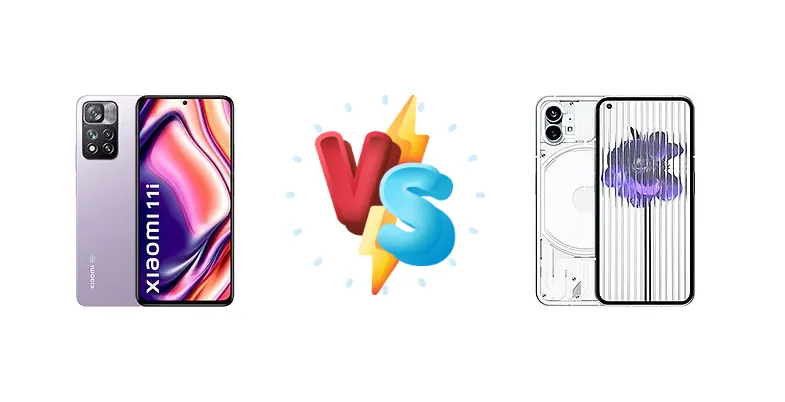
The Xiaomi 11i and Nothing Phone (1) represent distinct approaches to the mid-range smartphone market. The 11i, released earlier, focuses on delivering raw performance at an aggressive price point. The Nothing Phone (1), a newcomer, prioritizes design and a unique user experience with its Glyph Interface, alongside a more balanced feature set. This comparison dissects their key differences to determine which phone best suits your needs.
🏆 Quick Verdict
For users prioritizing raw processing power and incredibly fast 67W charging, the Xiaomi 11i is the clear winner. However, the Nothing Phone (1) offers a more refined experience with its distinctive design, wireless charging, and potentially better long-term software support, making it ideal for those valuing aesthetics and a unique ecosystem.
| Network |
|---|
| 2G bands | GSM 850 / 900 / 1800 / 1900 | GSM 850 / 900 / 1800 / 1900 |
| 3G bands | HSDPA 850 / 900 / 1900 / 2100 | HSDPA 800 / 850 / 900 / 1700(AWS) / 1900 / 2100 |
| 4G bands | 1, 3, 5, 8, 40, 41 | 1, 2, 3, 4, 5, 7, 8, 12, 17, 18, 19, 20, 26, 28, 32, 34, 38, 39, 40, 41, 66 |
| 5G bands | 1, 3, 5, 8, 28, 40, 77, 78 SA/NSA | 1, 3, 5, 7, 8, 20, 28, 38, 40, 41, 77, 78 SA/NSA |
| Speed | HSPA, LTE, 5G | HSPA, LTE, 5G |
| Technology | GSM / HSPA / LTE / 5G | GSM / HSPA / LTE / 5G |
| Launch |
|---|
| Announced | 2022, January 06 | 2022, July 12 |
| Status | Available. Released 2022, January 12 | Available. Released 2022, July 16 |
| Body |
|---|
| Build | Glass front (Gorilla Glass 5), glass back | Glass front (Gorilla Glass 5), glass back (Gorilla Glass 5), aluminum frame |
| Dimensions | 163.7 x 76.2 x 8.3 mm (6.44 x 3.00 x 0.33 in) | 159.2 x 75.8 x 8.3 mm (6.27 x 2.98 x 0.33 in) |
| SIM | Nano-SIM + Nano-SIM | Nano-SIM + Nano-SIM |
| Weight | 207 g (7.30 oz) | 193.5 g (6.84 oz) |
| | IP53, dust and splash resistant | - |
| Display |
|---|
| Protection | Corning Gorilla Glass 5 | Corning Gorilla Glass 5 |
| Resolution | 1080 x 2400 pixels, 20:9 ratio (~395 ppi density) | 1080 x 2400 pixels, 20:9 ratio (~402 ppi density) |
| Size | 6.67 inches, 107.4 cm2 (~86.1% screen-to-body ratio) | 6.55 inches, 103.6 cm2 (~85.8% screen-to-body ratio) |
| Type | AMOLED, 120Hz, HDR10, 700 nits, 1200 nits (peak) | OLED, 1B colors, 120Hz, 1440Hz PWM, HDR10+, 500 nits (typ), 1200 nits (peak) |
| Platform |
|---|
| CPU | Octa-core (2x2.5 GHz Cortex-A78 & 6x2.0 GHz Cortex-A55) | Octa-core (1x2.5 GHz Cortex-A78 & 3x2.4 GHz Cortex-A78 & 4x1.9 GHz Cortex-A55) |
| Chipset | Mediatek Dimensity 920 (6 nm) | Qualcomm SM7325-AE Snapdragon 778G+ 5G (6 nm) |
| GPU | Mali-G68 MC4 | Adreno 642L |
| OS | Android 11, upgradable to Android 12, MIUI 13 | Android 12, upgradable to Android 15, up to 3 major Android upgrades, Nothing OS 3.0 |
| Memory |
|---|
| Card slot | microSDXC (uses shared SIM slot) | No |
| Internal | 128GB 6GB RAM, 128GB 8GB RAM, 256GB 8GB RAM | 128GB 8GB RAM, 256GB 8GB RAM, 256GB 12GB RAM |
| | UFS 2.2 | - |
| Main Camera |
|---|
| Dual | - | 50 MP, f/1.9, 24mm (wide), 1/1.56", 1.0µm, PDAF, OIS
50 MP, f/2.2, 114˚ (ultrawide), 1/2.76", 0.64µm, AF |
| Features | LED flash, HDR, panorama | LED flash, panorama, HDR |
| Single | 16 MP, f/2.5, (wide), 1/3.06" 1.0µm | - |
| Triple | 108 MP, f/1.9, 26mm (wide), 1/1.52", 0.7µm, PDAF
8 MP, f/2.2, 120˚ (ultrawide), 1.0µm
2 MP (macro) | - |
| Video | 4K@30fps, 1080p@30/60/120fps, 720p@960fps | 4K@30fps, 1080p@30/60fps, gyro-EIS, live HDR |
| Selfie camera |
|---|
| Single | 16 MP, f/2.5, (wide), 1/3.06" 1.0µm | 16 MP, f/2.5, (wide), 1/3.1", 1.0µm |
| Video | 1080p@30fps | 1080p@30fps |
| Sound |
|---|
| 3.5mm jack | Yes | - |
| 35mm jack | Yes | No |
| Loudspeaker | Yes, with stereo speakers | Yes, with stereo speakers |
| | 24-bit/192kHz audio | - |
| Comms |
|---|
| Bluetooth | 5.2, A2DP, LE | 5.2, A2DP, LE |
| Infrared port | Yes | - |
| NFC | No | Yes |
| Positioning | GPS, GLONASS, BDS | GPS (L1), GLONASS (L1), BDS (B1I+B1c), GALILEO (E1), QZSS (L1) |
| Radio | No | No |
| USB | USB Type-C 2.0, OTG | USB Type-C 2.0, OTG |
| WLAN | Wi-Fi 802.11 a/b/g/n/ac/6, dual-band, Wi-Fi Direct | Wi-Fi 802.11 a/b/g/n/ac/6, dual-band |
| Features |
|---|
| Sensors | Fingerprint (side-mounted), accelerometer, gyro, proximity, compass | Fingerprint (under display, optical), accelerometer, proximity, gyro, compass |
| Battery |
|---|
| Charging | 67W wired, 50% in 13 min | 33W wired, PD3.0, QC4, 50% in 30 min, 100% in 70 min
15W wireless
5W reverse wireless |
| Type | Li-Po 5160 mAh | Li-Ion 4500 mAh (17.42 Wh) |
| Misc |
|---|
| Colors | Camo Green, Stealth Black, Purple Mist, Pacific Pearl | White, Black |
| Models | MZB0A5EIN | A063 |
| Price | About 330 EUR | $ 539.00 / £ 234.77 / € 249.95 / ₹ 17,990 |
| SAR | 0.82 W/kg (head) 0.61 W/kg (body) | 1.29 W/kg (head) 1.09 W/kg (body) |
| SAR EU | - | 0.99 W/kg (head) 1.48 W/kg (body) |
Xiaomi 11i
- Significantly faster 67W wired charging
- Potentially higher raw CPU performance in specific benchmarks
- Aggressive pricing for the hardware offered
- Lack of wireless charging
- Less distinctive design
- Potentially less optimized software updates
Nothing Phone (1)
- Unique Glyph Interface for notifications
- Wireless and reverse wireless charging
- Potentially better long-term software support
- Slower 33W wired charging
- Slightly lower peak CPU performance
- Higher price point
Display Comparison
The Nothing Phone (1) boasts a measured peak brightness of 663 nits, providing a visibly brighter experience in direct sunlight compared to the Xiaomi 11i (brightness data unavailable, but typically lower in this price bracket). While both likely utilize AMOLED panels for vibrant colors, the Nothing Phone (1)'s brightness advantage is a tangible benefit for outdoor visibility. The 11i’s display specs are less publicized, suggesting a more standard implementation, potentially impacting HDR content viewing. Bezels are comparable, but the Nothing Phone (1)'s flat display contributes to a more modern aesthetic.
Camera Comparison
Camera details beyond 'Photo/Video' for the Nothing Phone (1) are limited, but its marketing emphasizes computational photography. The Xiaomi 11i’s camera specs are unavailable, but phones in this segment typically feature a primary sensor around 64MP. The Nothing Phone (1)'s image processing style leans towards a more natural look, while Xiaomi often boosts saturation. The Snapdragon 778G+'s ISP (Image Signal Processor) is generally considered more advanced, potentially resulting in better dynamic range and low-light performance. The absence of detailed camera information for the 11i makes a definitive comparison difficult, but the Nothing Phone (1) likely holds an advantage in image quality.
Performance
Both phones employ 6nm process nodes, but the chipsets differ significantly. The Xiaomi 11i’s Mediatek Dimensity 920 features a dual-core Cortex-A78 setup (2x2.5 GHz) alongside six Cortex-A55 cores (6x2.0 GHz). The Nothing Phone (1) utilizes the Qualcomm Snapdragon 778G+ 5G, with a single Cortex-A78 core (1x2.5 GHz) but a triple cluster of Cortex-A78 cores (3x2.4 GHz) and four Cortex-A55 cores (4x1.9 GHz). This configuration gives the Nothing Phone (1) a potential edge in multi-threaded tasks and sustained performance, despite the slightly lower clock speed on the primary core. The Snapdragon 778G+ is also known for its efficient power consumption, potentially leading to better battery life. Both phones benefit from ample RAM, but the Nothing Phone (1) is more likely to receive optimized software updates from Nothing, further enhancing performance over time.
Battery Life
The Nothing Phone (1) boasts an endurance rating of 108 hours, indicating strong battery life. While the Xiaomi 11i’s battery capacity is unknown, its 67W wired charging is significantly faster than the Nothing Phone (1)'s 33W charging. The 11i can reach 50% charge in just 13 minutes, while the Nothing Phone (1) takes 30 minutes. The Nothing Phone (1) also offers 15W wireless charging and 5W reverse wireless charging, features absent on the Xiaomi 11i. This makes the Nothing Phone (1) more versatile for users who prefer wireless convenience, while the 11i excels in rapid top-ups.
Buying Guide
Buy the Xiaomi 11i if you need maximum performance for gaming or demanding applications and value the fastest possible wired charging. It’s the choice for power users on a tight budget. Buy the Nothing Phone (1) if you prefer a distinctive design, appreciate the convenience of wireless charging, and want a phone that stands out from the crowd, even if it means sacrificing some peak performance.
Frequently Asked Questions
❓ Does the Dimensity 920 in the Xiaomi 11i throttle under sustained gaming loads?
The Dimensity 920 is a capable chipset, but its thermal management in the Xiaomi 11i is a potential concern. While it delivers strong peak performance, prolonged gaming sessions may lead to throttling, reducing frame rates over time. The Snapdragon 778G+ in the Nothing Phone (1) is generally more efficient and less prone to throttling.
❓ How useful is the Glyph Interface on the Nothing Phone (1) in everyday use?
The Glyph Interface is a polarizing feature. It provides visual cues for notifications, charging progress, and calls, but its usefulness depends on individual preferences. Some users find it distracting, while others appreciate the unique and customizable notification system. It's a key differentiator for the Nothing Phone (1) and adds to its distinctive identity.
❓ Is the 33W charging on the Nothing Phone (1) slow compared to the Xiaomi 11i's 67W?
Yes, 33W is considerably slower than 67W. The Xiaomi 11i can reach 50% charge in 13 minutes, while the Nothing Phone (1) takes 30 minutes. However, the Nothing Phone (1) compensates with wireless charging, offering added convenience. If rapid charging is a priority, the Xiaomi 11i is the better choice.