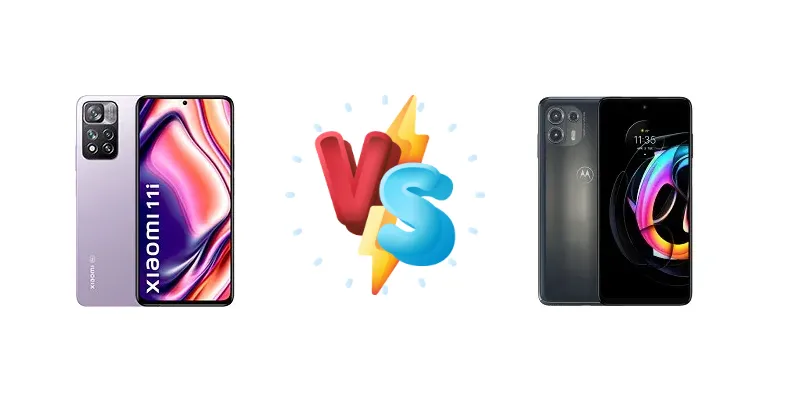
The Xiaomi 11i and Motorola Edge 20 Fusion represent compelling options in the increasingly competitive mid-range smartphone market. While both aim to deliver a balanced experience, they take different approaches to performance and charging speed. This comparison dissects their key specifications to determine which device best suits your needs.
🏆 Quick Verdict
For most users, the Xiaomi 11i emerges as the stronger contender. Its Mediatek Dimensity 920 chipset offers a noticeable performance advantage over the Edge 20 Fusion’s Dimensity 800U, and the blazing-fast 67W charging significantly reduces downtime. While the Edge 20 Fusion offers a respectable experience, the 11i provides more power for the price.
| Network |
|---|
| 2G bands | GSM 850 / 900 / 1800 / 1900 | GSM 850 / 900 / 1800 / 1900 |
| 3G bands | HSDPA 850 / 900 / 1900 / 2100 | HSDPA 850 / 900 / 1700(AWS) / 1900 / 2100 |
| 4G bands | 1, 3, 5, 8, 40, 41 | 1, 2, 3, 4, 5, 7, 8, 12, 13, 17, 18, 19, 20, 26, 28, 32, 34, 38, 39, 40, 41, 42, 43, 66 |
| 5G bands | 1, 3, 5, 8, 28, 40, 77, 78 SA/NSA | 1, 3, 5, 7, 8, 20, 28, 38, 40, 41, 77, 78, 66 SA/NSA/Sub6 |
| Speed | HSPA, LTE, 5G | HSPA 42.2/5.76 Mbps, LTE Cat18 1200/150 Mbps, 5G |
| Technology | GSM / HSPA / LTE / 5G | GSM / HSPA / LTE / 5G |
| Launch |
|---|
| Announced | 2022, January 06 | 2021, August 17 |
| Status | Available. Released 2022, January 12 | Available. Released 2021, August 27 |
| Body |
|---|
| Build | Glass front (Gorilla Glass 5), glass back | Glass front |
| Dimensions | 163.7 x 76.2 x 8.3 mm (6.44 x 3.00 x 0.33 in) | 166 x 76 x 8.3 mm (6.54 x 2.99 x 0.33 in) |
| SIM | Nano-SIM + Nano-SIM | Nano-SIM + Nano-SIM |
| Weight | 207 g (7.30 oz) | 185 g (6.53 oz) |
| | IP53, dust and splash resistant | Water-repellent design |
| Display |
|---|
| Protection | Corning Gorilla Glass 5 | - |
| Resolution | 1080 x 2400 pixels, 20:9 ratio (~395 ppi density) | 1080 x 2400 pixels, 20:9 ratio (~393 ppi density) |
| Size | 6.67 inches, 107.4 cm2 (~86.1% screen-to-body ratio) | 6.7 inches, 108.4 cm2 (~85.9% screen-to-body ratio) |
| Type | AMOLED, 120Hz, HDR10, 700 nits, 1200 nits (peak) | OLED, 1B colors, 90Hz, HDR10+ |
| Platform |
|---|
| CPU | Octa-core (2x2.5 GHz Cortex-A78 & 6x2.0 GHz Cortex-A55) | Octa-core (2x2.4 GHz Cortex-A76 & 6x2.0 GHz Cortex-A55) |
| Chipset | Mediatek Dimensity 920 (6 nm) | Mediatek Dimensity 800U (7 nm) |
| GPU | Mali-G68 MC4 | Mali-G57 MC3 |
| OS | Android 11, upgradable to Android 12, MIUI 13 | Android 11 |
| Memory |
|---|
| Card slot | microSDXC (uses shared SIM slot) | microSDXC |
| Internal | 128GB 6GB RAM, 128GB 8GB RAM, 256GB 8GB RAM | 128GB 6GB RAM, 128GB 8GB RAM |
| | UFS 2.2 | - |
| Main Camera |
|---|
| Features | LED flash, HDR, panorama | LED flash, HDR, panorama |
| Single | 16 MP, f/2.5, (wide), 1/3.06" 1.0µm | - |
| Triple | 108 MP, f/1.9, 26mm (wide), 1/1.52", 0.7µm, PDAF
8 MP, f/2.2, 120˚ (ultrawide), 1.0µm
2 MP (macro) | 108 MP, f/1.9, (wide), 1/1.52", 0.7µm, PDAF
8 MP, f/2.2, 118˚ (ultrawide)
Auxiliary lens |
| Video | 4K@30fps, 1080p@30/60/120fps, 720p@960fps | 4K@30fps, 1080p@30/60/120fps, gyro-EIS |
| Selfie camera |
|---|
| Features | - | HDR |
| Single | 16 MP, f/2.5, (wide), 1/3.06" 1.0µm | 32 MP, f/2.3, (wide), 0.7µm |
| Video | 1080p@30fps | 1080p@30fps |
| Sound |
|---|
| 3.5mm jack | Yes | Yes |
| 35mm jack | Yes | Yes |
| Loudspeaker | Yes, with stereo speakers | Yes |
| | 24-bit/192kHz audio | - |
| Comms |
|---|
| Bluetooth | 5.2, A2DP, LE | 5.0, A2DP, LE |
| Infrared port | Yes | - |
| NFC | No | Yes |
| Positioning | GPS, GLONASS, BDS | GPS, GLONASS, GALILEO |
| Radio | No | FM radio |
| USB | USB Type-C 2.0, OTG | USB Type-C 2.0 |
| WLAN | Wi-Fi 802.11 a/b/g/n/ac/6, dual-band, Wi-Fi Direct | Wi-Fi 802.11 a/b/g/n/ac, dual-band, Wi-Fi Direct |
| Features |
|---|
| Sensors | Fingerprint (side-mounted), accelerometer, gyro, proximity, compass | Fingerprint (side-mounted), accelerometer, gyro, proximity, compass |
| Battery |
|---|
| Charging | 67W wired, 50% in 13 min | 30W wired |
| Type | Li-Po 5160 mAh | Li-Po 5000 mAh |
| Misc |
|---|
| Colors | Camo Green, Stealth Black, Purple Mist, Pacific Pearl | Electric Graphite, Cyber Teal |
| Models | MZB0A5EIN | - |
| Price | About 330 EUR | About 250 EUR |
| SAR | 0.82 W/kg (head) 0.61 W/kg (body) | - |
Xiaomi 11i
- Significantly faster 67W charging
- More powerful Mediatek Dimensity 920 chipset
- Potentially better image processing due to ISP capabilities
- Xiaomi’s MIUI software can be polarizing
- Display details (refresh rate, panel type) are unknown
Motorola Edge 20 Fusion
- Potentially cleaner software experience with Motorola’s near-stock Android
- 7nm process may offer slightly better efficiency
- Generally more understated design
- Slower 30W charging
- Less powerful Mediatek Dimensity 800U chipset
- Camera performance likely lags behind the Xiaomi 11i
Display Comparison
Neither device boasts a standout display. While specific panel details (like OLED vs LCD) are missing, the focus here is on performance. The lack of high refresh rate information suggests both likely operate at 60Hz. The real differentiator will be color accuracy and peak brightness, which are not specified. However, given Motorola’s history, the Edge 20 Fusion may lean towards more natural color calibration, while Xiaomi often boosts saturation.
Camera Comparison
Without detailed camera specs beyond the chipsets, a direct comparison is limited. However, the Dimensity 920 generally supports more advanced image signal processors (ISPs), potentially leading to better image processing in the Xiaomi 11i. Motorola often focuses on software-based image enhancement, but the 11i’s chipset has the potential for superior dynamic range and low-light performance. The absence of information regarding sensor size and OIS makes a definitive judgment impossible, but the chipset advantage leans towards the Xiaomi.
Performance
The Xiaomi 11i’s Mediatek Dimensity 920 (6nm) holds a clear advantage over the Motorola Edge 20 Fusion’s Dimensity 800U (7nm). The 920 utilizes Cortex-A78 cores clocked at 2.5 GHz, compared to the 800U’s Cortex-A76 cores at 2.4 GHz. This, combined with the more modern 6nm process, translates to better sustained performance and efficiency. While the 800U is capable, the 920 will handle demanding games and multitasking with greater ease. The 6nm node also implies better thermal management, potentially reducing throttling during extended gaming sessions. The RAM configuration (not specified) will also play a role, but the chipset difference is the primary factor.
Battery Life
The Xiaomi 11i’s 67W wired charging is a game-changer. Claimed 50% charge in 13 minutes is significantly faster than the Motorola Edge 20 Fusion’s 30W charging. While battery capacity isn’t specified for either device, the faster charging of the 11i mitigates any potential capacity disadvantage. Users who frequently top up their phones will greatly appreciate the 11i’s speed. The 800U’s 7nm process *might* offer slightly better efficiency, but the charging speed difference is more impactful for the average user.
Buying Guide
Buy the Xiaomi 11i if you prioritize raw performance for gaming and demanding applications, and value incredibly fast charging. You'll benefit from a smoother experience and less time tethered to a wall outlet. Buy the Motorola Edge 20 Fusion if you prefer a more understated design and a potentially cleaner software experience, accepting a trade-off in processing power and charging speed. It's a solid all-rounder for everyday tasks.
Frequently Asked Questions
❓ Will the Xiaomi 11i get noticeably hotter than the Motorola Edge 20 Fusion during extended gaming sessions?
While both phones have thermal management systems, the Xiaomi 11i’s Dimensity 920, despite being more powerful, is built on a 6nm process. This generally leads to better thermal efficiency compared to the 7nm Dimensity 800U in the Edge 20 Fusion. However, sustained peak performance on the 11i will still generate heat, but it's likely to be managed more effectively, reducing the risk of severe throttling.
❓ Is the 30W charging on the Motorola Edge 20 Fusion slow compared to modern standards?
Yes, 30W charging is considered relatively slow in today’s smartphone market, especially when compared to the Xiaomi 11i’s 67W charging. While 30W is still usable, it will take considerably longer to fully charge the Edge 20 Fusion, potentially taking over an hour and a half for a full charge from 0%.
❓ Does the Xiaomi 11i’s MIUI software have a lot of bloatware?
MIUI is known for including pre-installed apps (bloatware). While Xiaomi has reduced this in recent versions, users can still expect to find several apps they may not need. Fortunately, many of these can be uninstalled or disabled, but it requires some initial effort.