
Xiaomi 11i HyperCharge 5G vs Xiaomi Redmi Note 12 Pro: The Ultimate Showdown
| Phones Images | |||||
|---|---|---|---|---|---|
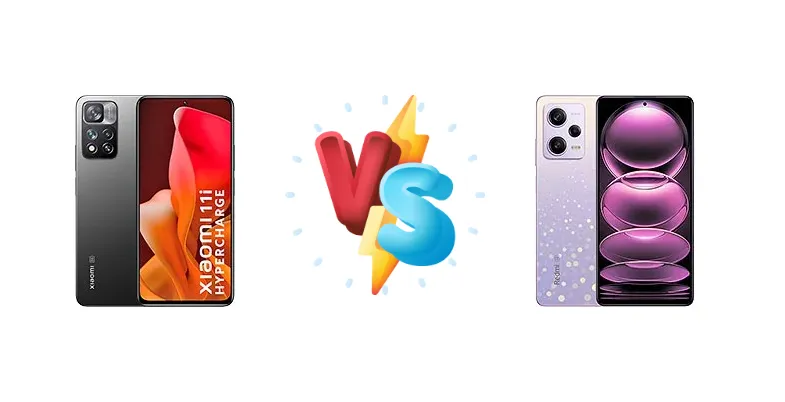
|
🏆 Quick Verdict
The Xiaomi 11i HyperCharge 5G takes the lead with its unmatched 120W charging speed, a significant advantage for those prioritizing quick top-ups. However, the Redmi Note 12 Pro offers a brighter display and potentially better camera performance, making it a strong contender for everyday users.
| PHONES | ||
|---|---|---|
| Phone Names | Xiaomi 11i HyperCharge 5G | Xiaomi Redmi Note 12 Pro |
| Network | ||
|---|---|---|
| 2G bands | GSM 850 / 900 / 1800 / 1900 | GSM 850 / 900 / 1800 / 1900 |
| 3G bands | HSDPA 850 / 900 / 1900 / 2100 | HSDPA 800 / 850 / 900 / 1900 / 2100 |
| 4G bands | 1, 3, 5, 8, 40, 41 | 1, 2, 3, 4, 5, 7, 8, 12, 13, 17, 18, 19, 20, 26, 28, 32, 38, 40, 41, 66 - International |
| 5G bands | 1, 3, 5, 8, 28, 40, 77, 78 SA/NSA | 1, 3, 5, 7, 8, 20, 28, 38, 40, 41, 66, 77, 78 SA/NSA - International |
| Speed | HSPA, LTE, 5G | HSPA, LTE, 5G |
| Technology | GSM / HSPA / LTE / 5G | GSM / CDMA / HSPA / EVDO / LTE / 5G |
| - | 1, 3, 5, 8, 28, 38, 41, 77, 78 SA/NSA - China | |
| Launch | ||
|---|---|---|
| Announced | 2022, January 06 | 2022, October 27 |
| Status | Available. Released 2022, January 12 | Available. Released 2022, November 01 |
| Body | ||
|---|---|---|
| Build | Glass front (Gorilla Glass 5), glass back | Glass front (Gorilla Glass 5), glass back, plastic frame |
| Dimensions | 163.7 x 76.2 x 8.3 mm (6.44 x 3.00 x 0.33 in) | 163 x 76 x 8 mm (6.42 x 2.99 x 0.31 in) |
| SIM | Nano-SIM + Nano-SIM | Nano-SIM + Nano-SIM |
| Weight | 204 g (7.20 oz) | 187 g (6.60 oz) |
| IP53, dust and splash resistant | IP53, dust and splash resistant | |
| Display | ||
|---|---|---|
| Protection | Corning Gorilla Glass 5 | Corning Gorilla Glass 5 |
| Resolution | 1080 x 2400 pixels, 20:9 ratio (~395 ppi density) | 1080 x 2400 pixels, 20:9 ratio (~395 ppi density) |
| Size | 6.67 inches, 107.4 cm2 (~86.1% screen-to-body ratio) | 6.67 inches, 107.4 cm2 (~86.7% screen-to-body ratio) |
| Type | AMOLED, 120Hz, 700 nits, 1200 nits (peak) | AMOLED, 1B colors, 120Hz, Dolby Vision, HDR10+, 500 nits (typ), 900 nits (HBM) |
| Platform | ||
|---|---|---|
| CPU | Octa-core (2x2.5 GHz Cortex-A78 & 6x2.0 GHz Cortex-A55) | Octa-core (2x2.6 GHz Cortex-A78 & 6x2.0 GHz Cortex-A55) |
| Chipset | Mediatek Dimensity 920 (6 nm) | Mediatek Dimensity 1080 (6 nm) |
| GPU | Mali-G68 MC4 | Mali-G68 MC4 |
| OS | Android 11, upgradable to Android 12, MIUI 13 | Android 12, MIUI 13 |
| Memory | ||
|---|---|---|
| Card slot | microSDXC (uses shared SIM slot) | No |
| Internal | 128GB 6GB RAM, 128GB 8GB RAM, 256GB 8GB RAM | 128GB 6GB RAM, 128GB 8GB RAM, 256GB 8GB RAM, 256GB 12GB RAM |
| UFS 2.2 | UFS 2.2 | |
| Main Camera | ||
|---|---|---|
| Features | LED flash, HDR, panorama | Dual-LED dual-tone flash, HDR, panorama |
| Single | 16 MP, f/2.5, (wide), 1/3.06" 1.0µm | - |
| Triple | 108 MP, f/1.9, 26mm (wide), 1/1.52", 0.7µm, PDAF 8 MP, f/2.2, 120˚ (ultrawide), 1.0µm 2 MP (macro) | 50 MP, f/1.9, 24mm (wide), 1/1.56", 1.0µm, PDAF, OIS 8 MP, f/2.2, 120˚ (ultrawide), 1/4.0", 1.12µm 2 MP (macro) |
| Video | 4K@30fps, 1080p@30/60/120fps, 720p@960fps | 4K@30fps, 1080p@30/60/120fps, 720p@960fps |
| Selfie camera | ||
|---|---|---|
| Features | - | HDR |
| Single | 16 MP, f/2.5, (wide), 1/3.06" 1.0µm | 16 MP, f/2.5, (wide), 1/3.06", 1.0µm |
| Video | 1080p@30fps | 1080p@30/60fps |
| Sound | ||
|---|---|---|
| 3.5mm jack | Yes | Yes |
| 35mm jack | Yes | Yes |
| Loudspeaker | Yes, with stereo speakers | Yes, with stereo speakers |
| 24-bit/192kHz audio | 24-bit/192kHz audio | |
| Comms | ||
|---|---|---|
| Bluetooth | 5.2, A2DP, LE | 5.2, A2DP, LE |
| Infrared port | Yes | Yes |
| NFC | No | Yes (market/region dependent) |
| Positioning | GPS, GLONASS, BDS | GPS (L1), GLONASS (G1), BDS (B1I+B1c), GALILEO (E1), QZSS (L1) |
| Radio | No | No |
| USB | USB Type-C 2.0, OTG | USB Type-C 2.0, OTG |
| WLAN | Wi-Fi 802.11 a/b/g/n/ac/6, dual-band, Wi-Fi Direct | Wi-Fi 802.11 a/b/g/n/ac/6, dual-band, Wi-Fi Direct |
| Features | ||
|---|---|---|
| Sensors | Fingerprint (side-mounted), accelerometer, gyro, proximity, compass | Fingerprint (side-mounted), accelerometer, gyro, proximity, compass |
| Battery | ||
|---|---|---|
| Charging | 120W wired, 100% in 15 min | 67W wired, PD3.0, 50% in 15 min, 100% in 46 min |
| Type | Li-Po 4500 mAh | Li-Po 5000 mAh |
| Misc | ||
|---|---|---|
| Colors | Camo Green, Stealth Black, Purple Mist, Pacific Pearl | Frosted Blue (Sky Blue), Onyx Black (Midnight Black), Polar White, Stardust Purple |
| Models | 21091116UI, MZB0A55IN | 22101316C, 22101316I, 23013RK75C, 22101316G |
| Price | About 300 EUR | € 148.54 / $ 142.17 / £ 149.99 / ₹ 19,999 |
| SAR | 0.82 W/kg (head) 0.61 W/kg (body) | 1.09 W/kg (head) 1.06 W/kg (body) |
| SAR EU | - | 0.99 W/kg (head) 0.99 W/kg (body) |
| Tests | ||
|---|---|---|
| Battery life | Endurance rating 106h | Endurance rating 97h |
| Camera | - | Photo / Video |
| Display | Contrast ratio: Infinite (nominal) | Contrast ratio: Infinite (nominal) |
| Loudspeaker | -25.2 LUFS (Very good) | -26.6 LUFS (Good) |
| Performance | AnTuTu: 375528 (v8), 437872 (v9) GeekBench: 2225 (v5.1) GFXBench: 22fps (ES 3.1 onscreen) | AnTuTu: 490526 (v9) GeekBench: 2209 (v5.1), 2372 (v6) GFXBench: 22fps (ES 3.1 onscreen) |
Xiaomi 11i HyperCharge 5G
- Blazing-fast 120W charging
- Excellent battery endurance
- Decent performance
- Stylish design
- Potentially less advanced camera
- Brightness data missing
- Dimensity 920 slightly less powerful than Dimensity 1080
Xiaomi Redmi Note 12 Pro
- Brighter display (890 nits)
- Likely better camera system
- Solid performance with Dimensity 1080
- Good value for money
- Slower 67W charging
- Slightly lower battery endurance compared to 11i
- Design may be less premium
Display Comparison
Both phones feature displays with a nominal 'infinite' contrast ratio, but the Redmi Note 12 Pro's measured 890 nits peak brightness gives it a noticeable edge in outdoor visibility. The 11i's display is likely vibrant, but lacks the quantifiable brightness data. Resolution and panel type (likely AMOLED for both) are assumed to be similar, offering good color accuracy and viewing angles.
Camera Comparison
While both phones offer 'Photo / Video' capabilities, the Redmi Note 12 Pro is generally expected to have a more advanced camera system, potentially including a higher resolution main sensor and improved image processing. The 11i's camera is competent, but likely doesn't match the Note 12 Pro's capabilities. Detailed camera tests would be needed for a definitive comparison.
Performance
The Dimensity 1080 in the Redmi Note 12 Pro offers a slight CPU clock speed advantage over the Dimensity 920 in the 11i. Both chipsets are based on a 6nm process and provide ample power for everyday tasks and moderate gaming. Real-world performance differences are likely minimal, with both phones handling multitasking and apps smoothly.
Battery Life
The Xiaomi 11i HyperCharge 5G's endurance rating of 106h is exceptionally high, suggesting excellent battery efficiency. The Redmi Note 12 Pro's active use score of 12:08h and endurance rating of 97h are still very respectable. However, the 11i's 120W charging blows the Note 12 Pro's 67W charging out of the water, allowing for incredibly fast recharge times.
Buying Guide
The Xiaomi 11i HyperCharge 5G is ideal for power users and those who frequently forget to charge their phones. The Redmi Note 12 Pro is a great choice for users seeking a balanced smartphone with a good display, camera, and solid performance for everyday tasks.