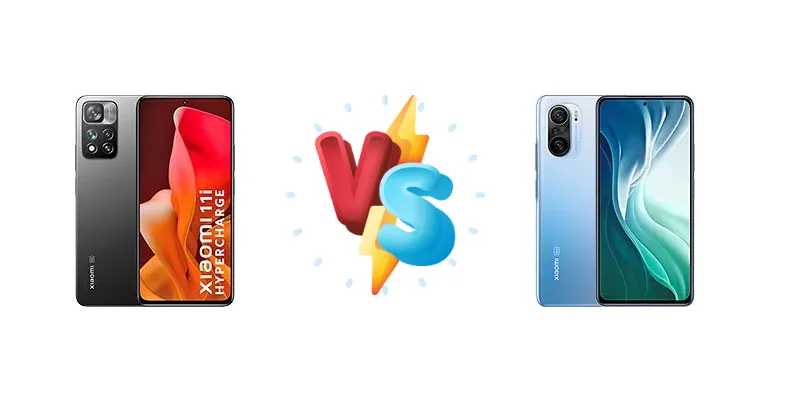
Xiaomi's lineup can be confusing, especially when similar models like the 11i HyperCharge and the Mi 11i exist. Both offer compelling features, but cater to slightly different priorities. This comprehensive comparison will dissect their strengths and weaknesses to help you make the right choice.
🏆 Quick Verdict
The Xiaomi 11i HyperCharge 5G takes the crown for charging speed and potentially battery longevity, while the Mi 11i boasts a superior Snapdragon 888 chipset and a brighter display. Ultimately, it depends on whether you prioritize blazing-fast charging or raw performance.
| Network |
|---|
| 2G bands | GSM 850 / 900 / 1800 / 1900 | GSM 850 / 900 / 1800 / 1900 |
| 3G bands | HSDPA 850 / 900 / 1900 / 2100 | HSDPA 850 / 900 / 1700(AWS) / 1900 / 2100 |
| 4G bands | 1, 3, 5, 8, 40, 41 | 1, 2, 3, 4, 5, 7, 8, 12, 17, 20, 28, 38, 40, 41, 66 |
| 5G bands | 1, 3, 5, 8, 28, 40, 77, 78 SA/NSA | 1, 3, 5, 7, 8, 20, 28, 38, 41, 77, 78 SA/NSA |
| Speed | HSPA, LTE, 5G | HSPA, LTE, 5G |
| Technology | GSM / HSPA / LTE / 5G | GSM / HSPA / LTE / 5G |
| Launch |
|---|
| Announced | 2022, January 06 | 2021, March 29 |
| Status | Available. Released 2022, January 12 | Available. Released 2021, May 31 |
| Body |
|---|
| Build | Glass front (Gorilla Glass 5), glass back | - |
| Dimensions | 163.7 x 76.2 x 8.3 mm (6.44 x 3.00 x 0.33 in) | 163.7 x 76.4 x 7.8 mm (6.44 x 3.01 x 0.31 in) |
| SIM | Nano-SIM + Nano-SIM | Nano-SIM + Nano-SIM |
| Weight | 204 g (7.20 oz) | 196 g (6.91 oz) |
| | IP53, dust and splash resistant | IP53, dust and splash resistant |
| Display |
|---|
| Protection | Corning Gorilla Glass 5 | Corning Gorilla Glass 5 |
| Resolution | 1080 x 2400 pixels, 20:9 ratio (~395 ppi density) | 1080 x 2400 pixels, 20:9 ratio (~395 ppi density) |
| Size | 6.67 inches, 107.4 cm2 (~86.1% screen-to-body ratio) | 6.67 inches, 107.4 cm2 (~85.9% screen-to-body ratio) |
| Type | AMOLED, 120Hz, 700 nits, 1200 nits (peak) | Super AMOLED, 120Hz, HDR10+, 900 nits (HBM), 1300 nits (peak) |
| Platform |
|---|
| CPU | Octa-core (2x2.5 GHz Cortex-A78 & 6x2.0 GHz Cortex-A55) | Octa-core (1x2.84 GHz Cortex-X1 & 3x2.42 GHz Cortex-A78 & 4x1.80 GHz Cortex-A55) |
| Chipset | Mediatek Dimensity 920 (6 nm) | Qualcomm SM8350 Snapdragon 888 5G (5 nm) |
| GPU | Mali-G68 MC4 | Adreno 660 |
| OS | Android 11, upgradable to Android 12, MIUI 13 | Android 11, MIUI 12 |
| Memory |
|---|
| Card slot | microSDXC (uses shared SIM slot) | No |
| Internal | 128GB 6GB RAM, 128GB 8GB RAM, 256GB 8GB RAM | 128GB 8GB RAM, 256GB 8GB RAM |
| | UFS 2.2 | UFS 3.1 |
| Main Camera |
|---|
| Features | LED flash, HDR, panorama | Color spectrum sensor, LED flash, HDR, panorama |
| Single | 16 MP, f/2.5, (wide), 1/3.06" 1.0µm | 20 MP, f/2.5, (wide), 1/3.4", 0.8µm |
| Triple | 108 MP, f/1.9, 26mm (wide), 1/1.52", 0.7µm, PDAF
8 MP, f/2.2, 120˚ (ultrawide), 1.0µm
2 MP (macro) | 108 MP, f/1.8, 26mm (wide), 1/1.52", 0.7µm, PDAF
8 MP, f/2.2, 119˚ (ultrawide)
5 MP, f/2.4, 50mm (telephoto macro), 1/5.0", 1.12µm, AF |
| Video | 4K@30fps, 1080p@30/60/120fps, 720p@960fps | 8K@30fps, 4K@30/60fps, 1080p@30/60/120/240/960fps, gyro-EIS, HDR10+ |
| Selfie camera |
|---|
| Features | - | HDR |
| Single | 16 MP, f/2.5, (wide), 1/3.06" 1.0µm | 20 MP, f/2.5, (wide), 1/3.4", 0.8µm |
| Video | 1080p@30fps | 1080p@30fps, 720p@120fps |
| Sound |
|---|
| 3.5mm jack | Yes | No |
| 35mm jack | Yes | No |
| Loudspeaker | Yes, with stereo speakers | Yes, with stereo speakers |
| | 24-bit/192kHz audio | 24-bit/192kHz audio |
| Comms |
|---|
| Bluetooth | 5.2, A2DP, LE | 5.2, A2DP, LE |
| Infrared port | Yes | Yes |
| NFC | No | Yes (market/region dependent) |
| Positioning | GPS, GLONASS, BDS | GPS (L1+L5), GLONASS (L1), BDS (B1I+B1c+B2a), GALILEO (E1+E5a), QZSS (L1+L5), NavIC (L5) |
| Radio | No | No |
| USB | USB Type-C 2.0, OTG | USB Type-C 2.0, OTG |
| WLAN | Wi-Fi 802.11 a/b/g/n/ac/6, dual-band, Wi-Fi Direct | Wi-Fi 802.11 a/b/g/n/ac/6, dual-band, Wi-Fi Direct |
| Features |
|---|
| Sensors | Fingerprint (side-mounted), accelerometer, gyro, proximity, compass | Fingerprint (side-mounted), accelerometer, gyro, proximity, compass, barometer |
| Battery |
|---|
| Charging | 120W wired, 100% in 15 min | 33W wired, PD3.0, QC3, 100% in 52 min |
| Type | Li-Po 4500 mAh | Li-Po 4520 mAh |
| Misc |
|---|
| Colors | Camo Green, Stealth Black, Purple Mist, Pacific Pearl | Celestial Silver, Frosty White, Cosmic Black |
| Models | 21091116UI, MZB0A55IN | M2012K11G |
| Price | About 300 EUR | About 230 EUR |
| SAR | 0.82 W/kg (head) 0.61 W/kg (body) | 0.95 W/kg (head) 0.74 W/kg (body) |
| SAR EU | - | 0.57 W/kg (head) 0.77 W/kg (body) |
| Tests |
|---|
| Battery life |
Endurance rating 106h
|
Endurance rating 96h
|
| Camera | - |
Photo / Video |
| Display |
Contrast ratio: Infinite (nominal) |
Contrast ratio: Infinite (nominal) |
| Loudspeaker |
-25.2 LUFS (Very good)
|
-26.0 LUFS (Very good)
|
| Performance |
AnTuTu: 375528 (v8), 437872 (v9)
GeekBench: 2225 (v5.1)
GFXBench: 22fps (ES 3.1 onscreen) |
AnTuTu: 690021 (v8)
GeekBench: 3641 (v5.1) |
Xiaomi 11i HyperCharge 5G
- Blazing-fast 120W charging
- Potentially longer battery life (106h endurance rating)
- Decent display quality
- Less powerful chipset (Dimensity 920)
- Camera performance potentially not as good as Mi 11i
- Display brightness lower than Mi 11i
Xiaomi Mi 11i
- Powerful Snapdragon 888 chipset
- Brighter display (939 nits)
- Good camera system (likely better image processing)
- Slower charging (33W)
- Slightly shorter battery life (96h endurance rating)
- Contrast ratio claim is generic
Display Comparison
The Xiaomi Mi 11i edges out the HyperCharge with a measured peak brightness of 939 nits, offering significantly better visibility in direct sunlight. While both claim an 'infinite' contrast ratio (a marketing term often used for OLED displays), the Mi 11i's higher brightness provides a more impactful visual experience. The HyperCharge's display is still good, but lacks the punch of the Mi 11i.
Camera Comparison
Both phones feature capable camera systems, but detailed camera specs are missing. Generally, the Mi 11i, with its Snapdragon 888, often benefits from better image processing and potentially improved low-light performance. The HyperCharge's camera is likely adequate, but not exceptional. Further testing would be needed for a definitive comparison.
Performance
Here, the Xiaomi Mi 11i is the clear winner. The Snapdragon 888 chipset is significantly more powerful than the Mediatek Dimensity 920. Expect smoother multitasking, faster app loading times, and better performance in demanding games. The Dimensity 920 is capable, but the 888 offers a noticeable upgrade.
Battery Life
The Xiaomi 11i HyperCharge boasts an impressive endurance rating of 106 hours, compared to the Mi 11i's 96 hours. However, this rating is based on a specific testing methodology and real-world usage can vary. The 120W wired charging on the HyperCharge is a game-changer, fully charging the phone in just 15 minutes, a massive advantage over the Mi 11i's 33W charging (52 minutes).
Buying Guide
The Xiaomi 11i HyperCharge 5G is ideal for users who value incredibly fast charging above all else and want extended battery life. The Xiaomi Mi 11i is a better choice for those seeking a smoother, more powerful experience thanks to the Snapdragon 888, and appreciate a brighter display for outdoor visibility.
Frequently Asked Questions
❓ Is the Xiaomi 11i HyperCharge worth the extra cost?
If fast charging is your top priority, then yes. The 120W charging is a significant advantage. However, if you value performance and a brighter display, the Mi 11i might be a better value.
❓ Which chipset is better, Dimensity 920 or Snapdragon 888?
The Snapdragon 888 is generally considered the more powerful chipset, offering better performance in demanding tasks and games.