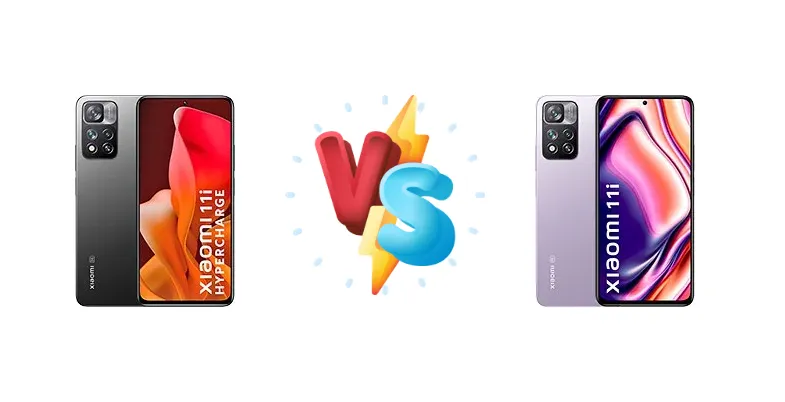
Xiaomi's 11i series offers compelling mid-range smartphones, but the HyperCharge variant introduces a significant charging upgrade. Choosing between the standard 11i and the HyperCharge model can be tricky. This comprehensive comparison will break down the differences to help you make the right decision.
🏆 Quick Verdict
The Xiaomi 11i HyperCharge 5G is the clear winner for those prioritizing incredibly fast charging. However, the standard Xiaomi 11i remains a strong contender, offering a more balanced package at a potentially lower price point. The core performance is identical.
| Network |
|---|
| 2G bands | GSM 850 / 900 / 1800 / 1900 | GSM 850 / 900 / 1800 / 1900 |
| 3G bands | HSDPA 850 / 900 / 1900 / 2100 | HSDPA 850 / 900 / 1900 / 2100 |
| 4G bands | 1, 3, 5, 8, 40, 41 | 1, 3, 5, 8, 40, 41 |
| 5G bands | 1, 3, 5, 8, 28, 40, 77, 78 SA/NSA | 1, 3, 5, 8, 28, 40, 77, 78 SA/NSA |
| Speed | HSPA, LTE, 5G | HSPA, LTE, 5G |
| Technology | GSM / HSPA / LTE / 5G | GSM / HSPA / LTE / 5G |
| Launch |
|---|
| Announced | 2022, January 06 | 2022, January 06 |
| Status | Available. Released 2022, January 12 | Available. Released 2022, January 12 |
| Body |
|---|
| Build | Glass front (Gorilla Glass 5), glass back | Glass front (Gorilla Glass 5), glass back |
| Dimensions | 163.7 x 76.2 x 8.3 mm (6.44 x 3.00 x 0.33 in) | 163.7 x 76.2 x 8.3 mm (6.44 x 3.00 x 0.33 in) |
| SIM | Nano-SIM + Nano-SIM | Nano-SIM + Nano-SIM |
| Weight | 204 g (7.20 oz) | 207 g (7.30 oz) |
| | IP53, dust and splash resistant | IP53, dust and splash resistant |
| Display |
|---|
| Protection | Corning Gorilla Glass 5 | Corning Gorilla Glass 5 |
| Resolution | 1080 x 2400 pixels, 20:9 ratio (~395 ppi density) | 1080 x 2400 pixels, 20:9 ratio (~395 ppi density) |
| Size | 6.67 inches, 107.4 cm2 (~86.1% screen-to-body ratio) | 6.67 inches, 107.4 cm2 (~86.1% screen-to-body ratio) |
| Type | AMOLED, 120Hz, 700 nits, 1200 nits (peak) | AMOLED, 120Hz, HDR10, 700 nits, 1200 nits (peak) |
| Platform |
|---|
| CPU | Octa-core (2x2.5 GHz Cortex-A78 & 6x2.0 GHz Cortex-A55) | Octa-core (2x2.5 GHz Cortex-A78 & 6x2.0 GHz Cortex-A55) |
| Chipset | Mediatek Dimensity 920 (6 nm) | Mediatek Dimensity 920 (6 nm) |
| GPU | Mali-G68 MC4 | Mali-G68 MC4 |
| OS | Android 11, upgradable to Android 12, MIUI 13 | Android 11, upgradable to Android 12, MIUI 13 |
| Memory |
|---|
| Card slot | microSDXC (uses shared SIM slot) | microSDXC (uses shared SIM slot) |
| Internal | 128GB 6GB RAM, 128GB 8GB RAM, 256GB 8GB RAM | 128GB 6GB RAM, 128GB 8GB RAM, 256GB 8GB RAM |
| | UFS 2.2 | UFS 2.2 |
| Main Camera |
|---|
| Features | LED flash, HDR, panorama | LED flash, HDR, panorama |
| Single | 16 MP, f/2.5, (wide), 1/3.06" 1.0µm | 16 MP, f/2.5, (wide), 1/3.06" 1.0µm |
| Triple | 108 MP, f/1.9, 26mm (wide), 1/1.52", 0.7µm, PDAF
8 MP, f/2.2, 120˚ (ultrawide), 1.0µm
2 MP (macro) | 108 MP, f/1.9, 26mm (wide), 1/1.52", 0.7µm, PDAF
8 MP, f/2.2, 120˚ (ultrawide), 1.0µm
2 MP (macro) |
| Video | 4K@30fps, 1080p@30/60/120fps, 720p@960fps | 4K@30fps, 1080p@30/60/120fps, 720p@960fps |
| Selfie camera |
|---|
| Single | 16 MP, f/2.5, (wide), 1/3.06" 1.0µm | 16 MP, f/2.5, (wide), 1/3.06" 1.0µm |
| Video | 1080p@30fps | 1080p@30fps |
| Sound |
|---|
| 3.5mm jack | Yes | Yes |
| 35mm jack | Yes | Yes |
| Loudspeaker | Yes, with stereo speakers | Yes, with stereo speakers |
| | 24-bit/192kHz audio | 24-bit/192kHz audio |
| Comms |
|---|
| Bluetooth | 5.2, A2DP, LE | 5.2, A2DP, LE |
| Infrared port | Yes | Yes |
| NFC | No | No |
| Positioning | GPS, GLONASS, BDS | GPS, GLONASS, BDS |
| Radio | No | No |
| USB | USB Type-C 2.0, OTG | USB Type-C 2.0, OTG |
| WLAN | Wi-Fi 802.11 a/b/g/n/ac/6, dual-band, Wi-Fi Direct | Wi-Fi 802.11 a/b/g/n/ac/6, dual-band, Wi-Fi Direct |
| Features |
|---|
| Sensors | Fingerprint (side-mounted), accelerometer, gyro, proximity, compass | Fingerprint (side-mounted), accelerometer, gyro, proximity, compass |
| Battery |
|---|
| Charging | 120W wired, 100% in 15 min | 67W wired, 50% in 13 min |
| Type | Li-Po 4500 mAh | Li-Po 5160 mAh |
| Misc |
|---|
| Colors | Camo Green, Stealth Black, Purple Mist, Pacific Pearl | Camo Green, Stealth Black, Purple Mist, Pacific Pearl |
| Models | 21091116UI, MZB0A55IN | MZB0A5EIN |
| Price | About 300 EUR | About 330 EUR |
| SAR | 0.82 W/kg (head) 0.61 W/kg (body) | 0.82 W/kg (head) 0.61 W/kg (body) |
| Tests |
|---|
| Battery life |
Endurance rating 106h
| - |
| Display |
Contrast ratio: Infinite (nominal) | - |
| Loudspeaker |
-25.2 LUFS (Very good)
| - |
| Performance |
AnTuTu: 375528 (v8), 437872 (v9)
GeekBench: 2225 (v5.1)
GFXBench: 22fps (ES 3.1 onscreen) | - |
Xiaomi 11i HyperCharge 5G
- Incredibly fast 120W charging
- Vibrant AMOLED display
- Solid performance with Dimensity 920
- Good camera system
- Potentially higher price
- May not offer significant performance gains over standard 11i
Xiaomi 11i
- More affordable
- Vibrant AMOLED display
- Solid performance with Dimensity 920
- Good camera system
- Still relatively fast 67W charging
- Slower charging compared to HyperCharge
- May lack some premium features
Display Comparison
Both phones feature a 6.67-inch AMOLED display with a 120Hz refresh rate and a Full HD+ resolution. While the 'Infinite' contrast ratio mentioned for the HyperCharge is likely a marketing term, both displays should offer vibrant colors and deep blacks. Expect excellent viewing angles and smooth scrolling on both devices.
Camera Comparison
Both phones typically feature a triple-camera setup, likely including a 108MP main sensor, an 8MP ultrawide lens, and a 2MP macro lens. Image quality should be comparable in most scenarios, with slight variations potentially arising from software processing differences. Low-light performance should be adequate.
Performance
Under the hood, both devices share the same Mediatek Dimensity 920 chipset and octa-core CPU. This means you can expect similar performance in everyday tasks, gaming, and multitasking. Differences in real-world performance will likely be minimal and depend more on software optimization.
Battery Life
This is where the biggest difference lies. The Xiaomi 11i HyperCharge 5G boasts a 120W wired charging capability, allowing it to charge from 0% to 50% in just 15 minutes. The standard Xiaomi 11i has a 67W wired charging, taking around 13 minutes to reach 50%. Battery capacity is likely similar (around 4500-5000mAh), so the HyperCharge variant offers significantly faster replenishment.
Buying Guide
The Xiaomi 11i HyperCharge 5G is ideal for users who value speed and convenience above all else, especially those who frequently forget to charge their phones. The Xiaomi 11i is a great choice for budget-conscious buyers who don't need the extreme charging speeds but still want a solid mid-range phone.
Frequently Asked Questions
❓ Is the Dimensity 920 a good chipset?
Yes, the Dimensity 920 is a capable mid-range chipset that provides smooth performance for most tasks and even handles some gaming well.
❓ How much does the Xiaomi 11i HyperCharge 5G cost?
The price of the Xiaomi 11i HyperCharge 5G varies depending on storage configuration and region, but it typically sits in the mid-range price bracket, slightly higher than the standard 11i.