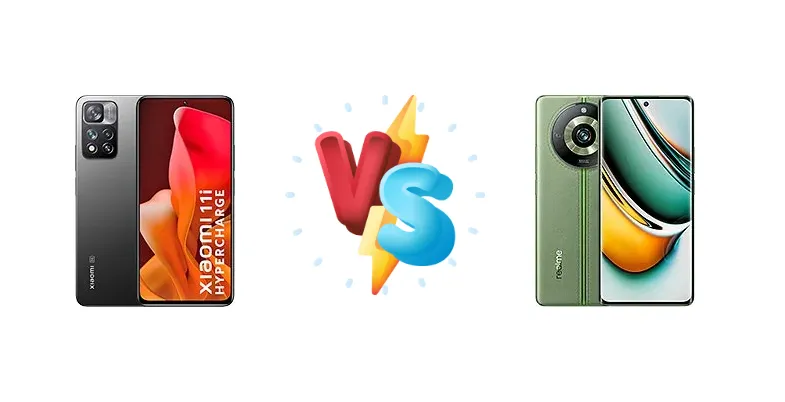
The mid-range smartphone market is fiercely competitive, and the Xiaomi 11i HyperCharge 5G and Realme 11 Pro are two strong contenders. Both offer compelling features at attractive price points, but which one truly delivers the best overall experience? Let's dive into a detailed comparison to help you decide.
🏆 Quick Verdict
The Xiaomi 11i HyperCharge 5G boasts significantly faster charging and a potentially more powerful chipset. However, the Realme 11 Pro offers a brighter display and potentially better camera performance. Ultimately, the choice depends on your priorities: speed and power versus display quality and photography.
| Network |
|---|
| 2G bands | GSM 850 / 900 / 1800 / 1900 | GSM 850 / 900 / 1800 / 1900 |
| 3G bands | HSDPA 850 / 900 / 1900 / 2100 | HSDPA 850 / 900 / 2100 |
| 4G bands | 1, 3, 5, 8, 40, 41 | 1, 3, 5, 7, 8, 28, 40, 41 - International |
| 5G bands | 1, 3, 5, 8, 28, 40, 77, 78 SA/NSA | 1, 3, 5, 8, 28, 40, 41, 77, 78 SA/NSA - International |
| Speed | HSPA, LTE, 5G | HSPA, LTE, 5G |
| Technology | GSM / HSPA / LTE / 5G | GSM / CDMA / HSPA / CDMA2000 / LTE / 5G |
| | - | CDMA2000 1x |
| Launch |
|---|
| Announced | 2022, January 06 | 2023, May 10 |
| Status | Available. Released 2022, January 12 | Available. Released 2023, May 15 |
| Body |
|---|
| Build | Glass front (Gorilla Glass 5), glass back | Glass front, leather or plastic back, plastic frame |
| Dimensions | 163.7 x 76.2 x 8.3 mm (6.44 x 3.00 x 0.33 in) | 161.7 x 73.9 x 8.2 mm or 8.8 mm |
| SIM | Nano-SIM + Nano-SIM | Nano-SIM + Nano-SIM |
| Weight | 204 g (7.20 oz) | 183 g or 189 g (6.46 oz) |
| | IP53, dust and splash resistant | - |
| Display |
|---|
| Protection | Corning Gorilla Glass 5 | - |
| Resolution | 1080 x 2400 pixels, 20:9 ratio (~395 ppi density) | 1080 x 2412 pixels, 20:9 ratio (~394 ppi density) |
| Size | 6.67 inches, 107.4 cm2 (~86.1% screen-to-body ratio) | 6.7 inches, 108.0 cm2 (~90.4% screen-to-body ratio) |
| Type | AMOLED, 120Hz, 700 nits, 1200 nits (peak) | AMOLED, 1B colors, HDR10+, 120Hz, 950 nits (peak) |
| Platform |
|---|
| CPU | Octa-core (2x2.5 GHz Cortex-A78 & 6x2.0 GHz Cortex-A55) | Octa-core (2x2.6 GHz Cortex-A78 & 6x2.0 GHz Cortex-A55) |
| Chipset | Mediatek Dimensity 920 (6 nm) | Mediatek Dimensity 7050 (6 nm) |
| GPU | Mali-G68 MC4 | Mali-G68 MC4 |
| OS | Android 11, upgradable to Android 12, MIUI 13 | Android 13, up to 2 major Android upgrades, Realme UI 5.0 |
| Memory |
|---|
| Card slot | microSDXC (uses shared SIM slot) | No |
| Internal | 128GB 6GB RAM, 128GB 8GB RAM, 256GB 8GB RAM | 128GB 8GB RAM, 256GB 8GB RAM, 256GB 12GB RAM, 512GB 12GB RAM |
| | UFS 2.2 | - |
| Main Camera |
|---|
| Dual | - | 100 MP, f/1.8, 26mm (wide), PDAF, OIS
Auxiliary lens |
| Features | LED flash, HDR, panorama | LED flash, HDR, panorama |
| Single | 16 MP, f/2.5, (wide), 1/3.06" 1.0µm | - |
| Triple | 108 MP, f/1.9, 26mm (wide), 1/1.52", 0.7µm, PDAF
8 MP, f/2.2, 120˚ (ultrawide), 1.0µm
2 MP (macro) | - |
| Video | 4K@30fps, 1080p@30/60/120fps, 720p@960fps | 4K@30fps, 1080p@30/60/120/480fps, 720p@960fps, gyro-EIS |
| Selfie camera |
|---|
| Features | - | Panorama |
| Single | 16 MP, f/2.5, (wide), 1/3.06" 1.0µm | 16 MP, f/2.5, 25mm (wide) |
| Video | 1080p@30fps | 1080p@30fps |
| Sound |
|---|
| 3.5mm jack | Yes | No |
| 35mm jack | Yes | No |
| Loudspeaker | Yes, with stereo speakers | Yes, with stereo speakers |
| | 24-bit/192kHz audio | 24-bit/192kHz audio |
| Comms |
|---|
| Bluetooth | 5.2, A2DP, LE | 5.2, A2DP, LE, aptX HD |
| Infrared port | Yes | - |
| NFC | No | Yes (market/region dependent) |
| Positioning | GPS, GLONASS, BDS | GPS, GALILEO, GLONASS, BDS, QZSS |
| Radio | No | No |
| USB | USB Type-C 2.0, OTG | USB Type-C 2.0 |
| WLAN | Wi-Fi 802.11 a/b/g/n/ac/6, dual-band, Wi-Fi Direct | Wi-Fi 802.11 a/b/g/n/ac/6, dual-band |
| Features |
|---|
| Sensors | Fingerprint (side-mounted), accelerometer, gyro, proximity, compass | Fingerprint (under display, optical), accelerometer, gyro, proximity, compass |
| Battery |
|---|
| Charging | 120W wired, 100% in 15 min | 67W wired |
| Type | Li-Po 4500 mAh | 5000 mAh |
| Misc |
|---|
| Colors | Camo Green, Stealth Black, Purple Mist, Pacific Pearl | Astral Black, Sunrise Beige, Oasis Green |
| Models | 21091116UI, MZB0A55IN | RMX3771 |
| Price | About 300 EUR | € 294.90 / ₹ 21,999 |
| SAR | 0.82 W/kg (head) 0.61 W/kg (body) | - |
| Tests |
|---|
| Battery life |
Endurance rating 106h
| - |
| Display |
Contrast ratio: Infinite (nominal) | - |
| Loudspeaker |
-25.2 LUFS (Very good)
| - |
| Performance |
AnTuTu: 375528 (v8), 437872 (v9)
GeekBench: 2225 (v5.1)
GFXBench: 22fps (ES 3.1 onscreen) | - |
Xiaomi 11i HyperCharge 5G
- Incredibly fast 120W charging
- Potentially more powerful chipset (Dimensity 920)
- Good value for money
- Solid build quality
- 'Infinite' contrast ratio claim is vague
- Camera may not be as good as Realme's
- Design might be less premium
Realme 11 Pro
- Brighter display (790 nits)
- Potentially better camera system
- Sleek and modern design
- Excellent battery life
- Slower charging (67W)
- Chipset slightly less powerful (Dimensity 7050)
- May be slightly more expensive
Display Comparison
The Realme 11 Pro takes the lead here with a measured peak brightness of 790 nits, offering a significantly more visible screen in bright sunlight. While the Xiaomi 11i HyperCharge 5G advertises an 'infinite' contrast ratio (likely a marketing term), the Realme's quantifiable brightness provides a tangible advantage. Both phones likely feature AMOLED panels with vibrant colors and deep blacks.
Camera Comparison
The Realme 11 Pro is expected to have a more versatile camera system, likely including a higher resolution main sensor and potentially improved image processing. While specific camera specs are not fully detailed, Realme has a reputation for strong camera performance in this price range. The Xiaomi 11i's camera is likely competent but may not match the Realme's capabilities.
Performance
The Xiaomi 11i HyperCharge 5G's Dimensity 920 generally edges out the Realme 11 Pro's Dimensity 7050 in raw performance benchmarks. While both are capable of handling everyday tasks and gaming, the 920 offers a slight advantage for demanding applications and multitasking. However, real-world performance differences may be minimal for most users.
Battery Life
Both phones offer impressive battery life. The Xiaomi 11i HyperCharge 5G boasts an endurance rating of 106 hours, while the Realme 11 Pro achieves 112 hours. Active use scores show 13:14h for the Realme. The Xiaomi 11i's standout feature is its 120W wired charging, which can fully charge the phone in just 15 minutes – a significant advantage over the Realme's 67W charging.
Buying Guide
The Xiaomi 11i HyperCharge 5G is ideal for users who prioritize incredibly fast charging and raw processing power. The Realme 11 Pro is a better choice for those who value a vibrant display, a versatile camera system, and a more refined overall design.
Frequently Asked Questions
❓ Which phone has better battery life?
Both offer excellent battery life, with the Realme 11 Pro showing a slight edge in endurance ratings and active use scores. However, the Xiaomi 11i HyperCharge 5G's incredibly fast charging makes up for any difference in longevity.
❓ Is the Xiaomi 11i HyperCharge 5G good for gaming?
Yes, the Dimensity 920 chipset is capable of handling most mobile games smoothly. However, the Realme 11 Pro's Dimensity 7050 is also a competent performer for gaming.