
Xiaomi 11 Lite 5G NE vs Xiaomi 13 Lite: A Head-to-Head Showdown
| Phones Images | |||||
|---|---|---|---|---|---|
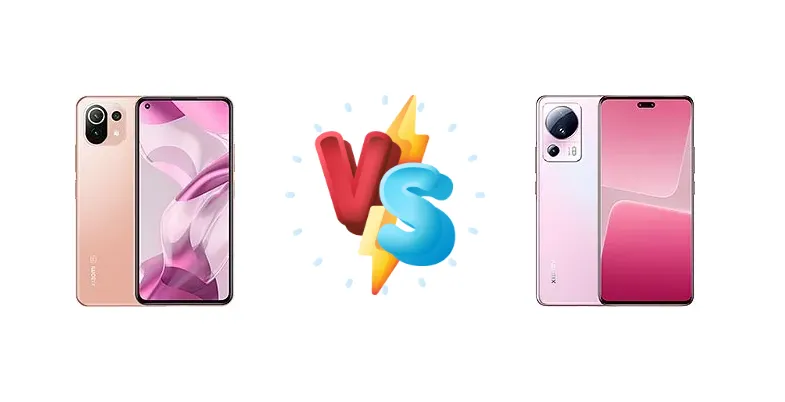
|
🏆 Quick Verdict
The Xiaomi 13 Lite emerges as the clear winner thanks to its significantly faster charging, brighter display, and more modern chipset. While the 11 Lite 5G NE boasts impressive battery endurance, the 13 Lite's overall improvements make it the better choice for most users.
| PHONES | ||
|---|---|---|
| Phone Names | Xiaomi 11 Lite 5G NE | Xiaomi 13 Lite |
| Network | ||
|---|---|---|
| 2G bands | GSM 850 / 900 / 1800 / 1900 | GSM 850 / 900 / 1800 / 1900 |
| 3G bands | HSDPA 850 / 900 / 1700(AWS) / 1900 / 2100 | HSDPA 800 / 850 / 900 / 1700(AWS) / 1900 / 2100 |
| 4G bands | 1, 2, 3, 4, 5, 7, 8, 12, 13, 17, 18, 19, 20, 26, 28, 32, 38, 40, 41, 42, 66 | 1, 2, 3, 4, 5, 7, 8, 12, 13, 17, 18, 19, 20, 26, 28, 32, 38, 40, 41, 42, 66 |
| 5G bands | 1, 3, 5, 7, 8, 20, 26, 38, 41, 66, 77, 78 SA/NSA | 1, 3, 5, 7, 8, 20, 28, 38, 40, 41, 66, 77, 78 SA/NSA |
| Speed | HSPA, LTE, 5G | HSPA, LTE, 5G |
| Technology | GSM / HSPA / LTE / 5G | GSM / HSPA / LTE / 5G |
| Launch | ||
|---|---|---|
| Announced | 2021, September 15 | 2023, February 26 |
| Status | Available. Released 2021, October 02 | Available. Released 2023, March 08 |
| Body | ||
|---|---|---|
| Build | - | Glass front (Gorilla Glass 5), glass back, plastic frame |
| Dimensions | 160.5 x 75.7 x 6.8 mm (6.32 x 2.98 x 0.27 in) | 159.2 x 72.7 x 7.2 mm (6.27 x 2.86 x 0.28 in) |
| SIM | Nano-SIM + Nano-SIM | · Nano-SIM + eSIM· Nano-SIM + Nano-SIM |
| Weight | 158 g (5.57 oz) | 171 g (6.03 oz) |
| IP53, dust and splash resistant | IP53, dust and splash resistant | |
| Display | ||
|---|---|---|
| Protection | Corning Gorilla Glass 5 | Corning Gorilla Glass 5 |
| Resolution | 1080 x 2400 pixels, 20:9 ratio (~402 ppi density) | 1080 x 2400 pixels, 20:9 ratio (~402 ppi density) |
| Size | 6.55 inches, 103.6 cm2 (~85.3% screen-to-body ratio) | 6.55 inches, 103.6 cm2 (~89.5% screen-to-body ratio) |
| Type | AMOLED, 1B colors, Dolby Vision, HDR10+, 90Hz, 500 nits (typ), 800 nits (HBM) | AMOLED, 68B colors, Dolby Vision, HDR10+, 120Hz, 500 nits (typ), 1000 nits (peak) |
| Platform | ||
|---|---|---|
| CPU | Octa-core (1x2.4 GHz Cortex-A78 & 3x2.2 GHz Cortex-A78 & 4x1.9 GHz Cortex-A55) | Octa-core (1x2.4 GHz Cortex-A710 & 3x2.36 GHz Cortex-A710 & 4x1.8 GHz Cortex-A510) |
| Chipset | Qualcomm SM7325 Snapdragon 778G 5G (6 nm) | Qualcomm SM7450-AB Snapdragon 7 Gen 1 (4 nm) |
| GPU | Adreno 642L | Adreno 644 |
| OS | Android 11, upgradable to Android 14, HyperOS | Android 12, MIUI 14 |
| Memory | ||
|---|---|---|
| Card slot | microSDXC (uses shared SIM slot) | No |
| Internal | 128GB 6GB RAM, 128GB 8GB RAM, 256GB 8GB RAM | 64GB 8GB RAM, 128GB 8GB RAM, 256GB 8GB RAM |
| UFS 2.2 | UFS 2.2 | |
| Main Camera | ||
|---|---|---|
| Features | Dual-LED dual-tone flash, HDR, panorama | Dual-LED dual-tone flash, HDR, panorama |
| Single | 20 MP, f/2.2, 27mm (wide), 1/3.4", 0.8µm | - |
| Triple | 64 MP, f/1.8, 26mm (wide), 1/1.97", 0.7µm, PDAF 8 MP, f/2.2, 119˚ (ultrawide), 1/4.0", 1.12µm 5 MP, f/2.4, 50mm (telephoto macro), 1/5.0", 1.12µm, AF | 50 MP, f/1.8, 23mm (wide), 1/1.56", 1.0µm, PDAF 8 MP, f/2.2, 119˚ (ultrawide), 1/4.0", 1.12µm 2 MP (macro) |
| Video | 4K@30fps, 1080p@30/60/120fps, 720p@960fps; gyro-EIS | 4K@30fps, 1080p@30/60/120fps, 720p@960fps |
| Selfie camera | ||
|---|---|---|
| Dual | - | 32 MP, f/2.4, 100˚ (ultrawide), 1/2.74", 0.8µm 8 MP, f/2.3, (depth) |
| Features | HDR, panorama | Dual-LED flash, HDR |
| Single | 20 MP, f/2.2, 27mm (wide), 1/3.4", 0.8µm | - |
| Video | 1080p@30/60fps, 720p@120fps | 1080p@30/60fps |
| Sound | ||
|---|---|---|
| 3.5mm jack | No | No |
| 35mm jack | No | No |
| Loudspeaker | Yes, with dual speakers | Yes |
| - | 24-bit/192kHz audio | |
| Comms | ||
|---|---|---|
| Bluetooth | 5.2 (Global), 5.1 (India) | 5.2, A2DP, LE |
| Infrared port | Yes | Yes |
| NFC | Yes (market/region dependent) | Yes (market/region dependent) |
| Positioning | GPS (L1+L5), GLONASS, BDS, GALILEO, NavIC | GPS (L1), GLONASS (G1), BDS (B1I+B1c), GALILEO (E1), QZSS (L1) |
| Radio | No | No |
| USB | USB Type-C 2.0, OTG | USB Type-C 2.0, OTG |
| WLAN | Wi-Fi 802.11 a/b/g/n/ac/6 (Global), Wi-Fi 802.11 a/b/g/n/ac (India) | Wi-Fi 802.11 a/b/g/n/ac/6, dual-band |
| Features | ||
|---|---|---|
| Sensors | Fingerprint (side-mounted), accelerometer, gyro, compass | Fingerprint (under display, optical), accelerometer, gyro, proximity, compass |
| Virtual proximity sensing | - | |
| Battery | ||
|---|---|---|
| Charging | 33W wired | 67W wired, 100% in 40 min |
| Type | Li-Po 4250 mAh | Li-Po 4500 mAh |
| Misc | ||
|---|---|---|
| Colors | Truffle Black (Vinyl Black), Bubblegum Blue (Jazz Blue), Peach Pink (Tuscany Coral), Snowflake White (Diamond Dazzle) | Black, Lite Blue, Lite Pink |
| Models | 2109119DG, 2107119DC, 2109119DI | - |
| Price | About 200 EUR | About 180 EUR |
| SAR | 1.09 W/kg (head) 1.05 W/kg (body) | - |
| SAR EU | 0.59 W/kg (head) 0.95 W/kg (body) | - |
| Tests | ||
|---|---|---|
| Battery life | Endurance rating 122h | Endurance rating 93h |
| Camera | Photo / Video | Photo / Video |
| Display | Contrast ratio: Infinite (nominal) | Contrast ratio: Infinite (nominal) |
| Loudspeaker | -23.6 LUFS (Very good) | -28.5 LUFS (Average) |
| Performance | AnTuTu: 527663 (v9) GeekBench: 2832 (v5.1) GFXBench: 28fps (ES 3.1 onscreen) | AnTuTu: 534143 (v9) GeekBench: 2936 (v5.1), 2434 (v6) GFXBench: 33fps (ES 3.1 onscreen) |
Xiaomi 11 Lite 5G NE
- Excellent battery life
- Compact and lightweight design
- Good value for money
- Stylish design
- Older chipset
- Slower charging
- Less bright display
- Potentially outdated camera technology
Xiaomi 13 Lite
- Faster processor (Snapdragon 7 Gen 1)
- Significantly faster charging (67W)
- Brighter display (938 nits)
- Improved camera (likely)
- Modern design
- Slightly lower battery endurance
- Potentially higher price
Display Comparison
The Xiaomi 13 Lite takes a commanding lead in the display department. While both offer 'infinite' contrast ratios (a marketing term often used), the 13 Lite's measured peak brightness of 938 nits is substantially higher than the 11 Lite 5G NE. This translates to better visibility in direct sunlight and a more vibrant viewing experience. The 13 Lite also likely has improved color accuracy and potentially a higher refresh rate (assumed to be 120Hz, though not explicitly stated).
Camera Comparison
Both phones offer 'Photo / Video' capabilities, but the 13 Lite likely benefits from improved image processing and potentially a higher-resolution front-facing camera, which is a key selling point for the 13 Lite. While detailed camera comparisons would require extensive testing, the 13 Lite's newer hardware suggests better overall image quality, especially in low-light conditions. The 13 Lite also likely has improved selfie camera features.
Performance
The Snapdragon 7 Gen 1 in the Xiaomi 13 Lite is a significant upgrade over the Snapdragon 778G 5G in the 11 Lite 5G NE. The newer chipset utilizes a more efficient 4nm process and features a more modern CPU architecture (Cortex-A710 vs Cortex-A78), resulting in noticeably faster performance in everyday tasks, gaming, and multitasking. The 13 Lite should handle demanding apps and games with greater ease.
Battery Life
The Xiaomi 11 Lite 5G NE holds a slight edge in battery endurance, boasting an impressive 122h rating compared to the 13 Lite's 93h. However, the Xiaomi 13 Lite more than compensates with its 67W wired charging, which can fully charge the phone in just 40 minutes – a massive advantage over the 11 Lite 5G NE's 33W charging.
Buying Guide
The Xiaomi 11 Lite 5G NE is a good choice for budget-conscious users prioritizing long battery life and a compact design. The Xiaomi 13 Lite is ideal for those seeking a faster processor, quicker charging, and a brighter, more vibrant display, even if it means slightly less battery endurance.