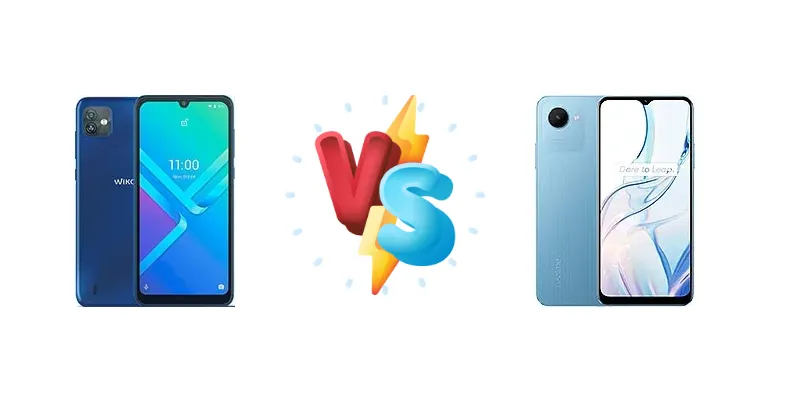
The Wiko Y82 and Realme C30s represent the fiercely competitive sub-$150 smartphone market. Both aim to deliver essential smartphone functionality at an accessible price point, but they take different approaches to achieving this. The Wiko Y82 leverages a more complex, though older, chipset architecture, while the Realme C30s opts for a streamlined, single-cluster CPU. This comparison will dissect these choices and determine which device offers the best experience for the average user.
🏆 Quick Verdict
For most users, the Realme C30s offers a slightly more streamlined experience. While the Wiko Y82's Unisoc SC9863A has more cores, the Realme C30s' simpler CPU and 10W charging provide a more predictable and potentially smoother day-to-day performance, especially for basic tasks and app usage.
| Network |
|---|
| 2G bands | GSM 850 / 900 / 1800 / 1900 | GSM 850 / 900 / 1800 / 1900 |
| 3G bands | HSDPA 850 / 900 / 1900 / 2100 | HSDPA 850 / 900 / 2100 |
| 4G bands | 1, 3, 5, 7, 8, 20, 40 | 1, 3, 5, 8, 38, 40, 41 |
| Speed | HSPA 42.2/5.76 Mbps, LTE Cat4 150/50 Mbps | HSPA, LTE |
| Technology | GSM / HSPA / LTE | GSM / HSPA / LTE |
| Launch |
|---|
| Announced | 2021, Q3 | 2022, September 14 |
| Status | Available. Released 2021, Q3 | Available. Released 2022, September 23 |
| Body |
|---|
| Build | - | Glass front, plastic frame, plastic back |
| Dimensions | 155.5 x 73.3 x 9.3 mm (6.12 x 2.89 x 0.37 in) | 164.2 x 75.7 x 8.5 mm (6.46 x 2.98 x 0.33 in) |
| SIM | Nano-SIM + Nano-SIM | Nano-SIM + Nano-SIM |
| Weight | - | 186 g (6.56 oz) |
| Display |
|---|
| Resolution | 720 x 1560 pixels, 19.5:9 ratio (~282 ppi density) | 720 x 1600 pixels, 20:9 ratio (~270 ppi density) |
| Size | 6.1 inches, 91.3 cm2 (~80.1% screen-to-body ratio) | 6.5 inches, 102.0 cm2 (~82.1% screen-to-body ratio) |
| Type | IPS LCD | IPS LCD |
| Platform |
|---|
| CPU | Octa-core (4x1.6 GHz Cortex-A55 & 4x1.2 GHz Cortex-A55) | Octa-core 1.6 GHz Cortex-A55 |
| Chipset | Unisoc SC9863A (28 nm) | - |
| GPU | IMG8322 | IMG8322 |
| OS | Android 11 | Android 12, Realme UI Go |
| Memory |
|---|
| Card slot | microSDXC | microSDXC (dedicated slot) |
| Internal | 32GB 3GB RAM | 32GB 2GB RAM, 32GB 3GB RAM, 64GB 3GB RAM, 64GB 4GB RAM |
| Main Camera |
|---|
| Features | LED flash, HDR | LED flash, HDR, panorama |
| Single | 13 MP, AF | 8 MP, (wide), 1/4.0", 1.12µm |
| Video | 720p@30fps | 1080p@30fps |
| Selfie camera |
|---|
| Features | - | HDR |
| Single | 5 MP | 5 MP, (wide), 1/5.0", 1.12µm |
| Video | - | 720p@30fps |
| Sound |
|---|
| 3.5mm jack | Yes | Yes |
| 35mm jack | Yes | Yes |
| Loudspeaker | Yes | Yes |
| Comms |
|---|
| Bluetooth | 4.2, A2DP, LE | 4.2, A2DP |
| NFC | No | No |
| Positioning | GPS, GLONASS, BDS | GPS, GLONASS |
| Radio | No | Unspecified |
| USB | microUSB 2.0 | microUSB 2.0, OTG |
| WLAN | Wi-Fi 802.11 b/g/n | Wi-Fi 802.11 b/g/n |
| Features |
|---|
| Sensors | Accelerometer, proximity | Fingerprint (side-mounted), accelerometer, proximity |
| Battery |
|---|
| Charging | - | 10W wired |
| Type | Li-Ion 3600 mAh, removable | 5000 mAh |
| Misc |
|---|
| Colors | Black, Dark Blue, Light Blue | Stripe Blue, Stripe Black |
| Models | W-K630-EEA | RMX3690 |
| Price | About 90 EUR | About 100 EUR |
| SAR | 0.27 W/kg (head) 1.39 W/kg (body) | - |
Wiko Y82
- Potentially better multitasking due to octa-core configuration.
- May offer slightly more processing power for demanding tasks.
- Could have a larger battery capacity (speculation).
- Less efficient 28nm chipset leads to potential thermal throttling.
- Unknown charging speed could result in longer charging times.
- Older chipset architecture may limit software updates.
Realme C30s
- Simpler CPU architecture for consistent performance.
- 10W charging provides a predictable charging experience.
- Potentially better thermal management due to efficient design.
- May struggle with heavy multitasking.
- Limited processing power for demanding applications.
- Basic camera capabilities.
Display Comparison
Neither device provides display specifications in the provided data. Given their price point, both likely utilize LCD panels with 720p+ resolution. Expect relatively low peak brightness and limited color accuracy. The absence of information regarding PWM dimming rates makes it impossible to assess potential eye strain for sensitive users. Bezels are likely to be substantial on both devices, maximizing screen real estate within a compact form factor.
Camera Comparison
Both devices are likely to feature basic camera setups geared towards casual photography. Without sensor size or aperture information, it’s difficult to make a meaningful comparison. The absence of Optical Image Stabilization (OIS) on either device suggests image quality will be heavily reliant on software processing. Given the market segment, expect limited low-light performance and a focus on daylight photography. Any 2MP macro or depth sensors included are likely to offer minimal practical benefit.
Performance
The core difference lies in the chipsets. The Wiko Y82’s Unisoc SC9863A is an octa-core processor built on a 28nm process, featuring a heterogeneous core arrangement with four Cortex-A55 cores clocked at 1.6GHz and four at 1.2GHz. This aims to balance performance and efficiency. The Realme C30s, however, utilizes an octa-core CPU with all cores clocked at 1.6GHz, all Cortex-A55. While the Wiko has more cores, the 28nm fabrication process of the Unisoc chip is significantly less efficient than modern nodes. This means the Wiko Y82 is likely to generate more heat under sustained load, potentially leading to thermal throttling and reduced performance. The Realme C30s, despite having fewer core configurations, benefits from a potentially more efficient design, offering more consistent performance. The lack of RAM specifications makes it difficult to assess multitasking capabilities, but both are likely to be limited.
Battery Life
Battery capacity is not specified for either device. However, the Realme C30s includes 10W wired charging, providing a defined charging speed. The Wiko Y82’s charging speed is unknown, but given its older chipset and potentially larger battery (to compensate for the less efficient processor), a full charge could take considerably longer. The Realme C30s’ 10W charging, while slow by modern standards, offers a predictable charging timeline, which is valuable in a budget device.
Buying Guide
Buy the Wiko Y82 if you anticipate needing to run multiple apps simultaneously or engage in light multitasking, as the octa-core processor *could* offer a slight advantage in those scenarios. However, be prepared for potentially longer app loading times due to the older chipset fabrication process. Buy the Realme C30s if you prioritize simplicity, consistent performance for essential tasks like calling, messaging, and social media, and a more predictable battery experience, even if it means sacrificing theoretical multi-core performance.
Frequently Asked Questions
❓ Will the Wiko Y82's processor struggle with popular apps like Facebook or WhatsApp?
While the Wiko Y82's octa-core processor *should* be capable of running these apps, the older 28nm fabrication process and potential for thermal throttling could lead to slower loading times and occasional lag, especially with multiple apps open. The Realme C30s, with its simpler CPU, may offer a more consistently smooth experience for these essential applications.
❓ How long will it take to fully charge the Realme C30s with the 10W charger?
With a 10W charger, a full charge from 0% will likely take between 3 to 4 hours, depending on the battery capacity (which is not specified). While not fast charging, this provides a predictable charging timeline, allowing you to charge overnight without concerns about overheating or excessively slow charging speeds.
❓ Is the Wiko Y82 a good choice for playing mobile games?
The Wiko Y82 is not ideal for gaming. The Unisoc SC9863A is a budget processor, and the 28nm process will likely result in significant thermal throttling during extended gaming sessions, leading to reduced frame rates and a poor gaming experience. The Realme C30s is similarly unsuitable for demanding games.