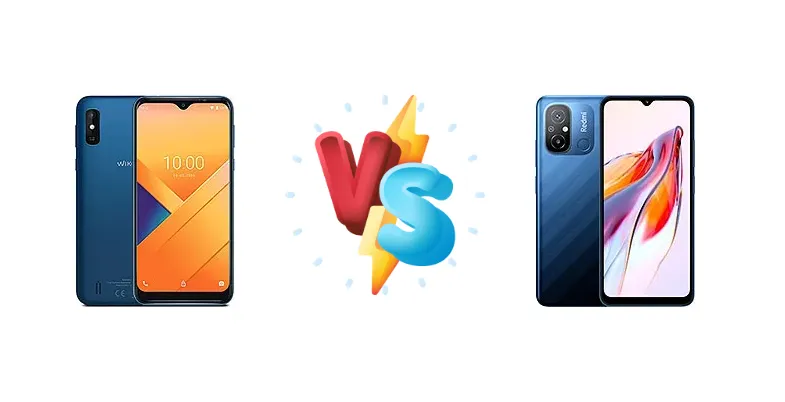
The Wiko Y81 and Xiaomi Redmi 12C represent the extreme end of the smartphone price spectrum. Both aim to deliver essential functionality at a minimal cost, but they achieve this with significantly different hardware. This comparison dissects their core components to determine which offers the best value for users prioritizing performance, battery life, or basic functionality.
🏆 Quick Verdict
For the average user, the Xiaomi Redmi 12C is the superior choice. Its Helio G85 chipset, featuring a more modern CPU architecture, provides a noticeable performance uplift over the Wiko Y81’s Helio A20, making it better suited for multitasking and light gaming. While both offer similar battery capacities, the Redmi 12C’s faster charging is a welcome addition.
| Network |
|---|
| 2G bands | GSM 850 / 900 / 1800 / 1900 | GSM 850 / 900 / 1800 / 1900 |
| 3G bands | HSDPA 850 / 900 / 1900 / 2100 | HSDPA 850 / 900 / 2100 |
| 4G bands | 1, 3, 5, 7, 8, 20, 40 | 1, 3, 5, 7, 8, 20, 28, 38, 40, 41 - International |
| Speed | HSPA 42.2/5.76 Mbps, LTE Cat4 150/50 Mbps | HSPA, LTE |
| Technology | GSM / HSPA / LTE | GSM / CDMA / HSPA / EVDO / LTE |
| | - | CDMA2000 1xEV-DO |
| Launch |
|---|
| Announced | 2020, August 18. Released 2020, August 18 | 2022, December 31 |
| Status | Discontinued | Available. Released 2023, January 01 |
| Body |
|---|
| Dimensions | 157.9 x 76.1 x 8.3 mm (6.22 x 3.00 x 0.33 in) | 168.8 x 76.4 x 8.8 mm (6.65 x 3.01 x 0.35 in) |
| SIM | Nano-SIM + Nano-SIM | Nano-SIM + Nano-SIM |
| Weight | 166 g (5.86 oz) | 192 g (6.77 oz) |
| Display |
|---|
| Resolution | 720 x 1520 pixels, 19:9 ratio (~271 ppi density) | 720 x 1650 pixels (~268 ppi density) |
| Size | 6.2 inches, 95.9 cm2 (~79.8% screen-to-body ratio) | 6.71 inches, 106.5 cm2 (~82.6% screen-to-body ratio) |
| Type | IPS LCD | IPS LCD, 500 nits (typ) |
| Platform |
|---|
| CPU | Quad-core 1.8 GHz Cortex-A53 | Octa-core (2x2.0 GHz Cortex-A75 & 6x1.8 GHz Cortex-A55) |
| Chipset | Mediatek MT6761D Helio A20 (12 nm) | Mediatek MT6769Z Helio G85 (12 nm) |
| GPU | PowerVR GE8300 | Mali-G52 MC2 |
| OS | Android 10 (Go edition) | Android 12, MIUI 13 |
| Memory |
|---|
| Card slot | microSDXC | microSDXC (dedicated slot) |
| Internal | 32GB 2GB RAM | 32GB 2GB RAM, 32GB 3GB RAM, 32GB 4GB RAM, 64GB 3GB RAM, 64GB 4GB RAM, 128GB 3GB RAM, 128GB 4GB RAM, 128GB 6GB RAM |
| | eMMC 5.1 | eMMC 5.1 |
| Main Camera |
|---|
| Dual | - | 50 MP, (wide), PDAF
0.08 MP (depth) |
| Features | LED flash, HDR, panorama | LED flash, HDR |
| Single | 13 MP, AF | 50 MP, f/1.8, (wide), 1/2.76", PDAF
Auxiliary lens |
| Video | 1080p@30fps | 1080p@30fps |
| Selfie camera |
|---|
| Single | 5 MP | 5 MP, f/2.2, (wide) |
| Video | - | 1080p@30fps |
| Sound |
|---|
| 3.5mm jack | Yes | Yes |
| 35mm jack | Yes | Yes |
| Loudspeaker | Yes | Yes |
| Comms |
|---|
| Bluetooth | 4.2, A2DP, LE | 5.1, A2DP, LE |
| NFC | No | Yes (market/region dependent) |
| Positioning | GPS | GPS, GLONASS, BDS, GALILEO |
| Radio | FM radio | FM radio |
| USB | microUSB 2.0, OTG | microUSB 2.0 |
| WLAN | Wi-Fi 802.11 b/g/n | Wi-Fi 802.11 a/b/g/n/ac, dual-band, Wi-Fi Direct |
| Features |
|---|
| Sensors | Accelerometer, proximity, compass | Fingerprint (rear-mounted), accelerometer |
| | - | Virtual proximity sensing |
| Battery |
|---|
| Charging | - | 10W wired |
| Type | Li-Ion 4000 mAh | Li-Po 5000 mAh |
| Misc |
|---|
| Colors | Deep Blue, Gold, Green | Graphite Gray, Ocean Blue, Mint Green, Lavender Purple |
| Models | - | 22120RN86G, 22120RN86I, 22126RN91Y, 2212ARNC4L |
| Price | About 80 EUR | £ 132.99 / € 107.41 |
| SAR | - | 1.08 W/kg (head) 0.64 W/kg (body) |
| SAR EU | 0.56 W/kg (head) 1.61 W/kg (body) | 0.98 W/kg (head) 0.99 W/kg (body) |
Wiko Y81
- Extremely affordable
- Functional for basic tasks
- Likely lightweight and compact
- Outdated processor
- Poor performance for multitasking
- Slow charging (likely)
Xiaomi Redmi 12C
- Significantly better performance
- Faster charging (10W)
- More responsive user experience
- Still a budget device with limitations
- Camera quality is basic
- May have bloatware
Display Comparison
Neither device boasts a standout display. Both likely utilize LCD panels, common in this price bracket. The absence of detailed display specifications (resolution, brightness) suggests both are geared towards basic visibility rather than media consumption. Bezels are expected to be substantial on both, maximizing screen real estate within a compact form factor. Color accuracy is unlikely to be a priority, with both likely covering a standard sRGB gamut.
Camera Comparison
Camera performance is likely to be similar, leaning towards basic functionality on both devices. Without sensor size or aperture information, it’s safe to assume both rely on entry-level sensors. The Redmi 12C may benefit from slightly more advanced image processing capabilities inherent in the Helio G85’s ISP, but don’t expect flagship-level results. The prevalence of 2MP macro/depth sensors on both devices suggests these are included for marketing purposes rather than genuine photographic utility.
Performance
The core difference lies in the chipsets. The Xiaomi Redmi 12C’s Mediatek Helio G85 (12nm) is a significant upgrade over the Wiko Y81’s Helio A20 (12nm). The G85’s octa-core configuration – with two 2.0 GHz Cortex-A75 cores and six 1.8 GHz Cortex-A55 cores – provides a substantial advantage in multi-threaded tasks compared to the A20’s quad-core Cortex-A53 setup running at 1.8 GHz. The A75 cores in the G85 offer higher single-core performance, translating to snappier app launches and smoother overall responsiveness. While both are 12nm chips, the architectural improvements in the G85 outweigh the process node similarity. The Redmi 12C will handle multitasking and moderately demanding apps far more effectively.
Battery Life
Both devices likely feature similar battery capacities, typical for this segment (around 5000mAh is common). However, the Redmi 12C’s inclusion of 10W wired charging is a clear advantage. While not fast charging by modern standards, it’s significantly quicker than the charging speeds typically found on devices in the Wiko Y81’s price range. This translates to less downtime and a more convenient user experience. The efficiency gains from the Helio G85 may also contribute to slightly better real-world battery life on the Redmi 12C, despite similar capacity.
Buying Guide
Buy the Wiko Y81 if you absolutely need a smartphone for the most basic tasks – calls, texts, and occasional light browsing – and are on the tightest of budgets. It’s a functional device for those with minimal smartphone requirements. Buy the Xiaomi Redmi 12C if you want a more responsive experience, even for light gaming or running multiple apps, and appreciate the convenience of faster charging. It’s a better all-rounder for everyday use.
Frequently Asked Questions
❓ Will the Redmi 12C be able to run popular social media apps like TikTok and Instagram smoothly?
Yes, the Helio G85 in the Redmi 12C is capable of running social media apps like TikTok and Instagram without significant lag. The octa-core CPU and improved GPU provide a smoother experience compared to the Wiko Y81’s Helio A20, especially when multitasking between apps.
❓ Is the 10W charging on the Redmi 12C slow compared to other smartphones?
Yes, 10W charging is relatively slow by today’s standards. However, it’s a significant improvement over the likely 5W or slower charging on the Wiko Y81. Expect a full charge to take around 3-4 hours. It’s sufficient for overnight charging and provides a noticeable convenience boost.
❓ Can the Redmi 12C handle basic mobile games like Candy Crush or Subway Surfers?
Absolutely. The Helio G85’s integrated GPU is more than capable of handling casual mobile games like Candy Crush or Subway Surfers. You should experience smooth gameplay without significant frame drops. More demanding games may require lower graphics settings.
❓ Does the Wiko Y81 have any advantages over the Redmi 12C for someone who only needs a phone for calls and texts?
The Wiko Y81’s primary advantage is its potentially lower price point. If you *only* need a phone for calls and texts and are on an extremely limited budget, the Y81 will suffice. However, the Redmi 12C offers a more future-proof experience even for basic use.