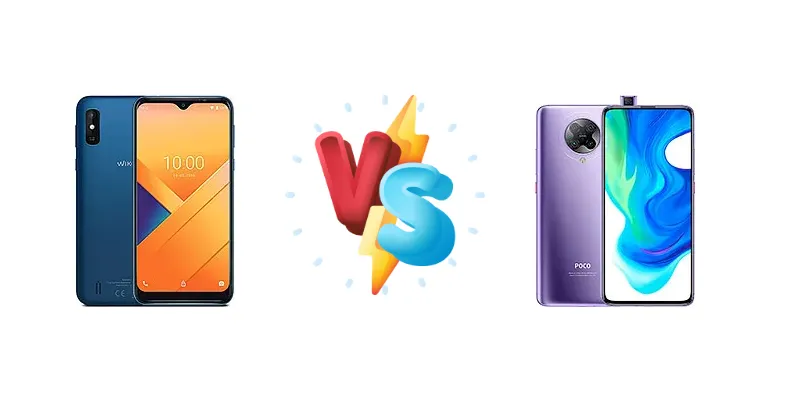
Looking for a budget-friendly smartphone? The Wiko Y81 and Xiaomi Poco F2 Pro offer compelling options, but cater to different needs. This comparison dives deep into their specs and features to help you choose the right device for your budget and lifestyle.
🏆 Quick Verdict
The Xiaomi Poco F2 Pro is the clear winner. Its Snapdragon 865 chipset, brighter display, faster charging, and superior camera capabilities far outweigh the Wiko Y81's lower price point. The Y81 is a basic option, while the Poco F2 Pro delivers flagship-like performance at a mid-range price.
| Network |
|---|
| 2G bands | GSM 850 / 900 / 1800 / 1900 | GSM 850 / 900 / 1800 / 1900 |
| 3G bands | HSDPA 850 / 900 / 1900 / 2100 | HSDPA 850 / 900 / 1700(AWS) / 1900 / 2100 - International |
| 4G bands | 1, 3, 5, 7, 8, 20, 40 | 1, 2, 3, 4, 5, 7, 8, 20, 28, 38, 40, 41 - International |
| 5G bands | - | 77, 78 Sub6 |
| Speed | HSPA 42.2/5.76 Mbps, LTE Cat4 150/50 Mbps | HSPA, LTE, 5G |
| Technology | GSM / HSPA / LTE | GSM / HSPA / LTE / 5G |
| Launch |
|---|
| Announced | 2020, August 18. Released 2020, August 18 | 2020, May 12 |
| Status | Discontinued | Available. Released 2020, May 19 |
| Body |
|---|
| Build | - | Glass front (Gorilla Glass 5), glass back (Gorilla Glass 5), aluminum frame |
| Dimensions | 157.9 x 76.1 x 8.3 mm (6.22 x 3.00 x 0.33 in) | 163.3 x 75.4 x 8.9 mm (6.43 x 2.97 x 0.35 in) |
| SIM | Nano-SIM + Nano-SIM | Nano-SIM + Nano-SIM |
| Weight | 166 g (5.86 oz) | 219 g (7.72 oz) |
| Display |
|---|
| Protection | - | Corning Gorilla Glass 5 |
| Resolution | 720 x 1520 pixels, 19:9 ratio (~271 ppi density) | 1080 x 2400 pixels, 20:9 ratio (~395 ppi density) |
| Size | 6.2 inches, 95.9 cm2 (~79.8% screen-to-body ratio) | 6.67 inches, 107.4 cm2 (~87.2% screen-to-body ratio) |
| Type | IPS LCD | Super AMOLED, HDR10+, 500 nits (typ) |
| Platform |
|---|
| CPU | Quad-core 1.8 GHz Cortex-A53 | Octa-core (1x2.84 GHz Cortex-A77 & 3x2.42 GHz Cortex-A77 & 4x1.80 GHz Cortex-A55) |
| Chipset | Mediatek MT6761D Helio A20 (12 nm) | Qualcomm SM8250 Snapdragon 865 5G (7 nm+) |
| GPU | PowerVR GE8300 | Adreno 650 |
| OS | Android 10 (Go edition) | Android 10, upgradable to Android 12, MIUI 14 |
| Memory |
|---|
| Card slot | microSDXC | No |
| Internal | 32GB 2GB RAM | 64GB 6GB RAM, 128GB 6GB RAM, 256GB 8GB RAM |
| | eMMC 5.1 | UFS 3.1
6GB RAM (LPDDR4X)
8GB RAM (LPDDR5) |
| Main Camera |
|---|
| Features | LED flash, HDR, panorama | Dual-LED dual-tone flash, HDR, panorama |
| Quad | - | 64 MP, f/1.9, 26mm (wide), 1/1.72", 0.8µm, PDAF
5 MP, f/2.2, 50mm (telephoto macro), AF
13 MP, f/2.4, 123˚ (ultrawide), 1.12µm
Auxiliary lens |
| Single | 13 MP, AF | - |
| Video | 1080p@30fps | 8K@24/30fps, 4K@30/60fps, 1080p@30/60/120/240fps, 1080p@960fps; gyro-EIS |
| Selfie camera |
|---|
| Features | - | HDR |
| Single | 5 MP | Motorized pop-up 20 MP, f/2.2, (wide), 1/3.4", 0.8µm |
| Video | - | 1080p@30fps, 720p@120fps |
| Sound |
|---|
| 3.5mm jack | Yes | Yes |
| 35mm jack | Yes | Yes |
| Loudspeaker | Yes | Yes |
| | - | 24-bit/192kHz audio
|
| Comms |
|---|
| Bluetooth | 4.2, A2DP, LE | 5.1, A2DP, LE, aptX HD, aptX Adaptive |
| Infrared port | - | Yes |
| NFC | No | Yes |
| Positioning | GPS | GPS (L1+L5), GLONASS (G1), BDS (B1), GALILEO (E1+E5a), QZSS (L1+L5) |
| Radio | FM radio | No |
| USB | microUSB 2.0, OTG | USB Type-C 2.0, OTG |
| WLAN | Wi-Fi 802.11 b/g/n | Wi-Fi 802.11 a/b/g/n/ac/6, dual-band, Wi-Fi Direct |
| Features |
|---|
| Sensors | Accelerometer, proximity, compass | Fingerprint (under display, optical), accelerometer, gyro, proximity, compass, barometer |
| Battery |
|---|
| Charging | - | 30W wired, PD3.0, QC4, 100% in 63 min |
| Type | Li-Ion 4000 mAh | Li-Po 4700 mAh |
| Misc |
|---|
| Colors | Deep Blue, Gold, Green | Neon Blue, Phantom White, Electric Purple, Cyber Gray |
| Models | - | M2004J11G |
| Price | About 80 EUR | About 150 EUR |
| SAR | - | 1.09 W/kg (head) 0.51 W/kg (body) |
| SAR EU | 0.56 W/kg (head) 1.61 W/kg (body) | 0.79 W/kg (head) 1.03 W/kg (body) |
| Tests |
|---|
| Battery life | - |
Endurance rating 120h
|
| Camera | - |
Photo / Video |
| Display | - |
Contrast ratio: Infinite (nominal) |
| Loudspeaker | - |
-25.6 LUFS (Very good)
|
| Performance | - |
AnTuTu: 538221 (v8)
GeekBench: 3332 (v5.1)
GFXBench: 40fps (ES 3.1 onscreen) |
Wiko Y81
- Affordable
- Decent battery life
- Sleek design (subjective)
- Weak performance
- Basic camera
- Slow charging
- Outdated chipset
Xiaomi Poco F2 Pro
- Powerful Snapdragon 865 chipset
- Bright and vibrant display
- Fast charging (30W)
- Excellent camera
- 5G connectivity
- Older model (potential software update concerns)
- Design may not appeal to everyone
Display Comparison
The Poco F2 Pro boasts a significantly brighter display (854 nits) with an infinite contrast ratio, offering vibrant colors and excellent visibility even in direct sunlight. The Wiko Y81's display is likely more standard, lacking the same level of brightness and contrast. The Poco F2 Pro's display is the clear winner.
Camera Comparison
While both phones offer photo and video capabilities, the Poco F2 Pro's camera system is expected to be considerably better. The Snapdragon 865 typically pairs with higher-resolution sensors and advanced image processing. The Wiko Y81's camera is likely adequate for basic photography, but won't compete with the Poco F2 Pro's capabilities.
Performance
The Poco F2 Pro's Snapdragon 865 5G chipset is a powerhouse compared to the Wiko Y81's Helio A20. Expect significantly faster app loading times, smoother multitasking, and better gaming performance on the Poco F2 Pro. The octa-core CPU and 7nm+ process provide a substantial advantage.
Battery Life
Both phones boast an endurance rating of 120h, suggesting excellent battery life. However, the Poco F2 Pro's 30W fast charging provides a significant advantage, allowing for much quicker top-ups compared to the Wiko Y81's likely slower charging speeds.
Buying Guide
The Wiko Y81 is ideal for users on a very tight budget who prioritize affordability over performance and features. The Xiaomi Poco F2 Pro is perfect for those seeking a powerful, feature-rich phone with a great camera and fast charging without breaking the bank.
Frequently Asked Questions
❓ Is the Wiko Y81 good for gaming?
The Wiko Y81's Helio A20 chipset is not ideal for demanding games. It can handle basic titles, but expect low frame rates and potential lag.
❓ How does the Poco F2 Pro's camera compare to more recent phones?
While not the latest flagship camera, the Poco F2 Pro's camera remains competitive, offering good image quality and features for its price range. Newer phones have advancements, but the F2 Pro still holds its own.