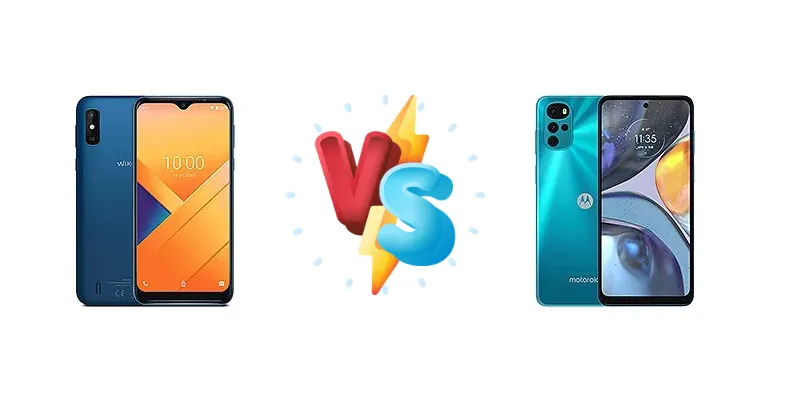
The Wiko Y81 and Motorola Moto G22 represent the fiercely competitive sub-$150 smartphone market. Both aim to deliver essential functionality at an accessible price, but they take different approaches to achieving this. The Y81 prioritizes basic functionality, while the Moto G22 attempts to offer a more modern experience with a faster processor and faster charging capabilities.
🏆 Quick Verdict
For most users, the Motorola Moto G22 is the better choice. Its Helio G37 chipset, featuring an octa-core CPU, provides a significantly more responsive experience than the Wiko Y81’s quad-core Helio A20. While the Y81 may offer slightly better value in some regions, the G22’s performance advantage justifies the potential price difference.
| Network |
|---|
| 2G bands | GSM 850 / 900 / 1800 / 1900 | GSM 850 / 900 / 1800 / 1900 |
| 3G bands | HSDPA 850 / 900 / 1900 / 2100 | HSDPA 850 / 900 / 1900 / 2100 |
| 4G bands | 1, 3, 5, 7, 8, 20, 40 | 1, 3, 5, 7, 8, 20, 38, 40, 41 |
| Speed | HSPA 42.2/5.76 Mbps, LTE Cat4 150/50 Mbps | HSPA 42.2/5.76 Mbps, LTE Cat4 150/50 Mbps |
| Technology | GSM / HSPA / LTE | GSM / HSPA / LTE |
| Launch |
|---|
| Announced | 2020, August 18. Released 2020, August 18 | 2022, March 04 |
| Status | Discontinued | Available. Released 2022, March 04 |
| Body |
|---|
| Build | - | Glass front, plastic frame, plastic back |
| Dimensions | 157.9 x 76.1 x 8.3 mm (6.22 x 3.00 x 0.33 in) | 164 x 75 x 8.5 mm (6.46 x 2.95 x 0.33 in) |
| SIM | Nano-SIM + Nano-SIM | · Nano-SIM· Nano-SIM + Nano-SIM |
| Weight | 166 g (5.86 oz) | 185 g (6.53 oz) |
| | - | Water-repellent design |
| Display |
|---|
| Resolution | 720 x 1520 pixels, 19:9 ratio (~271 ppi density) | 720 x 1600 pixels, 20:9 ratio (~268 ppi density) |
| Size | 6.2 inches, 95.9 cm2 (~79.8% screen-to-body ratio) | 6.5 inches, 103.5 cm2 (~84.2% screen-to-body ratio) |
| Type | IPS LCD | IPS LCD, 90Hz |
| Platform |
|---|
| CPU | Quad-core 1.8 GHz Cortex-A53 | Octa-core (4x2.3 GHz Cortex-A53 & 4x1.8 GHz Cortex-A53) |
| Chipset | Mediatek MT6761D Helio A20 (12 nm) | Mediatek MT6765V/CB Helio G37 (12 nm) |
| GPU | PowerVR GE8300 | PowerVR GE8320 |
| OS | Android 10 (Go edition) | Android 12 |
| Memory |
|---|
| Card slot | microSDXC | microSDXC (dedicated slot) |
| Internal | 32GB 2GB RAM | 64GB 4GB RAM, 128GB 4GB RAM |
| | eMMC 5.1 | - |
| Main Camera |
|---|
| Features | LED flash, HDR, panorama | LED flash, HDR, panorama |
| Quad | - | 50 MP, f/1.8, (wide), 0.64µm, PDAF
8 MP, f/2.2, 118˚ (ultrawide), 1/4.0", 1.12µm
2 MP (macro)
Auxiliary lens |
| Single | 13 MP, AF | - |
| Video | 1080p@30fps | 1080p@30fps |
| Selfie camera |
|---|
| Features | - | HDR |
| Single | 5 MP | 16 MP, f/2.5, (wide), 1.0µm |
| Video | - | 1080p@30fps |
| Sound |
|---|
| 3.5mm jack | Yes | Yes |
| 35mm jack | Yes | Yes |
| Loudspeaker | Yes | Yes |
| Comms |
|---|
| Bluetooth | 4.2, A2DP, LE | 5.0, A2DP, LE |
| NFC | No | Yes (market/region dependent) |
| Positioning | GPS | GPS, GLONASS, GALILEO |
| Radio | FM radio | Unspecified |
| USB | microUSB 2.0, OTG | USB Type-C 2.0 |
| WLAN | Wi-Fi 802.11 b/g/n | Wi-Fi 802.11 a/b/g/n/ac, dual-band, Wi-Fi Direct |
| Features |
|---|
| Sensors | Accelerometer, proximity, compass | Fingerprint (side-mounted), accelerometer, gyro, proximity, compass |
| Battery |
|---|
| Charging | - | 20W wired (India)
15W wired (Global) |
| Type | Li-Ion 4000 mAh | Li-Po 5000 mAh |
| Misc |
|---|
| Colors | Deep Blue, Gold, Green | Pearl White, Iceberg Blue, Cosmic Black, Mint Green |
| Models | - | XT2231-1, XT2231-2, XT2231-5 |
| Price | About 80 EUR | About 120 EUR |
| SAR EU | 0.56 W/kg (head) 1.61 W/kg (body) | - |
Wiko Y81
- Potentially lower price point
- Simple and straightforward user experience
- Likely longer battery life due to less demanding processor (depending on battery capacity)
- Significantly slower performance
- Less responsive user interface
- Limited multitasking capabilities
Motorola Moto G22
- Faster and more responsive performance
- Faster charging capabilities (20W/15W)
- Better multitasking experience
- Potentially higher price
- May experience slightly faster battery drain due to more powerful processor
Display Comparison
Neither device boasts a standout display. Both utilize 12nm chipsets, suggesting similar power constraints impacting display capabilities. Specific display specs (resolution, panel type) are missing, but given the price point, expect 720p LCD panels. The focus here isn't on visual fidelity, but on basic usability. Bezels are likely to be substantial on both, and color accuracy will be standard for this segment.
Camera Comparison
Camera performance is likely to be similar in real-world usage, as both phones will rely heavily on software processing to enhance images. Specific sensor details are unavailable, but the focus should be on the main sensor. The G37’s slightly more powerful ISP (Image Signal Processor) may offer a marginal advantage in image quality, particularly in low-light conditions. Expect both phones to include multiple rear cameras, but the 2MP macro and depth sensors commonly found in this price range offer limited practical benefit.
Performance
The core difference lies in the chipsets. The Wiko Y81’s Mediatek MT6761D Helio A20 is a quad-core processor clocked at 1.8 GHz, built on a 12nm process. This is a basic processor designed for minimal tasks. Conversely, the Motorola Moto G22 features the Mediatek MT6765V/CB Helio G37, an octa-core chip (4x2.3 GHz Cortex-A53 & 4x1.8 GHz Cortex-A53), also on a 12nm process. The G37’s octa-core configuration and higher clock speeds translate to significantly improved multitasking, app loading times, and overall responsiveness. The G37’s architecture, while still using Cortex-A53 cores, benefits from having double the number of cores, providing a substantial performance uplift. This difference will be most noticeable when switching between apps or running slightly more demanding applications.
Battery Life
Battery capacity is not specified for either device, but both will likely feature around a 5000mAh battery, typical for this segment. The key differentiator is charging speed. The Motorola Moto G22 supports 20W wired charging (in India) or 15W globally, allowing for significantly faster top-ups compared to the Wiko Y81, which likely supports only standard 10W charging. This means the G22 can go from 0-100% in a considerably shorter time, a significant convenience factor for many users.
Buying Guide
Buy the Wiko Y81 if you absolutely need the lowest possible price and your smartphone usage is limited to basic tasks like calls, texts, and light social media. Buy the Motorola Moto G22 if you prioritize a smoother, more responsive user experience, enjoy occasional gaming, or want faster charging for quicker top-ups. The G22 is the better all-rounder for the average user.
Frequently Asked Questions
❓ Will the Motorola Moto G22 struggle with popular apps like Facebook or WhatsApp?
While the Helio G37 isn't a powerhouse, it's more than capable of handling everyday apps like Facebook, WhatsApp, and web browsing. You might experience slight slowdowns with multiple apps open simultaneously, but it will provide a much smoother experience than the Wiko Y81's Helio A20.
❓ Is the 20W charging on the Moto G22 a significant advantage?
Yes, it is. Standard 10W charging can take several hours to fully charge a phone. The Moto G22’s 20W (or 15W globally) charging significantly reduces this time, allowing you to quickly top up your battery when needed. This is particularly useful if you're a heavy user or frequently forget to charge your phone overnight.
❓ Can the Wiko Y81 handle basic mobile games?
The Wiko Y81 can run very basic mobile games, but expect low frame rates and significant lag in anything beyond the simplest titles. The Helio A20 simply lacks the graphical processing power for a smooth gaming experience.
❓ Which phone is better for taking quick photos of documents?
The Motorola Moto G22 is likely better for document scanning due to its slightly more capable image processing. It may produce clearer, more legible images, especially in less-than-ideal lighting conditions.