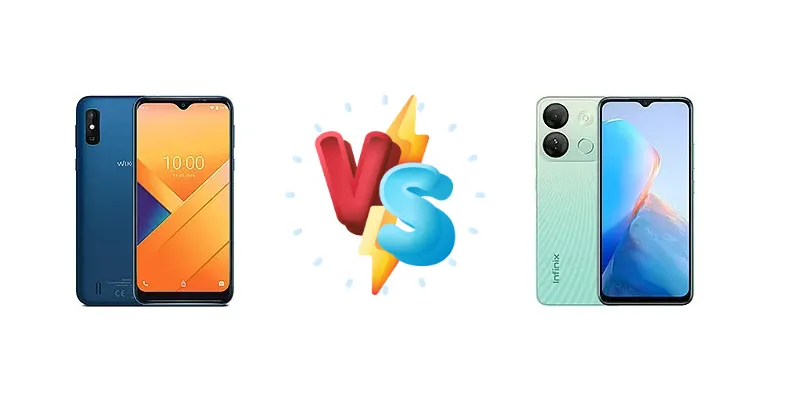
The Wiko Y81 and Infinix Smart 7 HD represent the fiercely competitive entry-level smartphone market. Both aim to deliver essential smartphone functionality at an incredibly affordable price point, but they take different approaches to achieving this. The Wiko Y81 leverages a Mediatek Helio A20 chipset, while the Infinix Smart 7 HD opts for an unspecified octa-core processor. This comparison will dissect the key differences to determine which device offers the best value.
🏆 Quick Verdict
For the average user prioritizing multitasking and a slightly smoother experience, the Infinix Smart 7 HD is the better choice. Its octa-core CPU, while clocked lower at 1.6 GHz, offers superior multi-core performance compared to the Wiko Y81’s quad-core Helio A20. However, the Wiko Y81 remains a viable option for extremely basic usage.
| Network |
|---|
| 2G bands | GSM 850 / 900 / 1800 / 1900 | GSM 850 / 900 / 1800 / 1900 |
| 3G bands | HSDPA 850 / 900 / 1900 / 2100 | HSDPA 850 / 900 / 2100 |
| 4G bands | 1, 3, 5, 7, 8, 20, 40 | 1, 3, 5, 8, 38, 40, 41 |
| Speed | HSPA 42.2/5.76 Mbps, LTE Cat4 150/50 Mbps | HSPA, LTE |
| Technology | GSM / HSPA / LTE | GSM / HSPA / LTE |
| | - | 1, 2, 3, 4, 5, 7, 8, 20, 28, 38, 40, 41 |
| Launch |
|---|
| Announced | 2020, August 18. Released 2020, August 18 | 2023, April 14 |
| Status | Discontinued | Available. Released 2023, April 14 |
| Body |
|---|
| Build | - | Glass front, plastic back, plastic frame |
| Dimensions | 157.9 x 76.1 x 8.3 mm (6.22 x 3.00 x 0.33 in) | 163.9 x 75.5 x 8.7 mm (6.45 x 2.97 x 0.34 in) |
| SIM | Nano-SIM + Nano-SIM | Nano-SIM + Nano-SIM |
| Weight | 166 g (5.86 oz) | 196.5 g (6.95 oz) |
| Display |
|---|
| Resolution | 720 x 1520 pixels, 19:9 ratio (~271 ppi density) | 720 x 1612 pixels, 20:9 ratio (~267 ppi density) |
| Size | 6.2 inches, 95.9 cm2 (~79.8% screen-to-body ratio) | 6.6 inches, 104.6 cm2 (~84.6% screen-to-body ratio) |
| Type | IPS LCD | IPS LCD, 500 nits |
| Platform |
|---|
| CPU | Quad-core 1.8 GHz Cortex-A53 | Octa-core 1.6 GHz |
| Chipset | Mediatek MT6761D Helio A20 (12 nm) | - |
| GPU | PowerVR GE8300 | - |
| OS | Android 10 (Go edition) | Android 12 (Go edition) |
| Memory |
|---|
| Card slot | microSDXC | microSDXC (dedicated slot) |
| Internal | 32GB 2GB RAM | 64GB 2GB RAM |
| | eMMC 5.1 | UFS 2.1 |
| Main Camera |
|---|
| Dual | - | 8 MP, f/2.0
0.08 MP, (depth) |
| Features | LED flash, HDR, panorama | Dual-LED flash, HDR, panorama |
| Single | 13 MP, AF | 8 MP, f/2.0
Auxiliary lens |
| Video | 1080p@30fps | 1080p@30fps |
| Selfie camera |
|---|
| Features | - | LED flash |
| Single | 5 MP | 5 MP, f/2.0 |
| Video | - | 720p@30fps |
| Sound |
|---|
| 3.5mm jack | Yes | Yes |
| 35mm jack | Yes | Yes |
| Loudspeaker | Yes | Yes |
| Comms |
|---|
| Bluetooth | 4.2, A2DP, LE | 5.0, A2DP, LE |
| NFC | No | No |
| Positioning | GPS | GPS |
| Radio | FM radio | FM radio |
| USB | microUSB 2.0, OTG | microUSB 2.0, OTG |
| WLAN | Wi-Fi 802.11 b/g/n | Wi-Fi 802.11 b/g/n |
| Features |
|---|
| Sensors | Accelerometer, proximity, compass | Fingerprint (rear-mounted), accelerometer, proximity |
| Battery |
|---|
| Charging | - | 10W wired |
| Type | Li-Ion 4000 mAh | 5000 mAh |
| Misc |
|---|
| Colors | Deep Blue, Gold, Green | Ink Black, Silk Blue, Jade White, Green Apple |
| Models | - | X6516 |
| Price | About 80 EUR | About 110 EUR |
| SAR EU | 0.56 W/kg (head) 1.61 W/kg (body) | - |
Wiko Y81
- Potentially better power efficiency under light loads (due to 12nm process)
- Simpler user experience for basic tasks
- Likely lower price point
- Significantly weaker multi-core performance
- Struggles with multitasking and demanding apps
- Older processor architecture
Infinix Smart 7 HD
- Superior multi-core performance for smoother multitasking
- More responsive user experience
- 10W charging support
- Potentially shorter battery life under heavy use
- May be slightly more expensive
- Octa-core processor may generate more heat
Display Comparison
Neither device’s display specifications are provided, so a direct comparison is limited. However, given their price points, both likely utilize LCD panels with 720p+ resolutions. The absence of details like peak brightness or color gamut suggests neither phone will excel in outdoor visibility or color accuracy. Expect standard viewing experiences suitable for basic content consumption. Bezels are likely to be substantial on both devices, maximizing screen real estate within a budget-friendly form factor.
Camera Comparison
Without detailed camera specifications, assessing image quality is challenging. Both phones likely feature basic camera setups geared towards casual photography. The absence of information regarding sensor size, aperture, or image stabilization suggests neither device will perform well in low-light conditions. The focus should be on adequate daylight performance for social media sharing. It's highly probable that both phones include a 2MP macro camera, which, given its limited resolution, will offer minimal practical benefit.
Performance
The core difference lies in the CPU architecture. The Wiko Y81’s Mediatek MT6761D Helio A20 is a quad-core processor based on the Cortex-A53 architecture, fabricated on a 12nm process. This is a relatively older and less efficient design. Conversely, the Infinix Smart 7 HD boasts an octa-core CPU clocked at 1.6 GHz. While the individual core clock speed is lower, the doubling of cores provides a significant advantage in multi-threaded tasks. This translates to smoother app switching, faster web browsing, and a more responsive user experience. The Helio A20 will struggle with demanding applications, while the Smart 7 HD will handle them with greater ease. The lack of RAM specifications for both devices makes it difficult to assess overall system responsiveness, but the CPU difference is the dominant factor.
Battery Life
The Infinix Smart 7 HD includes 10W wired charging, a standard offering in this price segment. Without knowing the battery capacity of either device, it’s difficult to predict real-world battery life. However, the 12nm process of the Helio A20 in the Wiko Y81 *could* translate to slightly better power efficiency under light loads. However, the octa-core processor in the Smart 7 HD is likely to consume more power during intensive tasks, potentially negating any efficiency gains. Expect both phones to require daily charging with moderate usage.
Buying Guide
Buy the Wiko Y81 if you need a phone for absolutely essential tasks – calls, texts, and very light app usage – and prioritize simplicity. It’s best suited for first-time smartphone users or those needing a secondary device for emergencies. Buy the Infinix Smart 7 HD if you prefer a phone capable of handling more than just the basics, including social media browsing, light gaming, and running multiple apps simultaneously. Its octa-core processor provides a noticeable performance boost for everyday tasks.
Frequently Asked Questions
❓ Will the Infinix Smart 7 HD be able to run popular social media apps like Facebook and Instagram smoothly?
Yes, the octa-core processor in the Infinix Smart 7 HD provides sufficient processing power to run social media apps like Facebook and Instagram smoothly, even with multiple apps open simultaneously. The Wiko Y81’s Helio A20 may experience lag and slowdowns when running these apps alongside others.
❓ Is the Wiko Y81 a good choice for someone who primarily uses their phone for calls and texts?
Yes, the Wiko Y81 is a perfectly adequate choice for users who primarily use their phone for calls and texts. Its quad-core processor is sufficient for these basic tasks, and its simplicity may be appealing to those unfamiliar with smartphones. However, it will struggle with anything beyond these core functions.
❓ Can I expect to play games on either of these phones?
While both phones can technically run some games, expectations should be tempered. The Wiko Y81 will be limited to very basic, older games. The Infinix Smart 7 HD can handle less demanding mobile games at lower settings, but graphically intensive titles will likely be unplayable or suffer from significant lag.