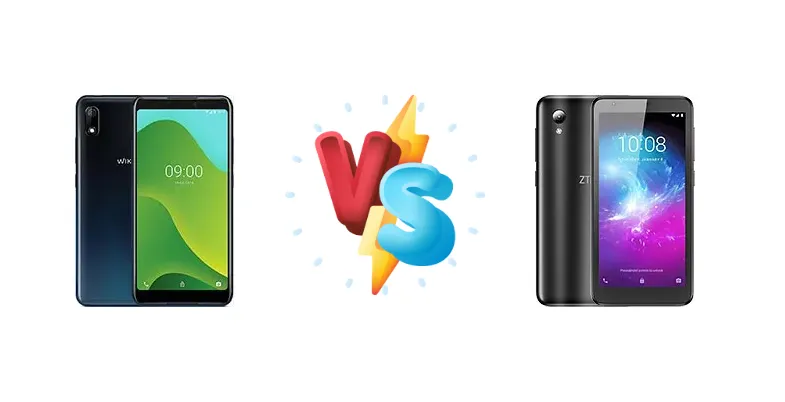
The Wiko Y70 and ZTE Blade L8 represent the extreme end of the smartphone price spectrum, targeting users who prioritize affordability above all else. Both devices aim to deliver essential smartphone functionality without breaking the bank, but subtle differences in their hardware and software can significantly impact the user experience. This comparison dissects these differences to help you choose the best option for your needs.
🏆 Quick Verdict
For the average user seeking a basic, functional smartphone, the ZTE Blade L8 edges out the Wiko Y70. The Blade L8’s Unisoc SC7731E chipset, while still entry-level, benefits from a more modern fabrication process (28nm) potentially offering slightly better efficiency and sustained performance compared to the Y70’s Cortex-A7.
| Network |
|---|
| 2G bands | GSM 850 / 900 / 1800 / 1900 | GSM 850 / 900 / 1800 / 1900 |
| 3G bands | HSDPA 850 / 900 / 1900 / 2100 | HSDPA 900 / 2100 |
| Speed | HSPA 21/5.76 Mbps | HSPA 42.2/5.76 Mbps |
| Technology | GSM / HSPA | GSM / HSPA |
| Launch |
|---|
| Announced | 2019, July. Released 2019, July | 2019, April. Released 2019, April |
| Status | Discontinued | Discontinued |
| Body |
|---|
| Dimensions | 160 x 77 x 9 mm (6.30 x 3.03 x 0.35 in) | 137.4 x 67.5 x 10.5 mm (5.41 x 2.66 x 0.41 in) |
| SIM | Dual SIM (Micro-SIM, dual stand-by) | Nano-SIM + Nano-SIM |
| Weight | 167 g (5.89 oz) | 144 g (5.08 oz) |
| Display |
|---|
| Resolution | 720 x 1440 pixels, 18:9 ratio (~269 ppi density) | 480 x 960 pixels, 18:9 ratio (~215 ppi density) |
| Size | 5.99 inches, 92.6 cm2 (~75.2% screen-to-body ratio) | 5.0 inches, 64.5 cm2 (~69.6% screen-to-body ratio) |
| Type | IPS LCD | IPS LCD |
| Platform |
|---|
| CPU | Quad-core 1.3 GHz Cortex-A7 | Quad-core 1.3 GHz |
| Chipset | - | Unisoc SC7731E (28 nm) |
| GPU | Mali-T820 MP1 | Mali-T820 MP1 |
| OS | Android 9.0 Pie (Go Edition) | Android 9.0 Pie (Go edition) |
| Memory |
|---|
| Card slot | microSDHC | microSDXC |
| Internal | 16GB 1GB RAM | 16GB 1GB RAM |
| Main Camera |
|---|
| Features | LED flash, HDR, panorama | LED flash, HDR |
| Single | 8 MP, AF | 8 MP, AF |
| Video | 1080p@30fps | 720p@30fps |
| Selfie camera |
|---|
| Features | LED flash | - |
| Single | 5 MP | 5 MP |
| Sound |
|---|
| 3.5mm jack | Yes | Yes |
| 35mm jack | Yes | Yes |
| Loudspeaker | Yes, with dual speakers | Yes |
| Comms |
|---|
| Bluetooth | 4.2, A2DP | 4.2, A2DP, LE |
| NFC | No | No |
| Positioning | GPS | GPS, GLONASS |
| Radio | FM Radio | FM radio |
| USB | microUSB 2.0, OTG | microUSB 2.0 |
| WLAN | Wi-Fi 802.11 b/g/n | Wi-Fi 802.11 b/g/n |
| Features |
|---|
| Sensors | Accelerometer, proximity, compass | Accelerometer |
| Battery |
|---|
| Type | Li-Ion 3730 mAh | Li-Ion 2000 mAh, non-removable |
| Misc |
|---|
| Colors | Gradient Dark Blue, Gold | Black, Blue |
| Price | About 80 EUR | About 60 EUR |
| SAR | 0.50 W/kg (head) 1.61 W/kg (body) | - |
Wiko Y70
- Familiar Cortex-A7 architecture
- Potentially lower cost (depending on retailer)
- Simple and straightforward user experience
- Older CPU architecture
- Likely limited performance
- Missing detailed specifications
ZTE Blade L8
- More modern 28nm chipset fabrication
- Potentially better power efficiency
- Slightly improved sustained performance
- Unisoc chipset may have limited software support
- Missing detailed specifications
- Still an entry-level device
Display Comparison
Neither Wiko nor ZTE provide display specifications beyond size. Given the price point, both likely utilize LCD panels with modest resolutions (likely 720p+). The absence of details regarding brightness, color gamut coverage, or refresh rates suggests a focus on cost reduction. Bezels are expected to be substantial on both devices, maximizing screen real estate within a compact form factor. Color accuracy is unlikely to be a priority, and viewing angles will likely be limited.
Camera Comparison
Camera details are sparse for both devices. It’s safe to assume both feature basic rear and front-facing cameras, likely with resolutions around 5-8MP. Image quality will be heavily reliant on software processing and will likely struggle in low-light conditions. The presence of a 2MP macro camera on either device is largely a marketing gimmick, offering minimal practical benefit due to the low resolution and lack of optical image stabilization. Expect limited dynamic range and detail in photos.
Performance
The core difference lies in the chipset. The Wiko Y70 features a Quad-core 1.3 GHz Cortex-A7 CPU, an older architecture known for its power efficiency but limited processing capabilities. The ZTE Blade L8 utilizes the Unisoc SC7731E, also a Quad-core 1.3 GHz CPU, but fabricated on a 28nm process. This smaller process node *can* translate to lower power consumption and potentially better thermal management, allowing the SC7731E to sustain peak performance for slightly longer periods. While both CPUs are fundamentally similar in clock speed and core count, the Unisoc chipset’s manufacturing process gives it a marginal advantage. RAM details are missing for both, but expect 1GB or 2GB, which will limit multitasking capabilities.
Battery Life
Battery capacity is not specified for either device. However, given the low-power CPUs and likely modest display resolutions, both should achieve at least a full day of light use (calls, texts, basic browsing). Charging wattage is also unknown, suggesting slow charging speeds via micro-USB. The 28nm process of the Unisoc SC7731E in the Blade L8 *could* contribute to slightly longer battery life due to improved power efficiency, but the difference will likely be minimal in real-world usage.
Buying Guide
Buy the Wiko Y70 if you need a simple, straightforward device with a known processor architecture (Cortex-A7) and are comfortable with potentially limited performance headroom. Buy the ZTE Blade L8 if you prefer a chipset built on a more modern process node, potentially leading to better power efficiency and a slightly smoother experience, even within the constraints of the budget segment.
Frequently Asked Questions
❓ Will the ZTE Blade L8 handle basic social media apps like Facebook and WhatsApp smoothly?
Yes, the Unisoc SC7731E chipset should be capable of running basic social media apps like Facebook and WhatsApp without significant lag, although multitasking with several apps open simultaneously may cause slowdowns due to the limited RAM (likely 1GB or 2GB).
❓ Is either phone suitable for playing demanding mobile games like PUBG or Call of Duty?
No, neither the Wiko Y70 nor the ZTE Blade L8 are suitable for playing demanding mobile games. The CPUs and GPUs are simply not powerful enough to deliver a playable experience, even at the lowest graphics settings. Expect significant frame rate drops and lag.
❓ What type of charging port do these phones use?
Given the budget nature of these devices, both the Wiko Y70 and ZTE Blade L8 almost certainly use a micro-USB port for charging and data transfer. Expect relatively slow charging speeds.
❓ How much storage space do these phones typically offer?
Expect both phones to come with a limited amount of internal storage, likely 8GB or 16GB. Fortunately, both likely support microSD card expansion, allowing you to add more storage for photos, videos, and apps.