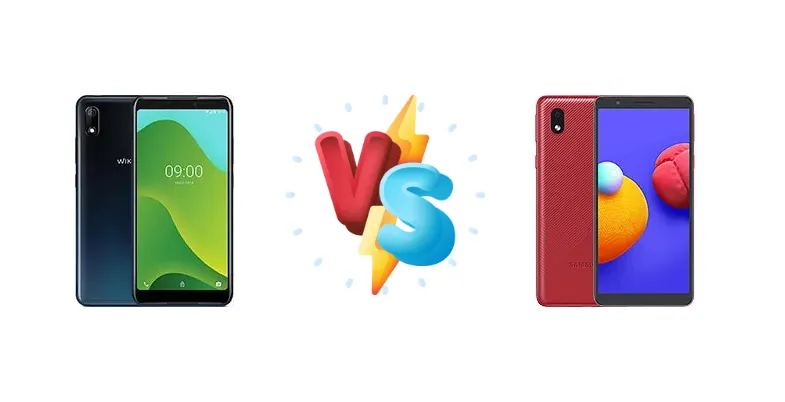
The Wiko Y70 and Samsung Galaxy A01 Core represent the absolute bottom end of the smartphone market. Both devices target first-time smartphone buyers or those needing a very basic, affordable device. This comparison dissects their key differences to determine which offers the best experience for the price.
🏆 Quick Verdict
For the average user prioritizing a marginally smoother experience, the Samsung Galaxy A01 Core is the better choice. Its Mediatek MT6739 chipset, running at 1.5 GHz, offers a slight performance advantage over the Wiko Y70’s 1.3 GHz Cortex-A7, making everyday tasks feel a bit more responsive.
| Network |
|---|
| 2G bands | GSM 850 / 900 / 1800 / 1900 | GSM 850 / 900 / 1800 / 1900 |
| 3G bands | HSDPA 850 / 900 / 1900 / 2100 | HSDPA 850 / 900 / 2100 |
| 4G bands | - | 1, 3, 5, 7, 8, 20, 28, 38, 40, 41 |
| Speed | HSPA 21/5.76 Mbps | HSPA 21.1/5.76 Mbps, LTE |
| Technology | GSM / HSPA | GSM / HSPA / LTE |
| Launch |
|---|
| Announced | 2019, July. Released 2019, July | 2020, July 21. Released 2020, August 06 |
| Status | Discontinued | Discontinued |
| Body |
|---|
| Build | - | Plastic back, plastic frame |
| Dimensions | 160 x 77 x 9 mm (6.30 x 3.03 x 0.35 in) | 141.7 x 67.5 x 8.6 mm (5.58 x 2.66 x 0.34 in) |
| SIM | Dual SIM (Micro-SIM, dual stand-by) | · Nano-SIM· Nano-SIM + Nano-SIM |
| Weight | 167 g (5.89 oz) | 150 g (5.29 oz) |
| Display |
|---|
| Resolution | 720 x 1440 pixels, 18:9 ratio (~269 ppi density) | 720 x 1480 pixels, 18.5:9 ratio (~311 ppi density) |
| Size | 5.99 inches, 92.6 cm2 (~75.2% screen-to-body ratio) | 5.3 inches, 71.3 cm2 (~74.5% screen-to-body ratio) |
| Type | IPS LCD | PLS LCD |
| Platform |
|---|
| CPU | Quad-core 1.3 GHz Cortex-A7 | Quad-core 1.5 GHz Cortex-A53 |
| Chipset | - | Mediatek MT6739 (28 nm) |
| GPU | Mali-T820 MP1 | PowerVR GE8100 |
| OS | Android 9.0 Pie (Go Edition) | Android 10 (Go edition) |
| Memory |
|---|
| Card slot | microSDHC | microSDXC (dedicated slot) |
| Internal | 16GB 1GB RAM | 16GB 1GB RAM, 16GB 2GB RAM, 32GB 2GB RAM |
| | - | eMMC 5.1 |
| Main Camera |
|---|
| Features | LED flash, HDR, panorama | LED flash |
| Single | 8 MP, AF | 8 MP, f/2.2, AF |
| Video | 1080p@30fps | 1080p@30fps |
| Selfie camera |
|---|
| Features | LED flash | - |
| Single | 5 MP | 5 MP, f/2.4 |
| Sound |
|---|
| 3.5mm jack | Yes | Yes |
| 35mm jack | Yes | Yes |
| Loudspeaker | Yes, with dual speakers | Yes |
| Comms |
|---|
| Bluetooth | 4.2, A2DP | 5.0, A2DP, LE |
| NFC | No | No |
| Positioning | GPS | GPS |
| Radio | FM Radio | FM radio |
| USB | microUSB 2.0, OTG | microUSB 2.0 |
| WLAN | Wi-Fi 802.11 b/g/n | Wi-Fi 802.11 b/g/n, Wi-Fi Direct |
| Features |
|---|
| Sensors | Accelerometer, proximity, compass | Accelerometer |
| Battery |
|---|
| Type | Li-Ion 3730 mAh | Li-Ion 3000 mAh |
| Misc |
|---|
| Colors | Gradient Dark Blue, Gold | Black, Blue, Red |
| Models | - | SM-A013F, SM-A013F/DS, SM-A013G, SM-A013G/DS, SM-A013M |
| Price | About 80 EUR | About 150 EUR |
| SAR | 0.50 W/kg (head) 1.61 W/kg (body) | - |
| SAR EU | - | 0.64 W/kg (head) 1.18 W/kg (body) |
Wiko Y70
- Potentially lower price point (depending on region)
- Wiko brand recognition in specific markets
- Simple and straightforward Android experience
- Slower processor (Cortex-A7)
- Less efficient chipset
- Likely limited software support
Samsung Galaxy A01 Core
- Slightly faster processor (Cortex-A53)
- More efficient chipset (MT6739)
- Samsung’s software optimizations and support
- May be slightly more expensive
- Still a very basic smartphone experience
- Limited internal storage
Display Comparison
Neither device boasts a standout display. Both are expected to feature low-resolution panels, likely around 480x854 pixels, given their target market. The absence of detailed display specifications necessitates assuming both utilize basic IPS LCD technology. The A01 Core’s slightly larger physical size *may* translate to a marginally more comfortable viewing experience, but neither will offer vibrant colors or sharp details. Expect significant compromises in outdoor visibility.
Camera Comparison
Camera performance on both devices will be extremely limited. Both are likely to feature a single rear camera, potentially 8MP, and a basic front-facing camera. Given the lack of detailed specifications, it’s safe to assume image quality will be poor, especially in low light. The A01 Core *might* benefit from slightly better image processing algorithms due to Samsung’s software expertise, but don’t expect miracles. Any secondary cameras (often 2MP macro lenses) are largely marketing gimmicks and offer minimal practical benefit.
Performance
The core difference lies in the chipset. The Samsung Galaxy A01 Core’s Mediatek MT6739, fabricated on a 28nm process, features a quad-core Cortex-A53 CPU clocked at 1.5 GHz. This is a modest improvement over the Wiko Y70’s quad-core 1.3 GHz Cortex-A7. The Cortex-A53 architecture is generally more efficient than the older Cortex-A7, meaning the A01 Core should exhibit slightly better sustained performance and potentially better battery life under load. Both devices will struggle with demanding tasks, but the A01 Core will likely handle basic multitasking and app switching with less lag. The 28nm process of the MT6739, while older, is a known quantity and generally reliable for this class of device.
Battery Life
Battery capacity is not specified for either device. However, given their price point and target market, both are likely to house batteries in the 3000-4000 mAh range. The Mediatek MT6739’s slightly better efficiency in the A01 Core could translate to a longer battery life, potentially adding an hour or two of usage. Charging speeds will be slow on both, likely utilizing Micro-USB and limited to 5W or 10W charging. Expect several hours to fully charge from 0-100%.
Buying Guide
Buy the Wiko Y70 if you need a device primarily for basic communication – calls, texts, and very light app usage – and value brand recognition within certain European markets. Buy the Samsung Galaxy A01 Core if you prefer a slightly more responsive user experience for navigating Android Go and running essential apps, and benefit from Samsung’s wider support network and software optimizations, even at this price point.
Frequently Asked Questions
❓ Will the Samsung Galaxy A01 Core struggle with WhatsApp and Facebook?
While it can run these apps, expect a laggy experience, especially with multiple chats open or when loading images and videos. The Mediatek MT6739 is sufficient for basic usage, but these apps are resource-intensive.
❓ Is the Wiko Y70 a good choice for a first smartphone for an elderly person?
It could be, *if* the user only needs to make calls, send texts, and occasionally take photos. The simplified interface and lower price point are appealing, but the slower processor might frustrate those unfamiliar with smartphones.
❓ Can either of these phones play PUBG Mobile?
No. The processors in both devices are far too weak to run PUBG Mobile at playable frame rates. Even on the lowest settings, expect significant lag and stuttering.
❓ What kind of storage does the Samsung Galaxy A01 Core have, and is it expandable?
The A01 Core typically comes with 16GB of internal storage, which is very limited. Fortunately, it *does* support microSD card expansion, allowing you to add up to 512GB of additional storage.