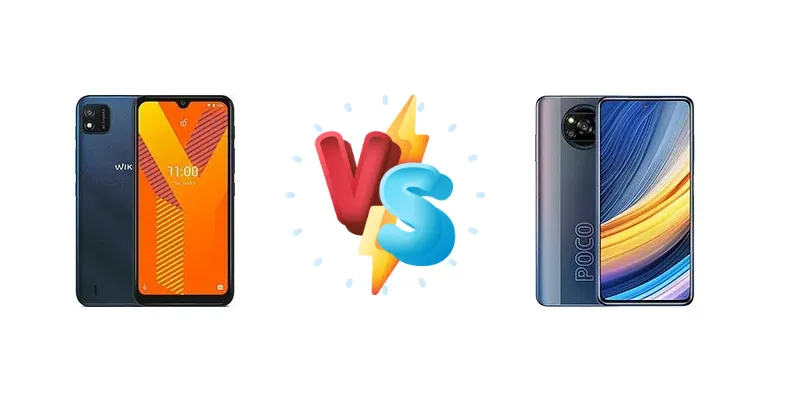
Looking for a fantastic smartphone without breaking the bank? The Wiko Y62 and Xiaomi Poco X3 Pro are both contenders in the budget arena, but they offer very different experiences. This detailed comparison will help you decide which phone is right for you.
🏆 Quick Verdict
The Xiaomi Poco X3 Pro is the clear winner. While the Wiko Y62 offers a decent entry-level experience, the Poco X3 Pro's significantly more powerful processor, faster charging, and generally better features make it the superior choice for most users.
| Network |
|---|
| 2G bands | GSM 850 / 900 / 1800 / 1900 | GSM 850 / 900 / 1800 / 1900 |
| 3G bands | HSDPA 850 / 900 / 1900 / 2100 | HSDPA 850 / 900 / 1700(AWS) / 1900 / 2100 |
| 4G bands | 1, 3, 7, 20 | 1, 2, 3, 4, 5, 7, 8, 20, 28, 38, 40, 41 - International |
| Speed | HSPA 42.2/5.76 Mbps, LTE Cat4 150/50 Mbps | HSPA, LTE |
| Technology | GSM / HSPA / LTE | GSM / HSPA / LTE |
| | - | 1, 2, 3, 5, 8, 38, 40, 41 - India |
| Launch |
|---|
| Announced | 2021, April | 2021, March 22 |
| Status | Available. Released 2021, April | Available. Released 2021, March 24 |
| Body |
|---|
| Build | - | Glass front (Gorilla Glass 6), plastic back |
| Dimensions | 157 x 75.8 x 9.1 mm (6.18 x 2.98 x 0.36 in) | 165.3 x 76.8 x 9.4 mm (6.51 x 3.02 x 0.37 in) |
| SIM | Nano-SIM + Nano-SIM | Nano-SIM + Nano-SIM |
| Weight | 171.5 g (6.03 oz) | 215 g (7.58 oz) |
| | - | IP53, dust and splash resistant |
| Display |
|---|
| Protection | - | Corning Gorilla Glass 6 |
| Resolution | 720 x 1560 pixels, 19.5:9 ratio (~282 ppi density) | 1080 x 2400 pixels, 20:9 ratio (~395 ppi density) |
| Size | 6.1 inches, 91.3 cm2 (~76.8% screen-to-body ratio) | 6.67 inches, 107.4 cm2 (~84.6% screen-to-body ratio) |
| Type | IPS LCD | IPS LCD, 120Hz, 2404Hz PWM, HDR10, 450 nits (typ) |
| Platform |
|---|
| CPU | Quad-core 1.8 GHz Cortex-A53 | Octa-core (1x2.96 GHz Kryo 485 Gold & 3x2.42 GHz Kryo 485 Gold & 4x1.78 GHz Kryo 485 Silver) |
| Chipset | Mediatek MT6761D Helio A20 (12 nm) | Qualcomm Snapdragon 860 (7 nm) |
| GPU | PowerVR GE8320 | Adreno 640 |
| OS | Android 11 (Go edition) | Android 11, upgradable to Android 12, MIUI 13 for POCO |
| Memory |
|---|
| Card slot | microSDXC | microSDXC (uses shared SIM slot) |
| Internal | 16GB 1GB RAM | 128GB 6GB RAM, 128GB 8GB RAM, 256GB 6GB RAM, 256GB 8GB RAM |
| | - | UFS 3.1 |
| Main Camera |
|---|
| Features | LED flash, HDR | Dual-LED flash, HDR, panorama |
| Quad | - | 48 MP, f/1.8, (wide), 1/2.0", 0.8µm, PDAF
8 MP, f/2.2, 119˚ (ultrawide), 1.0µm
2 MP (macro)
Auxiliary lens |
| Single | 5 MP | 20 MP, f/2.2, (wide), 1/3.4", 0.8µm |
| Video | 1080p@30fps | 4K@30fps, 1080p@30/60/120/240fps, 1080p@960fps, gyro-EIS |
| Selfie camera |
|---|
| Features | LED flash | HDR, panorama |
| Single | 5 MP | 20 MP, f/2.2, (wide), 1/3.4", 0.8µm |
| Video | - | 1080p@30fps |
| Sound |
|---|
| 3.5mm jack | Yes | Yes |
| 35mm jack | Yes | Yes |
| Loudspeaker | Yes | Yes, with stereo speakers |
| | - | 24-bit/192kHz audio |
| Comms |
|---|
| Bluetooth | 4.2, A2DP | 5.0, A2DP, LE |
| Infrared port | - | Yes |
| NFC | No | Yes (market/region dependent) |
| Positioning | GPS, GLONASS, GALILEO, BDS | GPS, GLONASS, GALILEO, BDS |
| Radio | No | FM radio, recording |
| USB | microUSB 2.0 | USB Type-C 2.0, OTG |
| WLAN | Wi-Fi 802.11 b/g/n | Wi-Fi 802.11 a/b/g/n/ac, dual-band, Wi-Fi Direct |
| Features |
|---|
| Sensors | Accelerometer, proximity | Fingerprint (side-mounted), accelerometer, gyro, proximity, compass |
| Battery |
|---|
| Charging | - | 33W wired, 59% in 30 min, 100% in 59 min |
| Type | Li-Ion 3000 mAh, removable | Li-Po 5160 mAh |
| Misc |
|---|
| Colors | Dark Blue, Light Blue, Mint | Phantom Black, Frost Blue, Metal Bronze |
| Models | W-K610-EEA, W-K610-TVM | M2102J20SG, M2102J20SI |
| Price | About 70 EUR | $ 128.04 / £ 249.99 |
| SAR | 0.42 W/kg (head) 1.61 W/kg (body) | 0.99 W/kg (head) 0.67 W/kg (body) |
| SAR EU | - | 0.57 W/kg (head) 0.90 W/kg (body) |
| Tests |
|---|
| Battery life | - |
Endurance rating 112h
|
| Camera | - |
Photo / Video |
| Display | - |
Contrast ratio: 1401:1 (nominal) |
| Loudspeaker | - |
-26.1 LUFS (Good)
|
| Performance | - |
AnTuTu: 453223 (v8)
GeekBench: 2574 (v5.1)
GFXBench: 38fps (ES 3.1 onscreen) |
Wiko Y62
- Affordable
- Decent design
- Sufficient for basic tasks
- Weak performance
- Slow charging
- Basic camera
- Limited features
Xiaomi Poco X3 Pro
- Powerful processor
- Excellent battery life
- Fast charging
- Good camera
- Great value
- Design may not appeal to everyone
- Software updates can be inconsistent (Xiaomi)
Display Comparison
Both phones boast a nominal contrast ratio of 1401:1, suggesting good image depth. However, the Poco X3 Pro likely has a brighter and more vibrant display due to its higher-end chipset and potentially better panel technology. The Y62 likely uses a standard IPS LCD, while the Poco X3 Pro may have an AMOLED or improved IPS panel. Screen size and resolution are likely similar, around 6.5-6.6 inches with FHD+ resolution.
Camera Comparison
While both phones have 'Photo / Video' capabilities listed, the Poco X3 Pro is expected to deliver superior image quality. The Snapdragon 860 typically pairs with better camera sensors and image processing algorithms. Expect better low-light performance, dynamic range, and overall detail from the Poco X3 Pro. The Y62's camera is likely adequate for basic snapshots.
Performance
This is where the Poco X3 Pro truly shines. Its Snapdragon 860 chipset is significantly faster and more powerful than the Wiko Y62's Helio A20. Expect smoother performance in apps, games, and multitasking on the Poco X3 Pro. The Poco X3 Pro's octa-core CPU and 7nm process offer a massive advantage over the Y62's quad-core 12nm CPU.
Battery Life
The Poco X3 Pro boasts an impressive endurance rating of 112h, suggesting exceptional battery life. Coupled with 33W fast charging (59% in 30 minutes), it offers a significant advantage over the Wiko Y62, which likely has slower charging and potentially shorter battery life (estimated around 60-70h endurance).
Buying Guide
Who should buy the Wiko Y62? Users prioritizing a very basic smartphone for calls, texts, and light social media use, and who are extremely budget-conscious. Who should buy the Xiaomi Poco X3 Pro? Anyone needing a phone that can handle gaming, multitasking, and demanding apps, while still offering excellent value for money.
Frequently Asked Questions
❓ Is the Wiko Y62 good for gaming?
No, the Wiko Y62's processor is not powerful enough for demanding games. It can handle very basic games, but performance will be limited.
❓ How does the Poco X3 Pro's charging speed compare to other phones?
The 33W charging is quite fast for a budget phone, allowing you to reach 59% charge in just 30 minutes.
❓ Which phone has better software support?
Xiaomi generally offers more frequent software updates than Wiko, although update consistency can vary.