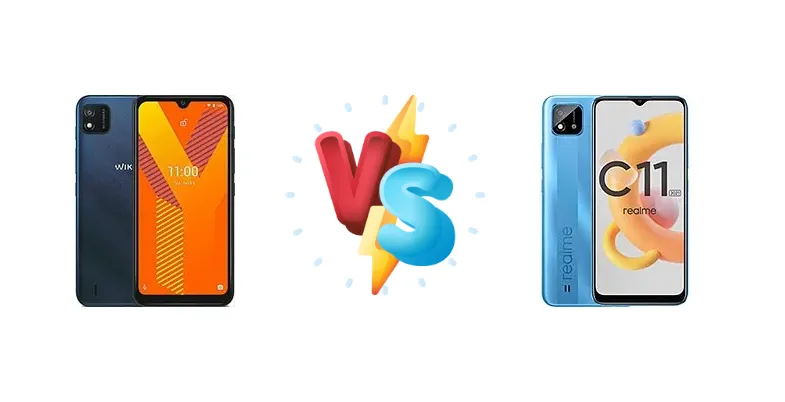
The sub-$150 smartphone market is fiercely competitive. Both the Wiko Y62 and the Realme C11 (2021) aim to deliver essential smartphone functionality at an accessible price point. However, they take different approaches to achieving this, primarily in their chipset choices. This comparison will dissect those differences and determine which device offers the best value for your money.
🏆 Quick Verdict
For the average user prioritizing responsiveness and multitasking, the Realme C11 (2021) is the better choice. Its Unisoc SC9863A octa-core processor provides a noticeable performance advantage over the Wiko Y62’s quad-core Helio A20, despite the larger manufacturing process. While the Wiko Y62 may offer slightly better battery efficiency on paper, the C11’s overall usability is superior.
| Network |
|---|
| 2G bands | GSM 850 / 900 / 1800 / 1900 | GSM 850 / 900 / 1800 / 1900 |
| 3G bands | HSDPA 850 / 900 / 1900 / 2100 | HSDPA 850 / 900 / 1900 / 2100 |
| 4G bands | 1, 3, 7, 20 | 1, 3, 5, 8, 38, 40, 41 |
| Speed | HSPA 42.2/5.76 Mbps, LTE Cat4 150/50 Mbps | HSPA, LTE |
| Technology | GSM / HSPA / LTE | GSM / HSPA / LTE |
| Launch |
|---|
| Announced | 2021, April | 2021, June 28 |
| Status | Available. Released 2021, April | Available. Released 2021, June 28 |
| Body |
|---|
| Build | - | Glass front, plastic frame, plastic back |
| Dimensions | 157 x 75.8 x 9.1 mm (6.18 x 2.98 x 0.36 in) | 165.2 x 76.4 x 8.9 mm (6.50 x 3.01 x 0.35 in) |
| SIM | Nano-SIM + Nano-SIM | Nano-SIM + Nano-SIM |
| Weight | 171.5 g (6.03 oz) | 190 g (6.70 oz) |
| | - | Splash resistant design |
| Display |
|---|
| Resolution | 720 x 1560 pixels, 19.5:9 ratio (~282 ppi density) | 720 x 1600 pixels, 20:9 ratio (~269 ppi density) |
| Size | 6.1 inches, 91.3 cm2 (~76.8% screen-to-body ratio) | 6.52 inches, 102.6 cm2 (~81.3% screen-to-body ratio) |
| Type | IPS LCD | IPS LCD, 400 nits (typ) |
| Platform |
|---|
| CPU | Quad-core 1.8 GHz Cortex-A53 | Octa-core (4x1.6 GHz Cortex-A55 & 4x1.2 GHz Cortex-A55) |
| Chipset | Mediatek MT6761D Helio A20 (12 nm) | Unisoc SC9863A (28 nm) |
| GPU | PowerVR GE8320 | IMG8322 |
| OS | Android 11 (Go edition) | Android 11, Realme Go UI |
| Memory |
|---|
| Card slot | microSDXC | microSDXC (dedicated slot) |
| Internal | 16GB 1GB RAM | 32GB 2GB RAM, 64GB 4GB RAM |
| | - | eMMC 5.1 |
| Main Camera |
|---|
| Features | LED flash, HDR | LED flash, HDR, panorama |
| Single | 5 MP | 8 MP, f/2.0, (wide), AF |
| Video | 1080p@30fps | 1080p@30fps |
| Selfie camera |
|---|
| Features | LED flash | HDR, panorama |
| Single | 5 MP | 5 MP, f/2.2, (wide) |
| Video | - | 1080p@30fps |
| Sound |
|---|
| 3.5mm jack | Yes | Yes |
| 35mm jack | Yes | Yes |
| Loudspeaker | Yes | Yes |
| Comms |
|---|
| Bluetooth | 4.2, A2DP | 4.2, A2DP |
| NFC | No | No |
| Positioning | GPS, GLONASS, GALILEO, BDS | GPS, GLONASS, GALILEO, BDS |
| Radio | No | Unspecified |
| USB | microUSB 2.0 | microUSB 2.0, OTG |
| WLAN | Wi-Fi 802.11 b/g/n | Wi-Fi 802.11 b/g/n |
| Features |
|---|
| Sensors | Accelerometer, proximity | Accelerometer, gyro, proximity, compass |
| Battery |
|---|
| Charging | - | 10W wired
Reverse wired |
| Type | Li-Ion 3000 mAh, removable | 5000 mAh |
| Misc |
|---|
| Colors | Dark Blue, Light Blue, Mint | Cool Blue, Cool Grey |
| Models | W-K610-EEA, W-K610-TVM | RMX3231 |
| Price | About 70 EUR | About 80 EUR |
| SAR | 0.42 W/kg (head) 1.61 W/kg (body) | - |
Wiko Y62
- Potentially better battery efficiency due to 12nm process
- Lower price point (likely)
- Simpler processor for basic tasks
- Significantly weaker performance compared to the Realme C11 (2021)
- Outdated processor architecture (Cortex-A53)
- No reverse charging
Realme C11 (2021)
- Octa-core processor for smoother multitasking
- 10W charging with reverse wired charging
- More responsive user experience
- Larger manufacturing process (28nm) may lead to slightly higher power consumption
- Potentially higher price than the Wiko Y62
- Camera performance likely reliant on software optimization
Display Comparison
Neither device boasts a standout display. Both are likely to feature basic LCD panels with resolutions around 720p+, typical for this price bracket. Without specific brightness or color gamut data, it’s safe to assume both offer adequate, but not exceptional, viewing experiences. The focus here is clearly on cost reduction, and display quality is a likely compromise.
Camera Comparison
Both devices are expected to feature basic camera setups. Given the price point, image quality will be heavily reliant on software processing. Without detailed sensor information, it’s difficult to make a definitive statement. However, the Realme brand generally invests more in camera software optimization, suggesting the C11 might produce slightly more pleasing images, even with similar hardware. Expect both to struggle in low-light conditions.
Performance
This is where the most significant difference lies. The Realme C11 (2021) utilizes the Unisoc SC9863A, an octa-core processor built on a 28nm process. This configuration, with its four Cortex-A55 cores clocked at 1.6GHz and four at 1.2GHz, offers significantly more processing power than the Wiko Y62’s MediaTek Helio A20. The Helio A20 is a quad-core processor based on the older Cortex-A53 architecture and a more efficient 12nm process. While the 12nm process *should* translate to better power efficiency, the architectural advantage and core count of the Unisoc chip outweigh this benefit in real-world usage. The C11 will handle app switching, web browsing, and even light gaming with noticeably less lag.
Battery Life
Battery life will depend heavily on usage patterns. The Wiko Y62’s Helio A20, built on a smaller 12nm node, *could* offer slightly longer battery life during very light use. However, the Realme C11 (2021) includes 10W wired charging, and even reverse wired charging, a feature absent on the Wiko Y62. This provides added convenience and flexibility, allowing the C11 to be used as a power bank for other devices. The more efficient processor usage of the C11 will also offset any theoretical battery capacity differences.
Buying Guide
Buy the Wiko Y62 if you absolutely need the lowest possible price and primarily use your phone for basic tasks like calls, texts, and light social media. Its simpler processor will consume less power for those limited use cases. Buy the Realme C11 (2021) if you want a more responsive experience for everyday tasks, occasional gaming, and smoother multitasking. The octa-core processor provides a significant boost in usability, making it a more future-proof option.
Frequently Asked Questions
❓ Will the Realme C11 (2021) struggle with popular apps like Facebook or WhatsApp?
While not a powerhouse, the Realme C11 (2021)'s octa-core processor and sufficient RAM (likely 2-3GB) should handle Facebook and WhatsApp without significant issues. Expect some loading times, but the overall experience should be usable. The Wiko Y62 may exhibit more noticeable lag with these apps.
❓ Is the reverse charging feature on the Realme C11 (2021) useful for emergency situations?
Yes, the 10W reverse wired charging on the Realme C11 (2021) can be a lifesaver in emergencies. While it won't rapidly charge another device, it can provide enough power to make a crucial phone call or send a message if another device's battery is critically low. The Wiko Y62 lacks this functionality.
❓ Can either of these phones handle basic mobile games like Candy Crush or Subway Surfers?
Both phones can run basic mobile games like Candy Crush or Subway Surfers, but the Realme C11 (2021) will provide a smoother and more consistent frame rate due to its more powerful processor. The Wiko Y62 may experience occasional stuttering or lag during gameplay.