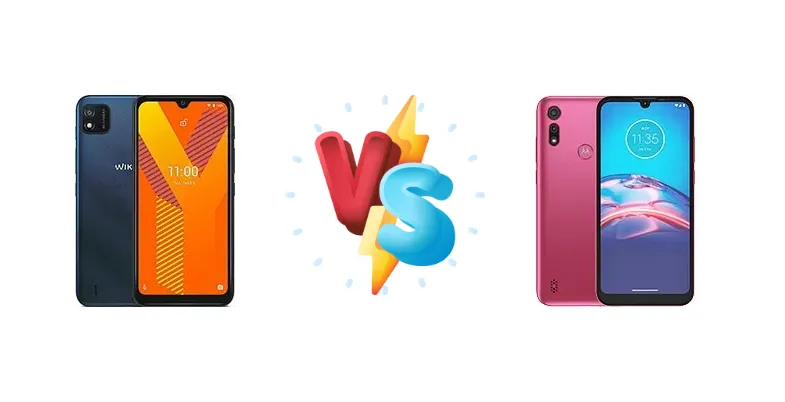
The Wiko Y62 and Motorola Moto E6i represent the extreme end of the budget smartphone spectrum. Both aim to deliver essential smartphone functionality at the lowest possible price point, but they take different approaches to achieving this. This comparison dissects their core components to reveal which device offers the best value for users prioritizing performance and efficiency.
🏆 Quick Verdict
For the average user, the Motorola Moto E6i is the better choice. While the Wiko Y62 benefits from a newer fabrication process (12nm vs 28nm), the Moto E6i’s octa-core processor provides a significant performance advantage in multi-tasking and app responsiveness, making it a more fluid daily driver.
| Network |
|---|
| 2G bands | GSM 850 / 900 / 1800 / 1900 | GSM 850 / 900 / 1800 / 1900 |
| 3G bands | HSDPA 850 / 900 / 1900 / 2100 | HSDPA 850 / 900 / 1700(AWS) / 1900 / 2100 |
| 4G bands | 1, 3, 7, 20 | 1, 2, 3, 4, 5, 7, 8, 19, 28, 66 |
| Speed | HSPA 42.2/5.76 Mbps, LTE Cat4 150/50 Mbps | HSPA, LTE |
| Technology | GSM / HSPA / LTE | GSM / HSPA / LTE |
| Launch |
|---|
| Announced | 2021, April | 2021, February 11 |
| Status | Available. Released 2021, April | Available. Released 2021, February 11 |
| Body |
|---|
| Build | - | Glass front, plastic back, plastic frame |
| Dimensions | 157 x 75.8 x 9.1 mm (6.18 x 2.98 x 0.36 in) | 155.6 x 73 x 8.5 mm (6.13 x 2.87 x 0.33 in) |
| SIM | Nano-SIM + Nano-SIM | Nano-SIM + Nano-SIM |
| Weight | 171.5 g (6.03 oz) | 160 g (5.64 oz) |
| Display |
|---|
| Resolution | 720 x 1560 pixels, 19.5:9 ratio (~282 ppi density) | 720 x 1560 pixels, 19.5:9 ratio (~282 ppi density) |
| Size | 6.1 inches, 91.3 cm2 (~76.8% screen-to-body ratio) | 6.1 inches, 91.3 cm2 (~80.4% screen-to-body ratio) |
| Type | IPS LCD | IPS LCD |
| Platform |
|---|
| CPU | Quad-core 1.8 GHz Cortex-A53 | Octa-core (4x1.6 GHz Cortex-A55 & 4x1.2 GHz Cortex-A55) |
| Chipset | Mediatek MT6761D Helio A20 (12 nm) | Unisoc SC9863A (28 nm) |
| GPU | PowerVR GE8320 | IMG8322 |
| OS | Android 11 (Go edition) | Android 10 (Go edition) |
| Memory |
|---|
| Card slot | microSDXC | microSDXC (uses shared SIM slot) |
| Internal | 16GB 1GB RAM | 32GB 2GB RAM |
| | - | eMMC 5.1 |
| Main Camera |
|---|
| Dual | - | 13 MP, f/2.2, 26mm (wide), 1/3.1", 1.12µm, PDAF
Auxiliary lens |
| Features | LED flash, HDR | LED flash, HDR, panorama |
| Single | 5 MP | - |
| Video | 1080p@30fps | 1080p@30fps |
| Selfie camera |
|---|
| Features | LED flash | - |
| Single | 5 MP | 5 MP, f/2.2, 27mm (wide), 1.12µm |
| Video | - | 1080p@30fps |
| Sound |
|---|
| 3.5mm jack | Yes | Yes |
| 35mm jack | Yes | Yes |
| Loudspeaker | Yes | Yes |
| Comms |
|---|
| Bluetooth | 4.2, A2DP | 4.2, A2DP, LE |
| NFC | No | No |
| Positioning | GPS, GLONASS, GALILEO, BDS | GPS, GLONASS |
| Radio | No | Unspecified |
| USB | microUSB 2.0 | microUSB 2.0, OTG |
| WLAN | Wi-Fi 802.11 b/g/n | Wi-Fi 802.11 b/g/n |
| Features |
|---|
| Sensors | Accelerometer, proximity | Fingerprint (rear-mounted), accelerometer, proximity |
| Battery |
|---|
| Charging | - | 10W wired |
| Type | Li-Ion 3000 mAh, removable | Li-Ion 3000 mAh |
| Misc |
|---|
| Colors | Dark Blue, Light Blue, Mint | Titanium Gray, Pink |
| Models | W-K610-EEA, W-K610-TVM | XT2053-5 |
| Price | About 70 EUR | About 170 EUR |
| SAR | 0.42 W/kg (head) 1.61 W/kg (body) | - |
Wiko Y62
- Potentially better power efficiency due to 12nm process.
- Simpler software experience (likely)
- Lower price point (potentially)
- Quad-core processor limits performance.
- Older CPU architecture (Cortex-A53).
- Charging speed not specified.
Motorola Moto E6i
- Octa-core processor for smoother multitasking.
- More modern CPU architecture (Cortex-A55).
- 10W wired charging included.
- Larger fabrication process (28nm) may impact efficiency.
- Potentially higher price.
- Unisoc chipset may have limited software support.
Display Comparison
Neither device boasts a standout display. Details regarding panel type, resolution, and brightness are unavailable, suggesting both utilize basic LCD panels common in this price bracket. The focus here is on functionality over fidelity. Bezels are likely to be substantial on both, and color accuracy will be standard for budget devices. Without further data, it's safe to assume a similar viewing experience.
Camera Comparison
Camera performance is likely to be similar on both devices, with both likely featuring basic sensors. Details are scarce, but it’s reasonable to expect a primary sensor around 8-13MP on each. Image processing will be minimal, and low-light performance will be limited. The absence of Optical Image Stabilization (OIS) on either device means image stabilization will rely solely on software algorithms. Any secondary cameras (often 2MP macro lenses) are unlikely to offer significant value.
Performance
The core difference lies in the chipsets. The Motorola Moto E6i’s Unisoc SC9863A features an octa-core CPU configuration (4x1.6 GHz Cortex-A55 & 4x1.2 GHz Cortex-A55), offering significantly more processing power than the Wiko Y62’s Mediatek MT6761D Helio A20, which is limited to a quad-core 1.8 GHz Cortex-A53. While the Helio A20 benefits from a more modern 12nm fabrication process compared to the Unisoc’s 28nm, the sheer number of cores in the Moto E6i provides a tangible advantage in multi-threaded tasks. This translates to smoother app switching, faster web browsing, and a more responsive user interface. The Unisoc’s Cortex-A55 cores are also more efficient than the A53 cores found in the Helio A20, further mitigating the impact of the larger process node.
Battery Life
Battery capacity details are missing for both devices. However, the Moto E6i includes 10W wired charging, a feature not explicitly mentioned for the Wiko Y62. While 10W is slow by modern standards, it provides a defined charging speed. The Wiko Y62’s 12nm process *could* translate to slightly better battery life under light usage, but the Moto E6i’s more efficient Cortex-A55 cores may offset this advantage during more demanding tasks. Without specific mAh figures, it’s difficult to definitively declare a winner.
Buying Guide
Buy the Wiko Y62 if you need a phone primarily for basic communication – calls, texts, and light social media – and prioritize potential long-term efficiency gains from its newer manufacturing process. Buy the Motorola Moto E6i if you prefer a more responsive experience for everyday tasks, including running multiple apps simultaneously, and value the benefits of an octa-core processor, even if it comes at the cost of slightly lower theoretical power efficiency.
Frequently Asked Questions
❓ Will the Motorola Moto E6i struggle with popular apps like Facebook or WhatsApp?
While not a powerhouse, the Moto E6i’s octa-core processor should handle Facebook and WhatsApp without significant issues. Expect some loading times and occasional slowdowns with multiple apps open, but it’s sufficient for basic social media usage. The Wiko Y62 may exhibit more noticeable lag in these scenarios.
❓ Is the Unisoc SC9863A chipset reliable in the long term, and will it receive software updates?
Unisoc chipsets have historically had a less robust software update track record compared to MediaTek or Qualcomm. While the Moto E6i will likely receive essential security patches, major Android version updates are less certain. Reliability is generally acceptable for basic usage, but don’t expect the same level of long-term support as more established brands.
❓ Can either of these phones handle basic mobile gaming?
Both phones can handle very basic 2D games. However, demanding 3D titles will likely be unplayable or require extremely low graphics settings. The Moto E6i’s processor will offer a slightly smoother experience, but neither phone is designed for gaming.