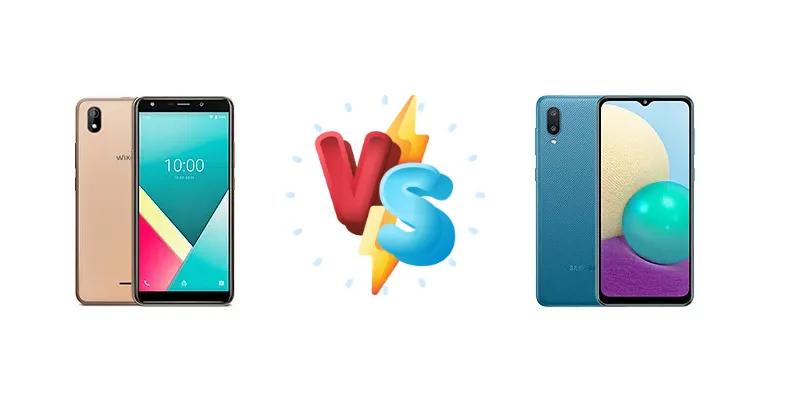
The Wiko Y61 and Samsung Galaxy A02 represent the extreme end of the smartphone price spectrum. Both aim to deliver basic smartphone functionality at the lowest possible cost, but they achieve this with different hardware choices. This comparison dissects those choices, focusing on where each phone excels and where compromises are made.
🏆 Quick Verdict
For the average user prioritizing basic functionality and a slightly more modern processor, the Wiko Y61 emerges as the better choice. While lacking the brand recognition of Samsung, its 1.8GHz quad-core CPU offers a modest performance advantage over the Galaxy A02’s 1.5GHz processor, making it more responsive for everyday tasks.
| Network |
|---|
| 2G bands | GSM 850 / 900 / 1800 / 1900 | GSM 850 / 900 / 1800 / 1900 |
| 3G bands | HSDPA 850 / 900 / 1900 / 2100 | HSDPA 850 / 900 / 2100 |
| 4G bands | 1, 3, 7, 8, 20 | 1, 3, 5, 7, 8, 20, 28, 38, 40, 41 |
| EDGE | Yes | - |
| GPRS | Class 12 | - |
| Speed | HSPA 42.2/5.76 Mbps, LTE Cat4 150/50 Mbps | HSPA 42.2/5.76 Mbps, LTE Cat4 150/50 Mbps |
| Technology | GSM / HSPA / LTE | GSM / HSPA / LTE |
| Launch |
|---|
| Announced | 2020. Released 2020 | 2021, January 27 |
| Status | Discontinued | Available. Released 2021, January 27 |
| Body |
|---|
| Build | - | Glass front, plastic back, plastic frame |
| Dimensions | 161.3 x 78.1 x 9 mm (6.35 x 3.07 x 0.35 in) | 164 x 75.9 x 9.1 mm (6.46 x 2.99 x 0.36 in) |
| SIM | Nano-SIM + Micro-SIM | · Nano-SIM· Nano-SIM + Nano-SIM |
| Weight | 190 g (6.70 oz) | 206 g (7.27 oz) |
| Display |
|---|
| Resolution | 480 x 960 pixels, 18:9 ratio (~179 ppi density) | 720 x 1600 pixels, 20:9 ratio (~270 ppi density) |
| Size | 5.99 inches, 92.6 cm2 (~73.5% screen-to-body ratio) | 6.5 inches, 102.0 cm2 (~81.9% screen-to-body ratio) |
| Type | IPS LCD | PLS LCD |
| Platform |
|---|
| CPU | Quad-core 1.8 GHz | Quad-core 1.5 GHz Cortex-A53 |
| Chipset | Mediatek MT6761WE | Mediatek MT6739W (28 nm) |
| GPU | PowerVR GE8300 | PowerVR GE8100 |
| OS | Android 10 (Go edition) | Android 10, upgradable to Android 11, One UI Core 3.1 |
| Memory |
|---|
| Call records | Yes | - |
| Card slot | microSDXC | microSDXC (dedicated slot) |
| Internal | 16GB 1GB RAM, 32GB 2GB RAM | 32GB 2GB RAM, 32GB 3GB RAM, 32GB 4GB RAM, 64GB 3GB RAM |
| Phonebook | Yes, Photocall | - |
| | eMMC 5.1 | eMMC 5.1 |
| Main Camera |
|---|
| Dual | - | 13 MP, f/1.9, (wide), AF
2 MP (macro) |
| Features | LED flash | LED flash |
| Single | 8 MP | - |
| Video | 1080p@30fps | 1080p@30fps |
| Selfie camera |
|---|
| Features | LED flash | - |
| Single | 5 MP | 5 MP, f/2.0 |
| Sound |
|---|
| 3.5mm jack | Yes | Yes |
| 35mm jack | Yes | Yes |
| Loudspeaker | Yes | Yes |
| | eMMC 5.1 | - |
| Comms |
|---|
| Bluetooth | 4.2, A2DP, LE | 5.1, A2DP, LE |
| NFC | No | No |
| Positioning | GPS | GPS, GLONASS |
| Radio | FM radio | FM radio |
| USB | microUSB 2.0 | microUSB 2.0 |
| WLAN | Wi-Fi 802.11 b/g/n | Wi-Fi 802.11 b/g/n, Wi-Fi Direct |
| Features |
|---|
| Browser | WAP 2.0/xHTML, HTML | - |
| Games | Yes | - |
| Java | Yes, MIDP 2.0 | - |
| Messaging | SMS, MMS, Email | - |
| Sensors | Accelerometer, proximity, compass | Accelerometer |
| | - | Virtual proximity sensing |
| Battery |
|---|
| Stand-by | Up to 744 h | - |
| Talk time | Up to 8 h | - |
| Type | Li-Ion 3000 mAh | Li-Po 5000 mAh |
| Misc |
|---|
| Colors | Deep Grey, Deep Green, Gold | Black, Blue |
| Models | W-K560-EEA, W-K560-ID | SM-A022F, SM-A022F/DS, SM-A022M, SM-A022M/DS, SM-A022G, SM-A022G/DS |
| Price | About 60 EUR | € 97.46 |
| SAR EU | - | 0.65 W/kg (head) 1.71 W/kg (body) |
| Pricing |
|---|
| 32GB 2GB RAM | - | $ 149.99 |
| 32GB 3GB RAM | - | $ 129.99 |
| 64GB 3GB RAM | - | $ 199.99 |
| RENEWED | - | £ 113.00 |
Wiko Y61
- Slightly faster processor (1.8GHz vs 1.5GHz)
- Potentially better power efficiency with newer chipset
- More responsive user experience for basic tasks
- Less brand recognition than Samsung
- RAM amount not specified
Samsung Galaxy A02
- Established brand reputation (Samsung)
- Multiple storage/RAM configurations available (32GB/2GB, 32GB/3GB, 64GB/3GB)
- Potentially better software support
- Slower processor (1.5GHz)
- Older, less efficient chipset (MT6739W, 28nm)
- 2MP macro camera offers limited value
Display Comparison
Neither device boasts a standout display. Both are expected to utilize LCD panels, typical for this price point. Specifics like resolution and brightness are not provided, but we can infer that both will offer a basic viewing experience. The lack of information prevents a detailed comparison of color accuracy or viewing angles. Bezels are likely to be substantial on both devices, maximizing screen real estate within a compact form factor.
Camera Comparison
Camera performance is likely to be similar on both devices, leaning towards basic functionality. Neither phone is expected to excel in low-light conditions. The Galaxy A02’s available configurations include options with different RAM amounts, but camera specs remain consistent. The presence of a 2MP macro camera on the A02 is largely a marketing feature, offering limited practical benefit due to the low resolution. Without detailed sensor size information, it’s difficult to definitively say which phone will produce better images, but the processor’s image signal processor (ISP) capabilities will play a significant role.
Performance
The core difference lies in the chipsets. The Wiko Y61’s Mediatek MT6761WE, with its 1.8 GHz quad-core CPU, offers a clock speed advantage over the Samsung Galaxy A02’s Mediatek MT6739W (1.5 GHz Cortex-A53). While both are entry-level processors, the higher clock speed suggests the Wiko Y61 will handle multitasking and app loading slightly faster. The MT6739W, built on a 28nm process, is older technology and potentially less power-efficient, which could lead to more noticeable thermal throttling during sustained use. The Galaxy A02’s availability in 2GB or 3GB RAM configurations impacts multitasking capabilities; the 3GB variant will offer a smoother experience than the 2GB model, but the Y61’s RAM is not specified.
Battery Life
Battery capacity isn’t specified for the Wiko Y61, but given its market segment, it’s likely comparable to the Galaxy A02’s. The Galaxy A02’s battery life will depend heavily on usage patterns and the amount of RAM (2GB vs 3GB). The MT6739W’s less efficient 28nm process could contribute to faster battery drain. Charging wattage is not provided for either device, suggesting both will rely on slow charging speeds via Micro-USB, a common feature in this price range.
Buying Guide
Buy the Wiko Y61 if you need a phone for essential tasks like calling, texting, and light social media browsing, and value a slightly smoother user experience within a limited budget. Buy the Samsung Galaxy A02 if you prioritize brand reliability and access to Samsung’s ecosystem, and are willing to accept a slightly slower processor in exchange for potentially better software support and a wider range of available storage/RAM configurations.
Frequently Asked Questions
❓ Will the Mediatek MT6739W in the Galaxy A02 struggle with modern apps?
Yes, the MT6739W is an older, entry-level chipset. While it can handle basic apps like calling, texting, and social media, it will likely exhibit lag and slowdowns when running more demanding applications or multitasking heavily. The Wiko Y61’s MT6761WE offers a modest improvement, but neither phone is designed for intensive use.
❓ Is the 3GB of RAM on some Galaxy A02 models worth the extra cost?
Absolutely. The 3GB RAM variant of the Galaxy A02 will provide a noticeably smoother multitasking experience compared to the 2GB model. It allows you to keep more apps open in the background without significant performance degradation. If you plan to use more than a few apps regularly, the 3GB version is highly recommended.
❓ Can either of these phones play PUBG Mobile?
While technically possible to *launch* PUBG Mobile on both devices, the experience will be far from ideal. The processors lack the graphical power to run the game smoothly, even at the lowest settings. Expect significant frame rate drops and lag, making gameplay frustrating. These phones are not suitable for gaming.
❓ What type of charging port do these phones use?
Both the Wiko Y61 and Samsung Galaxy A02 are expected to use a Micro-USB port for charging. This is a slower charging standard compared to USB-C, and charging times will likely be lengthy.