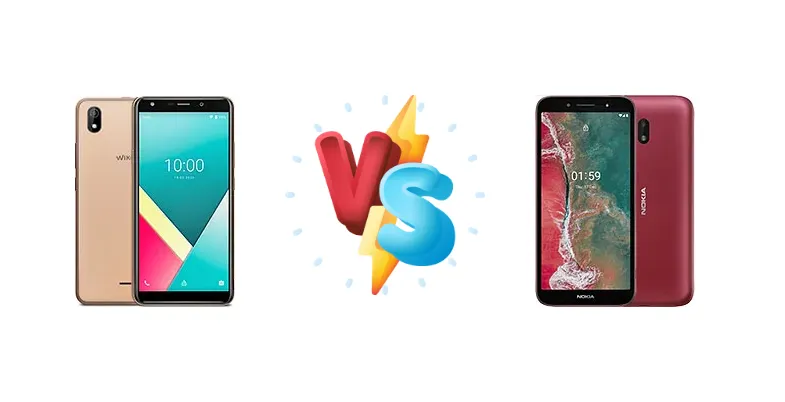
The Wiko Y61 and Nokia C1 Plus represent the absolute bottom end of the smartphone market, targeting users who need basic connectivity without breaking the bank. Both devices run Android Go edition to optimize performance on limited hardware, but key differences in their processors and overall specifications create distinct user experiences. This comparison will dissect those differences to determine which phone offers the best value.
🏆 Quick Verdict
For the average user prioritizing responsiveness and a slightly smoother experience, the Wiko Y61 emerges as the better choice. Its 1.8 GHz quad-core processor, based on the Mediatek MT6761WE chipset, provides a noticeable performance edge over the Nokia C1 Plus’s 1.4 GHz processor, making everyday tasks feel less sluggish.
| Network |
|---|
| 2G bands | GSM 850 / 900 / 1800 / 1900 | GSM 850 / 900 / 1800 / 1900 |
| 3G bands | HSDPA 850 / 900 / 1900 / 2100 | HSDPA 850 / 900 / 2100 - International, APAC |
| 4G bands | 1, 3, 7, 8, 20 | 1, 3, 7, 8, 20, 28 - International |
| EDGE | Yes | - |
| GPRS | Class 12 | - |
| Speed | HSPA 42.2/5.76 Mbps, LTE Cat4 150/50 Mbps | HSPA 21.1/5.76 Mbps, LTE Cat4 150/50 Mbps |
| Technology | GSM / HSPA / LTE | GSM / HSPA / LTE |
| | - | 1, 3, 8, 20, 28, 38, 40, 41 - Saudi Arabia |
| Launch |
|---|
| Announced | 2020. Released 2020 | 2020, December 15. Released 2021, January 29 |
| Status | Discontinued | Discontinued |
| Body |
|---|
| Build | - | Glass front, plastic back, plastic frame |
| Dimensions | 161.3 x 78.1 x 9 mm (6.35 x 3.07 x 0.35 in) | 149.1 x 71.2 x 8.8 mm (5.87 x 2.80 x 0.35 in) |
| SIM | Nano-SIM + Micro-SIM | · Nano-SIM· Nano-SIM + Nano-SIM |
| Weight | 190 g (6.70 oz) | 146 g (5.15 oz) |
| Display |
|---|
| Resolution | 480 x 960 pixels, 18:9 ratio (~179 ppi density) | 720 x 1440 pixels, 18:9 ratio (~295 ppi density) |
| Size | 5.99 inches, 92.6 cm2 (~73.5% screen-to-body ratio) | 5.45 inches, 76.7 cm2 (~72.2% screen-to-body ratio) |
| Type | IPS LCD | IPS LCD |
| Platform |
|---|
| CPU | Quad-core 1.8 GHz | Quad-core 1.4 GHz |
| Chipset | Mediatek MT6761WE | - |
| GPU | PowerVR GE8300 | - |
| OS | Android 10 (Go edition) | Android 10 (Go edition) |
| Memory |
|---|
| Call records | Yes | - |
| Card slot | microSDXC | microSDXC (dedicated slot) |
| Internal | 16GB 1GB RAM, 32GB 2GB RAM | 16GB 1GB RAM |
| Phonebook | Yes, Photocall | - |
| | eMMC 5.1 | eMMC 5.1 |
| Main Camera |
|---|
| Features | LED flash | LED flash, HDR |
| Single | 8 MP | 5 MP |
| Video | 1080p@30fps | 720p@30fps |
| Selfie camera |
|---|
| Features | LED flash | LED flash, HDR |
| Single | 5 MP | 5 MP |
| Video | - | 720p@30fps |
| Sound |
|---|
| 3.5mm jack | Yes | Yes |
| 35mm jack | Yes | Yes |
| Loudspeaker | Yes | Yes |
| | eMMC 5.1 | - |
| Comms |
|---|
| Bluetooth | 4.2, A2DP, LE | 4.2, A2DP, LE |
| NFC | No | No |
| Positioning | GPS | GPS |
| Radio | FM radio | FM radio |
| USB | microUSB 2.0 | microUSB 2.0 |
| WLAN | Wi-Fi 802.11 b/g/n | Wi-Fi 802.11 b/g/n |
| Features |
|---|
| Browser | WAP 2.0/xHTML, HTML | - |
| Games | Yes | - |
| Java | Yes, MIDP 2.0 | - |
| Messaging | SMS, MMS, Email | - |
| Sensors | Accelerometer, proximity, compass | Accelerometer, proximity |
| Battery |
|---|
| Stand-by | Up to 744 h | - |
| Talk time | Up to 8 h | - |
| Type | Li-Ion 3000 mAh | Li-Ion 2500 mAh, removable |
| Misc |
|---|
| Colors | Deep Grey, Deep Green, Gold | Blue, Red |
| Models | W-K560-EEA, W-K560-ID | TA-1312 |
| Price | About 60 EUR | About 70 EUR |
Wiko Y61
- Faster 1.8 GHz processor offers better performance.
- Mediatek MT6761WE chipset provides a slight architectural advantage.
- Potentially smoother user experience for basic tasks.
- Limited RAM likely restricts multitasking.
- Camera quality is expected to be basic.
Nokia C1 Plus
- Nokia brand recognition and potential for software updates.
- Android Go edition optimizes performance for limited hardware.
- Potentially cleaner software experience.
- Slower 1.4 GHz processor results in sluggish performance.
- May struggle with even basic apps and multitasking.
Display Comparison
Neither Wiko nor Nokia provide display specifications beyond size. Given the price point, both likely utilize LCD panels with modest resolutions (likely 720p+). The absence of detailed specs suggests neither phone will excel in brightness or color accuracy. Bezels are expected to be substantial on both devices, maximizing screen real estate within a compact form factor. The display experience will be functional, but not visually impressive on either device.
Camera Comparison
Camera details are sparse for both devices. It’s safe to assume both feature basic rear and front-facing cameras, likely with low megapixel counts. Without sensor size or aperture information, a detailed comparison is impossible. However, given the target market, image quality will be a secondary concern. Expect adequate performance in well-lit conditions, but poor results in low light. The presence of a 2MP macro camera on either device is largely a marketing gimmick and unlikely to produce usable images.
Performance
The core difference lies in the CPU: the Wiko Y61 boasts a quad-core processor clocked at 1.8 GHz, built on the Mediatek MT6761WE chipset. The Nokia C1 Plus features a quad-core processor running at 1.4 GHz. While both are entry-level, the 0.4 GHz clock speed difference, coupled with the chipset architecture, translates to a tangible performance advantage for the Wiko Y61. This means faster app loading times, smoother scrolling, and a more responsive overall user experience. The Nokia C1 Plus will likely struggle with even moderately demanding tasks. RAM specifications are not provided, but both are likely to be limited to 1-2GB, further emphasizing the importance of CPU efficiency.
Battery Life
Battery capacity is not specified for either device. However, given their budget nature, both likely house batteries in the 2000-3000 mAh range. Charging wattage is also unknown. Real-world battery life will depend heavily on usage patterns, but both phones should be able to last a full day with light use (calls, texts, occasional browsing). Fast charging is not expected on either device; a full charge will likely take several hours.
Buying Guide
Buy the Wiko Y61 if you need a phone capable of handling basic social media, messaging, and occasional web browsing with a degree of responsiveness. It’s ideal for users who want the most performance possible within a very tight budget. Buy the Nokia C1 Plus if you prioritize brand recognition and a potentially cleaner software experience, and are willing to accept a slower, more basic user experience. It’s best suited for users who primarily need a device for calls and texts.
Frequently Asked Questions
❓ Will the Wiko Y61 struggle with popular apps like Facebook or WhatsApp?
While the Wiko Y61 offers better performance than the Nokia C1 Plus, it's still an entry-level device. Facebook and WhatsApp will likely function, but may experience occasional lag or slowdowns, especially with multiple chats open or when loading images and videos. Managing app usage and closing unused apps will be crucial for maintaining a smooth experience.
❓ Is the Android Go edition on the Nokia C1 Plus a significant benefit?
Android Go edition is specifically designed for devices with limited RAM and processing power. It uses less storage space and data, and offers optimized versions of Google apps. While helpful, it can't fully compensate for the Nokia C1 Plus's slower processor. It will make the phone *usable*, but not necessarily *fast*.
❓ Can either of these phones handle mobile gaming?
Neither the Wiko Y61 nor the Nokia C1 Plus are suitable for mobile gaming beyond very simple, 2D games. The processors lack the power to run graphically demanding titles smoothly. Expect significant frame rate drops and lag even on low settings.