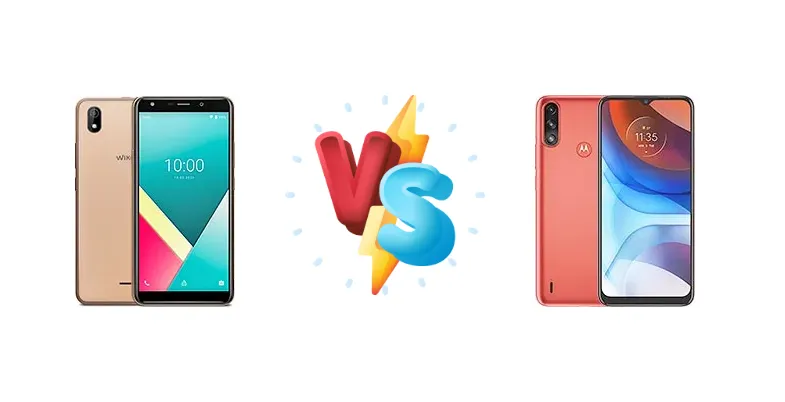
The Wiko Y61 and Motorola Moto E7i Power represent the extreme end of the smartphone price spectrum. Both aim to deliver essential functionality at a minimal cost, but they take different approaches to achieving this. The Y61 relies on a simpler, older Mediatek chipset, while the Moto E7i Power opts for the Unisoc SC9863A, an octa-core processor. This comparison will dissect their key differences to determine which offers the best value for budget-conscious consumers.
🏆 Quick Verdict
For most users, the Motorola Moto E7i Power is the better choice. Its octa-core processor, despite being built on a 28nm process, provides a noticeable performance advantage over the Wiko Y61’s quad-core setup. While charging is slow at 10W, the E7i Power’s more efficient processor and likely larger battery (though capacity is unspecified) will translate to longer real-world usage.
| Network |
|---|
| 2G bands | GSM 850 / 900 / 1800 / 1900 | GSM 850 / 900 / 1800 / 1900 |
| 3G bands | HSDPA 850 / 900 / 1900 / 2100 | HSDPA 850 / 900 / 1700(AWS) / 1900 / 2100 |
| 4G bands | 1, 3, 7, 8, 20 | LTE |
| EDGE | Yes | - |
| GPRS | Class 12 | - |
| Speed | HSPA 42.2/5.76 Mbps, LTE Cat4 150/50 Mbps | HSPA, LTE |
| Technology | GSM / HSPA / LTE | GSM / HSPA / LTE |
| Launch |
|---|
| Announced | 2020. Released 2020 | 2021, February 23 |
| Status | Discontinued | Available. Released 2021, March 15 |
| Body |
|---|
| Build | - | Glass front, plastic back, plastic frame |
| Dimensions | 161.3 x 78.1 x 9 mm (6.35 x 3.07 x 0.35 in) | 165.1 x 75.9 x 9.2 mm (6.5 x 2.99 x 0.36 in) |
| SIM | Nano-SIM + Micro-SIM | Nano-SIM + Nano-SIM |
| Weight | 190 g (6.70 oz) | 200 g (7.05 oz) |
| | - | Water-repellent design |
| Display |
|---|
| Resolution | 480 x 960 pixels, 18:9 ratio (~179 ppi density) | 720 x 1600 pixels, 20:9 ratio (~270 ppi density) |
| Size | 5.99 inches, 92.6 cm2 (~73.5% screen-to-body ratio) | 6.51 inches, 102.3 cm2 (~81.7% screen-to-body ratio) |
| Type | IPS LCD | IPS LCD, 380 nits (typ) |
| Platform |
|---|
| CPU | Quad-core 1.8 GHz | Octa-core (4x1.6 GHz Cortex-A55 & 4x1.2 GHz Cortex-A55) |
| Chipset | Mediatek MT6761WE | Unisoc SC9863A (28 nm) |
| GPU | PowerVR GE8300 | IMG8322 |
| OS | Android 10 (Go edition) | Android 10 (Go edition) |
| Memory |
|---|
| Call records | Yes | - |
| Card slot | microSDXC | microSDXC (uses shared SIM slot) |
| Internal | 16GB 1GB RAM, 32GB 2GB RAM | 32GB 2GB RAM |
| Phonebook | Yes, Photocall | - |
| | eMMC 5.1 | eMMC 5.1 |
| Main Camera |
|---|
| Dual | - | 13 MP, f/2.0, 26mm (wide), 1/3.1", 1.12µm, PDAF
2 MP (macro) |
| Features | LED flash | LED flash, HDR, panorama |
| Single | 8 MP | - |
| Video | 1080p@30fps | 1080p@30fps |
| Selfie camera |
|---|
| Features | LED flash | HDR |
| Single | 5 MP | 5 MP, f/2.2, 27mm (wide), 1.12µm |
| Video | - | 1080p@30fps |
| Sound |
|---|
| 3.5mm jack | Yes | Yes |
| 35mm jack | Yes | Yes |
| Loudspeaker | Yes | Yes |
| | eMMC 5.1 | - |
| Comms |
|---|
| Bluetooth | 4.2, A2DP, LE | 4.2, A2DP |
| NFC | No | No |
| Positioning | GPS | GPS, GLONASS, GALILEO |
| Radio | FM radio | Unspecified |
| USB | microUSB 2.0 | USB Type-C 2.0 |
| WLAN | Wi-Fi 802.11 b/g/n | Wi-Fi 802.11 b/g/n |
| Features |
|---|
| Browser | WAP 2.0/xHTML, HTML | - |
| Games | Yes | - |
| Java | Yes, MIDP 2.0 | - |
| Messaging | SMS, MMS, Email | - |
| Sensors | Accelerometer, proximity, compass | Fingerprint (rear-mounted), accelerometer, proximity |
| Battery |
|---|
| Charging | - | 10W wired |
| Stand-by | Up to 744 h | - |
| Talk time | Up to 8 h | - |
| Type | Li-Ion 3000 mAh | Li-Ion 5000 mAh |
| Misc |
|---|
| Colors | Deep Grey, Deep Green, Gold | Tahiti Blue, Coral Red |
| Models | W-K560-EEA, W-K560-ID | XT2097-13 |
| Price | About 60 EUR | About 120 EUR |
Wiko Y61
- Potentially simpler software experience.
- May be slightly cheaper (depending on retailer).
- Compact form factor (likely).
- Significantly weaker processor performance.
- Less efficient chipset, potentially shorter battery life.
- Limited multitasking capabilities.
Motorola Moto E7i Power
- Octa-core processor for smoother performance.
- More power-efficient chipset.
- Likely longer battery life.
- Potentially better image processing.
- Slow 10W charging.
- May be slightly more expensive.
- Unisoc chipset may have limited software support.
Display Comparison
Neither device’s display specifications are detailed in the provided data, so we must infer. Given their price point, both likely feature LCD panels with 720p+ resolution. The Wiko Y61’s Mediatek chipset may have limited display output capabilities, potentially resulting in slightly less vibrant colors. The Moto E7i Power, with its more modern Unisoc chipset, *could* support a slightly higher refresh rate, though this is unlikely. Bezels are expected to be substantial on both devices, reflecting their budget nature.
Camera Comparison
Without sensor details, a camera comparison is difficult. Both phones likely feature basic camera setups geared towards casual photography. It’s highly probable that both include a primary camera and a depth sensor, and potentially a low-resolution macro lens. Image processing will likely be minimal on both devices. The Unisoc chipset in the Moto E7i Power *may* offer slightly better image signal processing (ISP) capabilities, leading to marginally improved image quality, but this is speculative. The absence of OIS on either device means low-light performance will be limited.
Performance
The core difference lies in the processors. The Wiko Y61’s Mediatek MT6761WE is a quad-core processor clocked at 1.8 GHz. This is a relatively older architecture. The Motorola Moto E7i Power’s Unisoc SC9863A is an octa-core chip (4x1.6 GHz Cortex-A55 & 4x1.2 GHz Cortex-A55) fabricated on a 28nm process. While the 28nm node isn’t cutting-edge, the eight cores provide a significant advantage in multi-threaded tasks. The Cortex-A55 cores are power-efficient, suggesting better sustained performance than the Y61’s older cores. Users who frequently switch between apps or engage in light gaming will experience a smoother experience on the Moto E7i Power.
Battery Life
Battery capacity isn’t specified for either device. However, the Moto E7i Power’s more efficient Unisoc SC9863A processor, with its Cortex-A55 cores, is likely to deliver longer battery life on a single charge. The Wiko Y61’s older chipset will consume more power. The Moto E7i Power supports 10W wired charging, which is slow by modern standards. The Wiko Y61’s charging speed is unknown, but is unlikely to be significantly faster. Users prioritizing all-day battery life will likely find the Moto E7i Power more reliable.
Buying Guide
Buy the Wiko Y61 if your primary need is a very basic smartphone for calls, texts, and light app usage, and you prioritize simplicity over performance. Buy the Motorola Moto E7i Power if you want a more responsive experience for multitasking, social media, and occasional gaming, and are willing to accept slower charging speeds for improved overall performance and potentially longer battery life.
Frequently Asked Questions
❓ Is the Unisoc SC9863A chipset reliable for everyday tasks like browsing and social media?
Yes, the Unisoc SC9863A is designed for entry-level smartphones and is perfectly capable of handling everyday tasks like web browsing, social media, and messaging. While it won't excel at demanding games, it provides a smoother and more responsive experience than the older Mediatek MT6761WE in the Wiko Y61.
❓ How will the 10W charging on the Moto E7i Power affect my daily usage?
10W charging is relatively slow. Expect a full charge to take around 3-4 hours. However, the Moto E7i Power’s more efficient processor should result in longer battery life, reducing the frequency of needing to charge. It’s best suited for overnight charging.
❓ Will I experience lag when switching between apps on the Wiko Y61?
Yes, it's highly likely you'll experience noticeable lag when switching between apps on the Wiko Y61 due to its quad-core processor and limited RAM. The phone is best suited for running one app at a time.