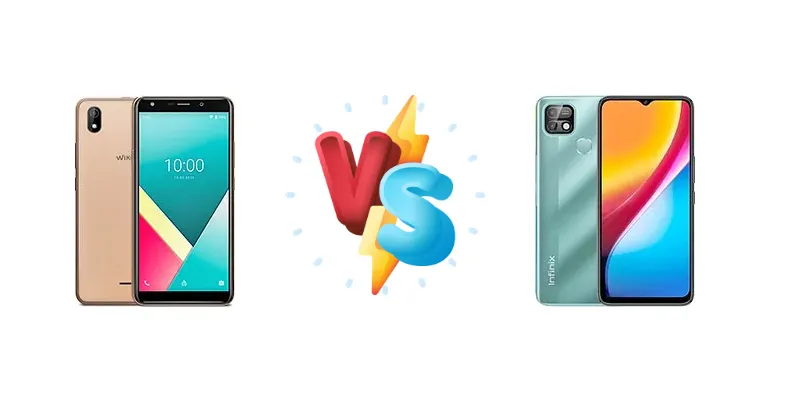
The sub-$150 smartphone market is fiercely competitive, and the Wiko Y61 and Infinix Smart 5 Pro are two contenders vying for your attention. While both aim to deliver essential smartphone functionality at an accessible price, they take different approaches to achieving this. The Wiko Y61 relies on a Mediatek chipset, while the Infinix Smart 5 Pro opts for a Unisoc solution. This comparison will dissect their key specifications to determine which device offers the best value for budget-conscious consumers.
🏆 Quick Verdict
For the average user prioritizing multitasking and a smoother overall experience, the Infinix Smart 5 Pro emerges as the better choice. Its octa-core processor, despite the Cortex-A55 architecture, provides a noticeable performance advantage over the Wiko Y61’s quad-core setup, making it more capable for everyday tasks and light gaming.
| Network |
|---|
| 2G bands | GSM 850 / 900 / 1800 / 1900 | GSM 850 / 900 / 1800 / 1900 |
| 3G bands | HSDPA 850 / 900 / 1900 / 2100 | HSDPA 850 / 900 / 2100 |
| 4G bands | 1, 3, 7, 8, 20 | 1, 3, 5, 8, 38, 40, 41 |
| EDGE | Yes | - |
| GPRS | Class 12 | - |
| Speed | HSPA 42.2/5.76 Mbps, LTE Cat4 150/50 Mbps | HSPA 21.1/5.76 Mbps, LTE Cat4 150/50 Mbps |
| Technology | GSM / HSPA / LTE | GSM / HSPA / LTE |
| | - | 1, 2, 3, 4, 5, 7, 8, 20, 28, 38, 41, 40, 66 |
| Launch |
|---|
| Announced | 2020. Released 2020 | 2021, November 17 |
| Status | Discontinued | Available. Released 2021, November 17 |
| Body |
|---|
| Build | - | Glass front, plastic back, plastic frame |
| Dimensions | 161.3 x 78.1 x 9 mm (6.35 x 3.07 x 0.35 in) | 164.4 x 75.6 x 9.5 mm (6.47 x 2.98 x 0.37 in) |
| SIM | Nano-SIM + Micro-SIM | Nano-SIM + Nano-SIM |
| Weight | 190 g (6.70 oz) | - |
| Display |
|---|
| Resolution | 480 x 960 pixels, 18:9 ratio (~179 ppi density) | 720 x 1600 pixels, 20:9 ratio (~269 ppi density) |
| Size | 5.99 inches, 92.6 cm2 (~73.5% screen-to-body ratio) | 6.52 inches, 102.6 cm2 (~82.6% screen-to-body ratio) |
| Type | IPS LCD | IPS LCD, 500 nits (peak) |
| Platform |
|---|
| CPU | Quad-core 1.8 GHz | Octa-core (4x1.6 GHz Cortex-A55 & 4x1.2 GHz Cortex-A55) |
| Chipset | Mediatek MT6761WE | Unisoc SC9863A (28 nm) |
| GPU | PowerVR GE8300 | IMG8322 |
| OS | Android 10 (Go edition) | Android 11 (Go edition), XOS 7.6 |
| Memory |
|---|
| Call records | Yes | - |
| Card slot | microSDXC | microSDXC (dedicated slot) |
| Internal | 16GB 1GB RAM, 32GB 2GB RAM | 32GB 2GB RAM |
| Phonebook | Yes, Photocall | - |
| | eMMC 5.1 | eMMC 5.1 |
| Main Camera |
|---|
| Dual | - | 13 MP, f/1.8, AF
Auxiliary lens |
| Features | LED flash | Quad-LED flash |
| Single | 8 MP | 8 MP |
| Video | 1080p@30fps | 1440p@30fps |
| Selfie camera |
|---|
| Features | LED flash | Dual-LED flash |
| Single | 5 MP | 8 MP |
| Video | - | 1080p@30fps |
| Sound |
|---|
| 3.5mm jack | Yes | Yes |
| 35mm jack | Yes | Yes |
| Loudspeaker | Yes | Yes |
| | eMMC 5.1 | - |
| Comms |
|---|
| Bluetooth | 4.2, A2DP, LE | 4.2, A2DP |
| NFC | No | No |
| Positioning | GPS | GPS |
| Radio | FM radio | FM radio |
| USB | microUSB 2.0 | microUSB 2.0 |
| WLAN | Wi-Fi 802.11 b/g/n | Wi-Fi 802.11 b/g/n |
| Features |
|---|
| Browser | WAP 2.0/xHTML, HTML | - |
| Games | Yes | - |
| Java | Yes, MIDP 2.0 | - |
| Messaging | SMS, MMS, Email | - |
| Sensors | Accelerometer, proximity, compass | Fingerprint (rear-mounted), accelerometer, proximity |
| Battery |
|---|
| Charging | - | 10W wired |
| Stand-by | Up to 744 h | - |
| Talk time | Up to 8 h | - |
| Type | Li-Ion 3000 mAh | 6000 mAh |
| Misc |
|---|
| Colors | Deep Grey, Deep Green, Gold | Morandi Green, Heart of Ocean |
| Models | W-K560-EEA, W-K560-ID | - |
| Price | About 60 EUR | About 70 EUR |
Wiko Y61
- Potentially simpler user experience due to less powerful hardware.
- May be more readily available in certain regions.
- Likely lower price point (depending on retailer).
- Significantly weaker performance compared to the Infinix Smart 5 Pro.
- Limited multitasking capabilities.
- Less responsive user interface.
Infinix Smart 5 Pro
- Octa-core processor offers superior multitasking.
- More responsive user interface.
- Better suited for running multiple apps and light gaming.
- Less efficient 28nm process node.
- 10W charging is relatively slow.
- May be slightly more expensive than the Wiko Y61.
Display Comparison
Neither device boasts a standout display. Given the provided data, a direct comparison is limited. Both likely utilize LCD panels common in this price bracket. The absence of specifications like resolution or refresh rate suggests a focus on cost reduction. Expect basic viewing experiences suitable for everyday use, but not ideal for media consumption. Bezels are likely to be substantial on both devices, further contributing to a less immersive experience.
Camera Comparison
Without detailed camera specifications, a thorough comparison is difficult. Both devices likely feature basic camera setups geared towards casual photography. The absence of information regarding sensor size, aperture, or image stabilization suggests limited low-light performance and dynamic range. It's safe to assume both phones will struggle in challenging lighting conditions. Any 2MP macro or depth sensors included on either device are likely to offer minimal benefit to the overall photography experience.
Performance
The core difference lies in the processors. The Infinix Smart 5 Pro’s Unisoc SC9863A is an octa-core chip featuring four Cortex-A55 cores clocked at 1.6 GHz and another four at 1.2 GHz. This contrasts sharply with the Wiko Y61’s Mediatek MT6761WE, a quad-core processor clocked at 1.8 GHz. While the Wiko’s cores are individually faster, the Infinix’s eight cores offer superior multitasking capabilities. The Unisoc chip’s 28nm process node is less efficient than more modern fabrication processes, but the core count advantage is likely to outweigh this in real-world usage. The Infinix will handle app switching and running multiple applications concurrently with greater ease.
Battery Life
The Infinix Smart 5 Pro includes 10W wired charging, a standard offering in this price range. While the battery capacity of both devices is unknown, the 10W charging suggests a similar charging time. The efficiency of the Unisoc SC9863A chip, while built on a less advanced process, could potentially offset a slightly smaller battery capacity compared to the Wiko Y61, resulting in comparable real-world battery life. Expect a full charge to take several hours.
Buying Guide
Buy the Wiko Y61 if you need a basic, reliable smartphone for calls, texts, and very light app usage, and prioritize simplicity above all else. It's a good option for first-time smartphone users or those needing a secondary device. Buy the Infinix Smart 5 Pro if you prefer a phone that can handle more demanding tasks like social media browsing, video streaming, and occasional gaming, and appreciate the benefits of a more powerful processor, even within the budget segment.
Frequently Asked Questions
❓ Will the Infinix Smart 5 Pro struggle with popular apps like WhatsApp and Facebook?
While the Unisoc SC9863A isn't a powerhouse, it's more than capable of running popular social media apps like WhatsApp and Facebook smoothly. The octa-core configuration provides enough processing power for these everyday tasks, and the phone should offer a reasonably responsive experience.
❓ Is the Wiko Y61 a good choice for someone who primarily uses their phone for calls and texts?
Yes, the Wiko Y61 is a suitable option for users who primarily need a phone for basic communication. Its quad-core processor is sufficient for calls, texts, and simple tasks, and it will likely offer good battery life for these limited use cases.
❓ Can the Infinix Smart 5 Pro handle any mobile games?
The Infinix Smart 5 Pro can handle light mobile games, but don't expect high frame rates or demanding graphics settings. Games like Candy Crush or simple puzzle games will run without issue. More graphically intensive titles like PUBG Mobile may be playable at the lowest settings, but performance will likely be limited.