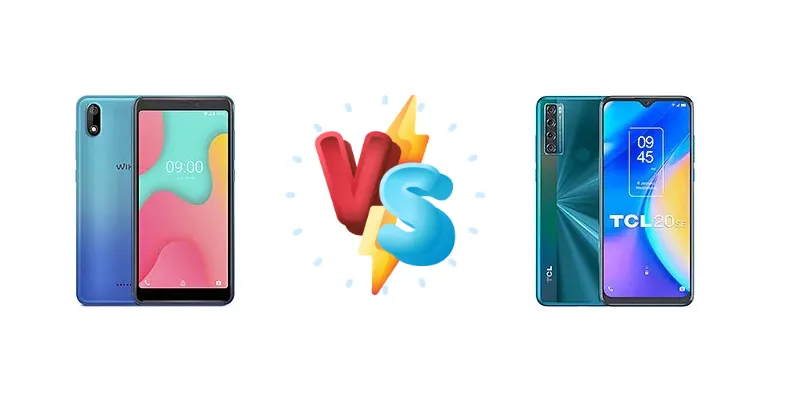
The Wiko Y60 and TCL 20 SE represent the fiercely competitive sub-$200 smartphone market. While both aim to deliver essential smartphone functionality at an accessible price, they take drastically different approaches to processing power. This comparison dissects the architectural differences and real-world implications of the Wiko Y60’s quad-core Cortex-A53 versus the TCL 20 SE’s octa-core Snapdragon 460.
🏆 Quick Verdict
For the average user prioritizing responsiveness and future-proofing, the TCL 20 SE is the clear winner. Its Snapdragon 460 chipset offers significantly improved performance over the Wiko Y60’s Cortex-A53, making it better suited for multitasking, app loading, and even light gaming. While the Wiko Y60 may suffice for basic tasks, the TCL 20 SE provides a smoother, more enjoyable experience.
| Network |
|---|
| 2G bands | GSM 850 / 900 / 1800 / 1900 | GSM 850 / 900 / 1800 / 1900 |
| 3G bands | HSDPA 850 / 900 / 1900 / 2100 | HSDPA 850 / 900 / 1900 / 2100 - EMEA, SEA, APAC |
| 4G bands | 1, 3, 7, 8, 20 | 1, 3, 5, 7, 8, 20, 28, 38, 40, 41 - EMEA, SEA, APAC |
| Speed | HSPA 42.2/5.76 Mbps, LTE Cat4 150/50 Mbps | HSPA, LTE |
| Technology | GSM / HSPA / LTE | GSM / HSPA / LTE |
| | - | 1, 2, 3, 4, 5, 7, 8, 12, 13, 17, 26, 28, 66 - LATAM |
| Launch |
|---|
| Announced | 2020. Released 2020 | 2021, January 11 |
| Status | Discontinued | Available. Released 2021, April 26 |
| Body |
|---|
| Dimensions | 146.8 x 71.8 x 9.3 mm (5.78 x 2.83 x 0.37 in) | 172.1 x 77.1 x 9.1 mm (6.78 x 3.04 x 0.36 in) |
| SIM | Nano-SIM + Micro-SIM | · Nano-SIM· Nano-SIM + Nano-SIM |
| Weight | 177.7 g (6.28 oz) | 206 g (7.27 oz) |
| Display |
|---|
| Resolution | 480 x 960 pixels, 18:9 ratio (~197 ppi density) | 720 x 1640 pixels (~263 ppi density) |
| Size | 5.45 inches, 76.7 cm2 (~72.7% screen-to-body ratio) | 6.82 inches, 110.5 cm2 (~83.2% screen-to-body ratio) |
| Type | TFT LCD | IPS LCD, 450 nits (typ) |
| Platform |
|---|
| CPU | Quad-core 1.3 GHz Cortex-A53 | Octa-core (4x1.8 GHz Kryo 240 & 4x1.6 GHz Kryo 240) |
| Chipset | - | Qualcomm SM4250 Snapdragon 460 (11 nm) |
| GPU | PowerVR GE8100 | Adreno 610 |
| OS | Android 9.0 Pie (Go edition) | Android 11, upgradable to Android 12, TCL UI |
| Memory |
|---|
| Card slot | microSDXC | microSDXC (uses shared SIM slot) |
| Internal | 16GB 1GB RAM | 64GB 4GB RAM, 128GB 4GB RAM |
| | eMMC 5.1 | UFS 2.1 (128GB only) |
| Main Camera |
|---|
| Features | LED flash | Dual-LED flash, HDR, panorama |
| Quad | - | 16 MP, f/1.8, 27mm (wide), 1/2.0", 1.12µm, PDAF
5 MP, f/2.2, 14mm, 115˚ (ultrawide), 1/5.0", 1.12µm
Auxiliary lens
2 MP (macro)
or
48 MP, f/2.0, 27mm (wide), 1/2.0", 0.8µm, PDAF
5 MP, f/2.2, 14mm, 115˚ (ultrawide), 1/5.0", 1.12µm
Auxiliary lens
2 MP (macro) |
| Single | 5 MP | - |
| Video | 1080p@30fps | 1080p@30fps |
| Selfie camera |
|---|
| Features | - | HDR |
| Single | 5 MP | 8 MP, f/2.0, 26mm (wide), 1/4.0", 1.12µm
or
13 MP, f/2.2, 26mm (wide), 1/3.0", 1.12µm |
| Video | - | 1080p@30fps |
| Sound |
|---|
| 3.5mm jack | Yes | Yes |
| 35mm jack | Yes | Yes |
| Loudspeaker | Yes | Yes, with dual speakers |
| | eMMC 5.1 | 24-bit/192kHz audio |
| Comms |
|---|
| Bluetooth | 4.2, A2DP, LE | 5.0, A2DP, LE, aptX |
| NFC | No | Yes |
| Positioning | GPS | GPS, GLONASS, GALILEO, BDS |
| Radio | FM radio | FM radio |
| USB | microUSB 2.0 | USB Type-C 2.0, OTG |
| WLAN | Wi-Fi 802.11 b/g/n | Wi-Fi 802.11 b/g/n, Wi-Fi Direct |
| Features |
|---|
| Sensors | Accelerometer, proximity, compass | Fingerprint (rear-mounted), accelerometer, proximity, compass |
| Battery |
|---|
| Charging | - | 18W wired |
| Type | Li-Ion 2500 mAh | Li-Po 5000 mAh |
| Misc |
|---|
| Colors | Gradient Dark Bleen (Anthracite Blue), Gradient Bl | Aurora Green, Nuit Black |
| Models | W-K510-OPE | T671H, T671F, T671O, T671E |
| Price | About 50 EUR | About 150 EUR |
Wiko Y60
- Potentially lower price point
- Simpler user interface (potentially)
- May have longer standby time due to lower power consumption
- Significantly slower performance
- Poor multitasking capabilities
- Limited gaming potential
- Slower charging speeds
TCL 20 SE
- Faster and more responsive performance
- Better multitasking capabilities
- Improved gaming experience
- 18W fast charging
- More efficient processor
- Potentially higher price
- May have slightly shorter battery life under heavy load
Display Comparison
Neither device’s display specifications are provided, so a direct comparison is limited. However, given the price bracket, both likely utilize LCD panels with 720p resolutions. The TCL 20 SE, being a slightly newer device, may benefit from improved color calibration and viewing angles. Bezels are likely to be substantial on both, reflecting their budget nature. Without specific data, it's reasonable to assume display quality is comparable, with the TCL 20 SE potentially having a slight edge.
Camera Comparison
Without detailed camera specifications, a precise comparison is difficult. However, budget phones in this segment often prioritize megapixel count over sensor size and image quality. It’s likely both devices feature a primary camera and potentially a depth or macro sensor. The TCL 20 SE, benefiting from the Snapdragon 460’s image signal processor (ISP), will likely exhibit better image processing capabilities, resulting in more detailed and vibrant photos, particularly in challenging lighting conditions. The Wiko Y60’s image processing will likely be more basic, leading to softer images and less dynamic range.
Performance
The performance disparity is the most significant difference. The Wiko Y60’s quad-core 1.3 GHz Cortex-A53 is an older, less efficient architecture. In contrast, the TCL 20 SE’s Qualcomm Snapdragon 460, built on an 11nm process, features an octa-core configuration (4x1.8 GHz Kryo 240 & 4x1.6 GHz Kryo 240). This means the TCL 20 SE can handle more complex tasks and multitasking with greater ease. The Snapdragon 460’s architecture also includes an Adreno 610 GPU, offering a substantial improvement in graphics performance over the Wiko Y60’s likely integrated Mali GPU. This translates to smoother app transitions and a better gaming experience on the TCL 20 SE.
Battery Life
Battery capacity isn’t specified for the Wiko Y60, but given its lower processing power, it’s likely comparable to the TCL 20 SE’s. However, the TCL 20 SE’s 18W wired charging is a significant advantage. This allows for faster charging times, minimizing downtime. While the Wiko Y60 likely supports standard 5W or 10W charging, it will take considerably longer to reach a full charge. The Snapdragon 460’s power efficiency also contributes to potentially better battery life under moderate usage on the TCL 20 SE.
Buying Guide
Buy the Wiko Y60 if you need a phone for extremely basic tasks – calls, texts, and occasional light browsing – and prioritize minimal cost above all else. It’s a functional device for those with very limited needs. Buy the TCL 20 SE if you prefer a more responsive experience, want to run multiple apps simultaneously, or occasionally enjoy mobile games. The Snapdragon 460 provides a noticeable performance boost that justifies the potential price difference.
Frequently Asked Questions
❓ Will the TCL 20 SE be able to run popular social media apps like TikTok and Instagram smoothly?
Yes, the Snapdragon 460 in the TCL 20 SE is more than capable of running popular social media apps like TikTok and Instagram smoothly. The octa-core processor and Adreno 610 GPU provide sufficient power for these applications, ensuring a fluid and responsive experience. The Wiko Y60 may struggle with these apps, especially when multitasking.
❓ Is the TCL 20 SE a good option for playing mobile games like PUBG Mobile or Call of Duty Mobile?
While the TCL 20 SE isn’t a dedicated gaming phone, it can handle less demanding mobile games reasonably well. PUBG Mobile and Call of Duty Mobile may be playable at lower graphics settings. The Snapdragon 460’s Adreno 610 GPU provides a noticeable improvement over the Wiko Y60’s graphics capabilities, but don’t expect high frame rates or ultra-high graphics settings. The Wiko Y60 would likely struggle significantly with these titles.
❓ How long will it take to fully charge the TCL 20 SE with the 18W charger?
With the included 18W charger, the TCL 20 SE should fully charge from 0% to 100% in approximately 2 to 2.5 hours, depending on usage during charging. This is significantly faster than the Wiko Y60, which likely supports slower charging speeds and will take considerably longer to reach a full charge.