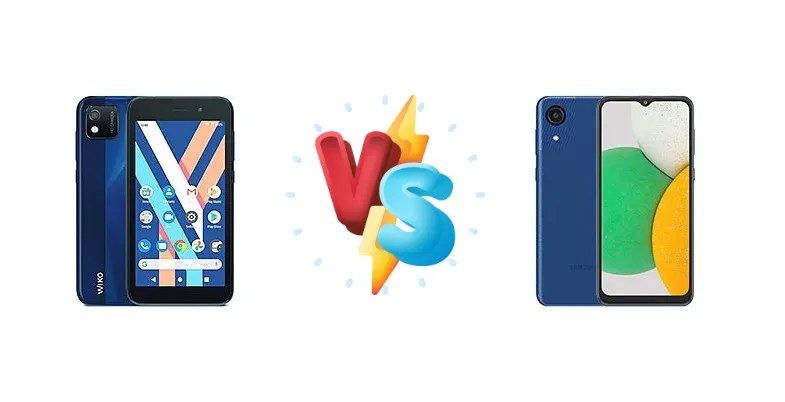
The Wiko Y52 and Samsung Galaxy A03 Core represent the absolute bottom end of the smartphone market, targeting users prioritizing affordability above all else. Both devices utilize Unisoc chipsets, but differ significantly in core count and clock speeds. This comparison dissects these differences to determine which phone delivers the best experience for the price.
🏆 Quick Verdict
For most users, the Samsung Galaxy A03 Core offers a more compelling experience. Its octa-core processor, despite sharing the same 28nm process as the Wiko Y52’s quad-core chip, provides a noticeable performance advantage in multitasking and app loading, making it the better choice for everyday use.
| Network |
|---|
| 2G bands | GSM 850 / 900 / 1800 / 1900 | GSM 850 / 900 / 1800 / 1900 |
| 3G bands | HSDPA 850 / 900 / 1900 / 2100 | HSDPA 850 / 900 / 2100 |
| 4G bands | 1, 3, 7, 20 | 1, 3, 5, 7, 8, 20, 28, 38, 40, 41 |
| Speed | HSPA 42.2/5.76 Mbps | HSPA 21.1/5.76 Mbps, LTE |
| Technology | GSM / HSPA / LTE | GSM / HSPA / LTE |
| Launch |
|---|
| Announced | 2021, November | 2021, November 15 |
| Status | Available. Released 2021, November | Available. Released 2021, December 06 |
| Body |
|---|
| Build | - | Plastic back, plastic frame |
| Dimensions | 143.2 x 73.5 x 10.2 mm (5.64 x 2.89 x 0.40 in) | 164.2 x 75.9 x 9.1 mm (6.46 x 2.99 x 0.36 in) |
| SIM | Nano-SIM + Micro-SIM | · Nano-SIM· Nano-SIM + Nano-SIM |
| Weight | 153 g (5.40 oz) | 211 g (7.44 oz) |
| Display |
|---|
| Resolution | 480 x 854 pixels, 16:9 ratio (~196 ppi density) | 720 x 1600 pixels, 20:9 ratio (~270 ppi density) |
| Size | 5.0 inches, 68.9 cm2 (~65.5% screen-to-body ratio) | 6.5 inches, 102.0 cm2 (~81.8% screen-to-body ratio) |
| Type | TN LCD | PLS LCD |
| Platform |
|---|
| CPU | Quad-core 1.4 GHz | Octa-core (4x1.6 GHz Cortex-A55 & 4x1.2 GHz Cortex-A55) |
| Chipset | Unisoc SC9832E (28 nm) | Unisoc SC9863A (28 nm) |
| GPU | Mali-T820 MP1 | IMG8322 |
| OS | Android 11 (Go edition) | Android 11 (Go edition) |
| Memory |
|---|
| Card slot | microSDXC | microSDXC (dedicated slot) |
| Internal | 16GB 1GB RAM | 32GB 2GB RAM |
| | - | eMMC 5.1 |
| Main Camera |
|---|
| Features | LED flash, HDR | LED flash |
| Single | 5 MP | 8 MP, f/2.0, AF |
| Video | 720p@30fps | 1080p@30fps |
| Selfie camera |
|---|
| Single | 5 MP | 5 MP, f/2.2 |
| Sound |
|---|
| 3.5mm jack | Yes | Yes |
| 35mm jack | Yes | Yes |
| Loudspeaker | Yes | Yes |
| Comms |
|---|
| Bluetooth | 4.2, A2DP | 4.2, A2DP |
| NFC | No | No |
| Positioning | GPS, GLONASS, BDS | GPS, GLONASS |
| Radio | No | Unspecified |
| USB | microUSB 2.0 | microUSB 2.0, OTG |
| WLAN | Wi-Fi 802.11 b/g/n | Wi-Fi 802.11 b/g/n, Wi-Fi Direct |
| Features |
|---|
| Sensors | Accelerometer, proximity | Accelerometer, proximity |
| Battery |
|---|
| Type | Li-Ion 2020 mAh, removable | Li-Ion 5000 mAh |
| Misc |
|---|
| Colors | Grey, Deep Blue, Green | Black, Blue |
| Models | W-K521-EEA | SM-A032F, SM-A032F/DS, SM-A032M |
| Price | About 50 EUR | £ 74.99 |
| SAR | 0.75 W/kg (head) 0.94 W/kg (body) | 0.30 W/kg (head) |
| SAR EU | - | 0.24 W/kg (head) 1.39 W/kg (body) |
Wiko Y52
- Potentially lower price point
- Simple and straightforward user experience
- Compact form factor
- Significantly weaker performance
- Limited multitasking capabilities
- Likely slower app loading times
Samsung Galaxy A03 Core
- Octa-core processor for smoother performance
- Better multitasking capabilities
- Potentially improved camera processing
- Slightly higher price
- May not offer significantly better battery life
- Still limited by budget components
Display Comparison
Neither device boasts a standout display. Both are likely to utilize LCD panels, common in this price bracket. Specifics like resolution and brightness are not provided, but given the target market, expectations should be tempered. The focus here is on functionality, not visual fidelity. Bezels are likely to be substantial on both models, maximizing screen real estate within a compact form factor.
Camera Comparison
Camera performance is expected to be basic on both devices. Details are scarce, but both will likely feature a primary camera alongside potentially a depth or macro sensor. Given the price point, image quality will be heavily reliant on software processing. The A03 Core *may* benefit from Samsung’s image processing algorithms, potentially offering slightly better results in favorable lighting conditions. However, the lack of OIS on either device means low-light performance will be limited. Focusing on the primary sensor resolution is key, as auxiliary sensors (like 2MP macros) offer minimal practical benefit.
Performance
The core difference lies in the chipset: the Wiko Y52 features the Unisoc SC9832E with a quad-core CPU clocked at 1.4 GHz, while the Samsung Galaxy A03 Core utilizes the Unisoc SC9863A, an octa-core processor with a heterogeneous configuration of 4x1.6 GHz Cortex-A55 cores and 4x1.2 GHz Cortex-A55 cores. This octa-core setup provides a significant advantage in multi-threaded tasks. While both are built on a 28nm process, the A03 Core’s architecture allows for better parallel processing, resulting in faster app launches and smoother multitasking. The A55 cores, while not high-performance, are more efficient than older Cortex-A53 designs often found in this segment. The Wiko Y52 will likely struggle with more demanding applications.
Battery Life
Battery capacity is not specified for either device. However, given the low-power chipsets and likely smaller screen sizes, both should offer all-day battery life with moderate usage. Charging wattage is also unknown, but is likely to be slow (5W-10W) on both models. The A03 Core’s more efficient octa-core processor *could* translate to slightly longer battery life under sustained load, but the difference is unlikely to be substantial.
Buying Guide
Buy the Wiko Y52 if you need a basic, functional smartphone for extremely light tasks like calls, texts, and occasional web browsing, and are on the absolute tightest budget. Buy the Samsung Galaxy A03 Core if you prefer a smoother, more responsive experience for social media, light gaming, and general app usage, and are willing to spend a small premium for improved performance.
Frequently Asked Questions
❓ Will the Samsung Galaxy A03 Core struggle with popular apps like Facebook or WhatsApp?
While the A03 Core won't deliver a flagship-level experience, its octa-core processor should handle Facebook and WhatsApp without significant lag. However, running multiple apps simultaneously may cause slowdowns. The Wiko Y52 will likely struggle more with these apps.
❓ Is the Unisoc SC9863A chipset known for overheating?
The Unisoc SC9863A is a low-power chipset and is unlikely to overheat under normal usage conditions. Both devices are built on a 28nm process, which is less efficient than newer nodes, but the relatively low clock speeds and core count mitigate the risk of thermal throttling.
❓ Can either of these phones play PUBG Mobile?
PUBG Mobile is likely playable on the Samsung Galaxy A03 Core at the lowest graphics settings and frame rates. The Wiko Y52 will likely struggle to run the game smoothly, even at the lowest settings. Expect significant frame drops and lag.
❓ What type of storage do these phones use – eMMC or UFS?
Given the price point, both devices almost certainly utilize eMMC storage. UFS storage is faster but more expensive and is typically reserved for higher-end smartphones. This impacts app loading times and overall system responsiveness.