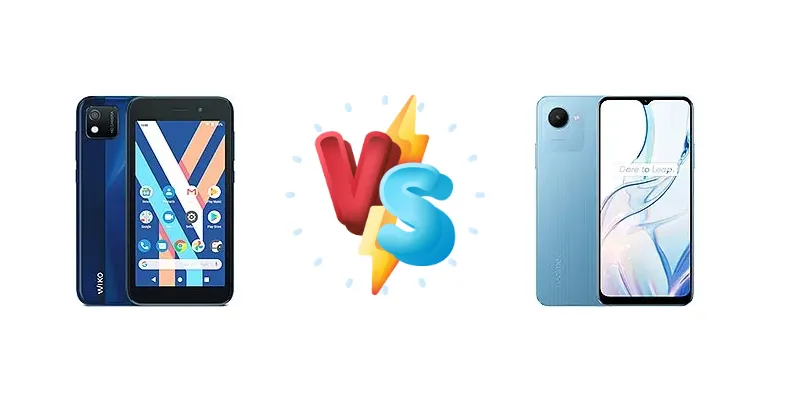
The sub-$150 smartphone market is fiercely competitive. Both the Wiko Y52 and the Realme C30s aim to deliver essential smartphone functionality at an accessible price point. However, they take different approaches to achieving this, with the Realme C30s prioritizing a more modern CPU architecture while the Wiko Y52 relies on a simpler, older chipset. This comparison will dissect the key differences to determine which device offers the best value.
🏆 Quick Verdict
For the average user prioritizing responsiveness and multitasking, the Realme C30s is the clear winner. Its octa-core Cortex-A55 CPU provides a significant performance advantage over the Wiko Y52’s quad-core Unisoc SC9832E, making everyday tasks smoother and more efficient. While both phones are entry-level, the C30s offers a more future-proof experience.
| Network |
|---|
| 2G bands | GSM 850 / 900 / 1800 / 1900 | GSM 850 / 900 / 1800 / 1900 |
| 3G bands | HSDPA 850 / 900 / 1900 / 2100 | HSDPA 850 / 900 / 2100 |
| 4G bands | 1, 3, 7, 20 | 1, 3, 5, 8, 38, 40, 41 |
| Speed | HSPA 42.2/5.76 Mbps | HSPA, LTE |
| Technology | GSM / HSPA / LTE | GSM / HSPA / LTE |
| Launch |
|---|
| Announced | 2021, November | 2022, September 14 |
| Status | Available. Released 2021, November | Available. Released 2022, September 23 |
| Body |
|---|
| Build | - | Glass front, plastic frame, plastic back |
| Dimensions | 143.2 x 73.5 x 10.2 mm (5.64 x 2.89 x 0.40 in) | 164.2 x 75.7 x 8.5 mm (6.46 x 2.98 x 0.33 in) |
| SIM | Nano-SIM + Micro-SIM | Nano-SIM + Nano-SIM |
| Weight | 153 g (5.40 oz) | 186 g (6.56 oz) |
| Display |
|---|
| Resolution | 480 x 854 pixels, 16:9 ratio (~196 ppi density) | 720 x 1600 pixels, 20:9 ratio (~270 ppi density) |
| Size | 5.0 inches, 68.9 cm2 (~65.5% screen-to-body ratio) | 6.5 inches, 102.0 cm2 (~82.1% screen-to-body ratio) |
| Type | TN LCD | IPS LCD |
| Platform |
|---|
| CPU | Quad-core 1.4 GHz | Octa-core 1.6 GHz Cortex-A55 |
| Chipset | Unisoc SC9832E (28 nm) | - |
| GPU | Mali-T820 MP1 | IMG8322 |
| OS | Android 11 (Go edition) | Android 12, Realme UI Go |
| Memory |
|---|
| Card slot | microSDXC | microSDXC (dedicated slot) |
| Internal | 16GB 1GB RAM | 32GB 2GB RAM, 32GB 3GB RAM, 64GB 3GB RAM, 64GB 4GB RAM |
| Main Camera |
|---|
| Features | LED flash, HDR | LED flash, HDR, panorama |
| Single | 5 MP | 8 MP, (wide), 1/4.0", 1.12µm |
| Video | 720p@30fps | 1080p@30fps |
| Selfie camera |
|---|
| Features | - | HDR |
| Single | 5 MP | 5 MP, (wide), 1/5.0", 1.12µm |
| Video | - | 720p@30fps |
| Sound |
|---|
| 3.5mm jack | Yes | Yes |
| 35mm jack | Yes | Yes |
| Loudspeaker | Yes | Yes |
| Comms |
|---|
| Bluetooth | 4.2, A2DP | 4.2, A2DP |
| NFC | No | No |
| Positioning | GPS, GLONASS, BDS | GPS, GLONASS |
| Radio | No | Unspecified |
| USB | microUSB 2.0 | microUSB 2.0, OTG |
| WLAN | Wi-Fi 802.11 b/g/n | Wi-Fi 802.11 b/g/n |
| Features |
|---|
| Sensors | Accelerometer, proximity | Fingerprint (side-mounted), accelerometer, proximity |
| Battery |
|---|
| Charging | - | 10W wired |
| Type | Li-Ion 2020 mAh, removable | 5000 mAh |
| Misc |
|---|
| Colors | Grey, Deep Blue, Green | Stripe Blue, Stripe Black |
| Models | W-K521-EEA | RMX3690 |
| Price | About 50 EUR | About 100 EUR |
| SAR | 0.75 W/kg (head) 0.94 W/kg (body) | - |
Wiko Y52
- Potentially lower price point
- Simple and easy to use interface
- May appeal to users prioritizing basic functionality
- Significantly weaker processor performance
- Likely slower app loading times
- Less capable for multitasking
Realme C30s
- Faster and more efficient octa-core processor
- Smoother multitasking and app performance
- 10W wired charging included
- More future-proof architecture
- May be slightly more expensive
- Still an entry-level device with limitations
Display Comparison
Neither device boasts a standout display. Given the lack of detailed display specifications for the Wiko Y52, we can assume it utilizes a standard LCD panel typical of this price range. The Realme C30s also features an LCD, but the focus here is on the processor. Both will likely offer adequate viewing angles and color reproduction for basic tasks, but don't expect vibrant colors or high brightness levels. Bezels are likely to be substantial on both devices, contributing to a less immersive viewing experience.
Camera Comparison
Both devices likely feature basic camera setups geared towards casual photography. Without detailed sensor information, it's difficult to make a direct comparison. However, the Realme C30s benefits from a more powerful processor, which aids in image processing. This means potentially better noise reduction and faster image capture. It's safe to assume both phones will struggle in low-light conditions, and any 'macro' lenses included will likely be of very low resolution and limited utility. Focusing on the processing power, the Realme C30s will likely deliver more usable images.
Performance
The core difference lies in the processors. The Realme C30s’ octa-core 1.6 GHz Cortex-A55 CPU represents a significant leap over the Wiko Y52’s quad-core 1.4 GHz Unisoc SC9832E. The Cortex-A55 architecture is more efficient and capable, allowing for smoother multitasking and faster app loading times. The Unisoc SC9832E, built on a 28nm process, is an older design and will struggle with demanding applications. While RAM amounts aren't specified, the CPU difference will be the dominant factor in perceived performance. The Realme C30s will handle more apps open simultaneously without significant slowdown.
Battery Life
Battery capacity isn't specified for either device, but both will likely fall in the 4000-5000 mAh range, typical for this segment. The Realme C30s includes 10W wired charging, which, while slow by modern standards, is a welcome addition. The Wiko Y52’s charging speed is unknown, but it’s likely to be similar or slower. The more efficient Cortex-A55 CPU in the Realme C30s may contribute to slightly longer battery life during typical usage, offsetting any potential capacity differences.
Buying Guide
Buy the Wiko Y52 if you need a basic smartphone for extremely light use – primarily calls, texts, and occasional simple apps – and are on a very tight budget. Its simplicity might appeal to those less comfortable with technology. Buy the Realme C30s if you prefer a more responsive experience for social media, browsing, and light gaming, and value a more modern processor architecture that will handle future app updates better.
Frequently Asked Questions
❓ Will the Realme C30s be able to run popular social media apps like TikTok and Instagram smoothly?
Yes, the Realme C30s’ octa-core Cortex-A55 processor is well-suited for running popular social media apps like TikTok and Instagram. While it won't offer a flagship-level experience, you can expect smooth scrolling, fast loading times, and reliable performance for everyday social media use. The Wiko Y52 may struggle with these apps, especially when multitasking.
❓ Is the Unisoc SC9832E processor in the Wiko Y52 sufficient for playing basic mobile games?
The Unisoc SC9832E processor in the Wiko Y52 is only suitable for very basic mobile games. Demanding titles will likely experience significant lag and frame rate drops. The Realme C30s, with its more powerful processor, will offer a noticeably better gaming experience, although it's still not ideal for graphically intensive games.
❓ How much storage do these phones typically offer, and can it be expanded?
While not specified, both phones likely come with 32GB or 64GB of internal storage. Crucially, both devices *should* support microSD card expansion, allowing you to add more storage for photos, videos, and apps. This is essential given the limited internal storage typically found in this price range.
❓ What Android version do these phones run, and will they receive software updates?
Both devices likely run Android Go Edition, a lightweight version of Android designed for devices with limited resources. Software update support is typically limited on phones in this price segment. Don't expect frequent or long-term updates from either Wiko or Realme.