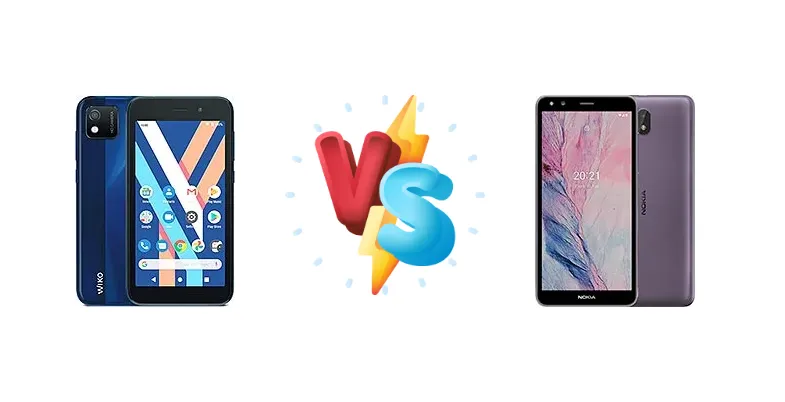
The Wiko Y52 and Nokia C01 Plus represent the extreme end of the smartphone price spectrum. Both aim to deliver essential smartphone functionality at a minimal cost, but they achieve this with different hardware approaches. This comparison dissects their core components to determine which device provides the best experience for users prioritizing affordability and basic usability.
🏆 Quick Verdict
For the average user needing a simple, reliable smartphone for calls, messaging, and light app use, the Nokia C01 Plus offers a noticeable performance advantage thanks to its octa-core processor. While both phones share a similar price point, the C01 Plus’s more capable chipset translates to a smoother user experience.
| Network |
|---|
| 2G bands | GSM 850 / 900 / 1800 / 1900 | GSM 850 / 900 / 1800 / 1900 |
| 3G bands | HSDPA 850 / 900 / 1900 / 2100 | HSDPA 850 / 900 / 2100 - International |
| 4G bands | 1, 3, 7, 20 | 1, 3, 5, 7, 8, 20, 28, 38, 40, 41 - International |
| Speed | HSPA 42.2/5.76 Mbps | HSPA 21.1/5.76 Mbps, LTE Cat4 150/50 Mbps |
| Technology | GSM / HSPA / LTE | GSM / HSPA / LTE |
| | - | 2, 4, 5, 7, 8, 28 - LATAM |
| Launch |
|---|
| Announced | 2021, November | 2021, June 08 |
| Status | Available. Released 2021, November | Available. Released 2021, June 28 |
| Body |
|---|
| Build | - | Plastic back, plastic frame |
| Dimensions | 143.2 x 73.5 x 10.2 mm (5.64 x 2.89 x 0.40 in) | 148 x 71.8 x 9.3 mm (5.83 x 2.83 x 0.37 in) |
| SIM | Nano-SIM + Micro-SIM | Nano-SIM + Nano-SIM |
| Weight | 153 g (5.40 oz) | 157 g (5.54 oz) |
| Display |
|---|
| Resolution | 480 x 854 pixels, 16:9 ratio (~196 ppi density) | 720 x 1440 pixels, 18:9 ratio (~295 ppi density) |
| Size | 5.0 inches, 68.9 cm2 (~65.5% screen-to-body ratio) | 5.45 inches, 76.7 cm2 (~72.1% screen-to-body ratio) |
| Type | TN LCD | IPS LCD |
| Platform |
|---|
| CPU | Quad-core 1.4 GHz | Octa-core (4x1.6 GHz Cortex-A55 & 4x1.2 GHz Cortex-A55) |
| Chipset | Unisoc SC9832E (28 nm) | Unisoc SC9863A (28 nm) |
| GPU | Mali-T820 MP1 | IMG8322 |
| OS | Android 11 (Go edition) | Android 11 (Go edition) |
| Memory |
|---|
| Card slot | microSDXC | microSDXC |
| Internal | 16GB 1GB RAM | 16GB 1GB RAM, 16GB 2GB RAM, 32GB 1GB RAM, 32GB 2GB RAM |
| | - | eMMC 5.1 |
| Main Camera |
|---|
| Features | LED flash, HDR | LED flash, HDR |
| Single | 5 MP | 5 MP |
| Video | 720p@30fps | 720p@30fps |
| Selfie camera |
|---|
| Features | - | LED flash, HDR |
| Single | 5 MP | 5 MP |
| Video | - | 720p@30fps |
| Sound |
|---|
| 3.5mm jack | Yes | Yes |
| 35mm jack | Yes | Yes |
| Loudspeaker | Yes | Yes |
| Comms |
|---|
| Bluetooth | 4.2, A2DP | 4.2, A2DP, LE |
| NFC | No | No |
| Positioning | GPS, GLONASS, BDS | GPS |
| Radio | No | FM radio |
| USB | microUSB 2.0 | microUSB 2.0 |
| WLAN | Wi-Fi 802.11 b/g/n | Wi-Fi 802.11 b/g/n |
| Features |
|---|
| Sensors | Accelerometer, proximity | Accelerometer, proximity |
| Battery |
|---|
| Type | Li-Ion 2020 mAh, removable | Li-Ion 3000 mAh, removable |
| Misc |
|---|
| Colors | Grey, Deep Blue, Green | Blue, Purple |
| Models | W-K521-EEA | TA-1383, TA-1387, TA-1391 |
| Price | About 50 EUR | About 90 EUR |
| SAR | 0.75 W/kg (head) 0.94 W/kg (body) | 1.13 W/kg (head) 0.84 W/kg (body) |
| SAR EU | - | 0.59 W/kg (head) 1.41 W/kg (body) |
Wiko Y52
- Potentially lower price point than the Nokia C01 Plus.
- Simple and straightforward user experience.
- Sufficient for basic calling and texting.
- Significantly slower performance compared to the Nokia C01 Plus.
- Limited multitasking capabilities.
- Likely lower build quality.
Nokia C01 Plus
- Octa-core processor provides a smoother user experience.
- Better multitasking capabilities.
- More responsive app launches and web browsing.
- May be slightly more expensive than the Wiko Y52.
- Still limited in terms of overall performance compared to mid-range phones.
- Camera quality likely similar to the Wiko Y52.
Display Comparison
Neither Wiko nor Nokia provide display specifications beyond size. Given the price bracket, both likely utilize LCD panels with modest resolutions (likely 720p+). The absence of detailed specs suggests neither phone prioritizes display quality. Expect similar viewing experiences, with limited brightness and color accuracy. Bezels are likely substantial on both devices to minimize manufacturing costs.
Camera Comparison
Both phones likely feature basic camera setups, and detailed specifications are scarce. It’s safe to assume both will include a primary camera and potentially a secondary depth sensor. Given the target market, image quality will be adequate for casual snapshots but shouldn’t be expected to compete with higher-end devices. The absence of Optical Image Stabilization (OIS) on either phone suggests low-light performance will be limited. Focusing on megapixel counts alone is misleading; image processing capabilities, which are also unknown, will play a crucial role in the final image quality.
Performance
The core difference lies in the chipset. The Wiko Y52’s Unisoc SC9832E is a quad-core processor, while the Nokia C01 Plus boasts the Unisoc SC9863A, an octa-core chip featuring a combination of 1.6 GHz and 1.2 GHz Cortex-A55 cores. This architectural difference is significant. The C01 Plus’s octa-core configuration allows for better parallel processing, resulting in smoother app launches, faster web browsing, and improved multitasking. While both are based on a 28nm process, the increased core count of the C01 Plus provides a clear performance advantage, particularly for users running multiple apps simultaneously. The Cortex-A55 cores, while entry-level, are more efficient than older ARM architectures.
Battery Life
Battery capacity details are unavailable for both devices. However, given their basic hardware and likely screen resolutions, both should offer all-day battery life with moderate usage. Charging wattage is also unspecified, suggesting both will likely ship with a standard 5W or 10W charger, resulting in relatively slow charging times. The more efficient octa-core processor in the Nokia C01 Plus *may* translate to slightly better battery endurance, but the difference is unlikely to be substantial.
Buying Guide
Buy the Wiko Y52 if you need a phone primarily for voice calls and very light usage, and are seeking the absolute lowest possible price. Its quad-core processor is sufficient for these basic tasks. Buy the Nokia C01 Plus if you prefer a more responsive experience, even for simple multitasking, and anticipate using apps like WhatsApp or Facebook regularly. The octa-core processor provides a tangible benefit in everyday usability.
Frequently Asked Questions
❓ Will the Nokia C01 Plus handle popular apps like WhatsApp and Facebook smoothly?
Yes, the Nokia C01 Plus’s octa-core processor is significantly better equipped to handle apps like WhatsApp and Facebook than the Wiko Y52’s quad-core chip. You should experience smoother scrolling, faster loading times, and fewer instances of lag when using these apps.
❓ Is the difference in performance between the two phones noticeable for basic tasks like making calls and sending texts?
For *strictly* making calls and sending texts, the difference will be minimal. However, even simple tasks like switching between the phone app and messaging app will feel snappier on the Nokia C01 Plus due to its more powerful processor.
❓ Can either of these phones play modern mobile games?
Neither phone is well-suited for modern, graphically demanding mobile games. While they might be able to run very basic 2D games, expect significant lag and low frame rates in most titles. These phones are designed for essential communication and light app usage, not gaming.
❓ Which phone is better for a first-time smartphone user or a senior citizen?
The Nokia C01 Plus is the better choice for a first-time smartphone user or a senior citizen. The smoother performance and more responsive interface will make the learning curve less steep and the overall experience more enjoyable. The Wiko Y52’s slower processor could lead to frustration.