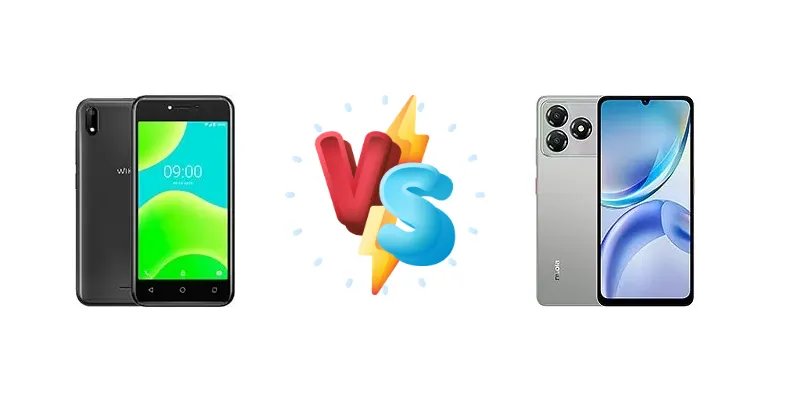
The Wiko Y50 and ZTE Blade A36 represent the fiercely competitive sub-$150 smartphone market. While both aim to deliver essential functionality at an accessible price, they take distinctly different approaches. The Y50 prioritizes simplicity with a basic quad-core processor, while the Blade A36 aims for a more robust experience with an octa-core chipset and a focus on battery endurance.
🏆 Quick Verdict
For the average user, the ZTE Blade A36 is the superior choice. Its Unisoc T7200 chipset, featuring Cortex-A75 cores, provides a significantly faster and more responsive experience than the Wiko Y50’s aging Cortex-A7 processor. The Blade A36’s exceptional battery life further solidifies its position as the more practical option.
| Network |
|---|
| 2G bands | GSM 850 / 900 / 1800 / 1900 | GSM 850 / 900 / 1800 / 1900 |
| 3G bands | HSDPA 850 / 900 / 1900 / 2100 | HSDPA 850 / 900 / 1900 / 2100 |
| 4G bands | - | 1, 3, 5, 7, 8, 20, 28, 38, 40, 41 |
| Speed | HSPA 42.2/5.76 Mbps | HSPA, LTE |
| Technology | GSM / HSPA | GSM / HSPA / LTE |
| Launch |
|---|
| Announced | 2019, July. Released 2019, July | 2025, June 18 |
| Status | Discontinued | Available. Released 2025, June |
| Body |
|---|
| Build | - | Glass front, plastic frame, plastic back |
| Dimensions | 146 x 73.5 x 8.7 mm (5.75 x 2.89 x 0.34 in) | 167.6 x 77.4 x 8.3 mm (6.60 x 3.05 x 0.33 in) |
| SIM | Nano-SIM + Micro-SIM | Nano-SIM + Nano-SIM |
| Weight | 160 g (5.64 oz) | - |
| Display |
|---|
| Protection | - | Mohs level 4 |
| Resolution | 480 x 854 pixels, 16:9 ratio (~196 ppi density) | 720 x 1600 pixels, 20:9 ratio (~260 ppi density) |
| Size | 5.0 inches, 68.9 cm2 (~64.2% screen-to-body ratio) | 6.75 inches, 110.0 cm2 (~84.8% screen-to-body ratio) |
| Type | TN LCD | IPS LCD, 90Hz |
| Platform |
|---|
| CPU | Quad-core 1.3 GHz Cortex-A7 | Octa-core (2x1.6 GHz Cortex-A75 & 6x1.6 GHz Cortex-A55) |
| Chipset | - | Unisoc T7200 (12 nm) |
| GPU | Mali-T820 MP1 | Mali-G57 MP1 |
| OS | Android 8.1 (Oreo) (Go Edition) | Android 15 |
| Memory |
|---|
| Card slot | microSDXC | microSDXC (dedicated slot) |
| Internal | 16GB 1GB RAM, 32GB 1GB RAM | 64GB 4GB RAM |
| Main Camera |
|---|
| Features | LED flash, HDR, panorama | LED flash |
| Single | 5 MP | 13 MP, AF
Auxiliary lens |
| Video | 720p@30fps | 1080p@30fps |
| Selfie camera |
|---|
| Features | LED flash | - |
| Single | 5 MP | 5 MP |
| Video | - | Yes |
| Sound |
|---|
| 3.5mm jack | Yes | - |
| 35mm jack | Yes | Yes |
| Loudspeaker | Yes | Yes |
| Comms |
|---|
| Bluetooth | 4.2, A2DP | 5.2, A2DP, LE |
| NFC | No | No |
| Positioning | GPS | GPS, GALILEO, GLONASS |
| Radio | FM Radio | FM radio |
| USB | microUSB 2.0 | USB Type-C 2.0 |
| WLAN | Wi-Fi 802.11 b/g/n | Wi-Fi 802.11 a/b/g/n/ac |
| Features |
|---|
| Sensors | Accelerometer | Accelerometer, proximity, compass |
| Battery |
|---|
| Charging | - | 10W wired |
| Type | Li-Ion 2200 mAh | 5000 mAh |
| Misc |
|---|
| Colors | Dark Grey, Blue, Gold | Black, Green, Silver |
| Models | - | Z2472 |
| Price | About 50 EUR | About 60 EUR |
| SAR | 0.86 W/kg (head) 1.40 W/kg (body) | - |
| EU LABEL |
|---|
| Battery | - | 54:13h endurance, 800 cycles |
| Energy | - | Class A |
| Free fall | - | Class D (80 falls) |
| Repairability | - | Class B |
Wiko Y50
- Potentially simpler user interface
- May be more affordable (depending on region)
- Lightweight due to basic components
- Significantly slower processor
- Poor multitasking performance
- Likely inferior camera quality
- Shorter battery life
ZTE Blade A36
- Faster and more responsive processor
- Excellent battery life (54:13h endurance)
- More capable for everyday tasks
- Better image processing
- 10W charging is relatively slow
- May be slightly more expensive than the Wiko Y50
Display Comparison
Neither device’s display specifications are provided, so we must infer based on market segment. Both likely utilize LCD panels with 720p+ resolutions. The Wiko Y50, given its simpler processor, likely has a more basic display with narrower viewing angles and lower brightness. The ZTE Blade A36, aiming for a more premium experience within its price bracket, may feature a slightly better panel with improved color accuracy and peak brightness, though neither is expected to compete with higher-end OLED displays.
Camera Comparison
Without specific camera sensor details, a direct comparison is difficult. However, it’s safe to assume both phones feature basic camera setups geared towards casual photography. The ZTE Blade A36, benefiting from its more powerful processor, likely has superior image processing capabilities, resulting in better dynamic range and noise reduction. The Wiko Y50’s image processing will likely be slower and less refined. The presence of a 2MP macro lens on either device is largely a marketing gimmick and offers limited practical benefit.
Performance
The performance gap between these two devices is substantial. The ZTE Blade A36’s Unisoc T7200, with its octa-core configuration (2x1.6 GHz Cortex-A75 & 6x1.6 GHz Cortex-A55) built on a 12nm process, offers a significant advantage over the Wiko Y50’s quad-core 1.3 GHz Cortex-A7. The Cortex-A75 cores in the Blade A36 are considerably more powerful than the Cortex-A7, resulting in faster app loading times, smoother multitasking, and improved responsiveness. The 12nm process also contributes to better power efficiency. The Y50 will struggle with demanding applications and multitasking.
Battery Life
The ZTE Blade A36 clearly excels in battery life. Its reported 54:13h endurance and 800 cycles indicate a significantly larger battery capacity and optimized power management compared to the Wiko Y50. While the Y50’s battery size is unknown, its less efficient processor will result in shorter usage times. The Blade A36’s 10W wired charging is standard for this price point, and the long endurance mitigates the slower charging speed.
Buying Guide
Buy the Wiko Y50 if you need a very basic smartphone for minimal tasks like calls, texts, and light web browsing, and prioritize absolute simplicity. Buy the ZTE Blade A36 if you prefer a smoother, more capable user experience for everyday tasks, streaming, and social media, and value long-lasting battery life. The Blade A36 is the better all-rounder.
Frequently Asked Questions
❓ Is the Unisoc T7200 in the ZTE Blade A36 powerful enough for casual gaming?
Yes, the Unisoc T7200, with its Cortex-A75 cores, is capable of handling most casual mobile games at medium settings. While it won't deliver a flagship gaming experience, it provides a significantly smoother experience than the Wiko Y50’s processor for titles like PUBG Mobile or Call of Duty Mobile.
❓ How does the battery life of the ZTE Blade A36 compare to other phones in its price range?
The ZTE Blade A36’s 54:13h endurance is exceptional for a phone in this price bracket. Most competitors offer battery life in the 30-40 hour range. This makes the Blade A36 a particularly good choice for users who prioritize long-lasting battery life and don't want to worry about frequent charging.
❓ Will the Wiko Y50 struggle with popular social media apps like Facebook and Instagram?
Yes, the Wiko Y50’s quad-core Cortex-A7 processor will likely struggle with the resource-intensive demands of modern social media apps. Expect slower loading times, occasional lag, and a less fluid user experience compared to the ZTE Blade A36.