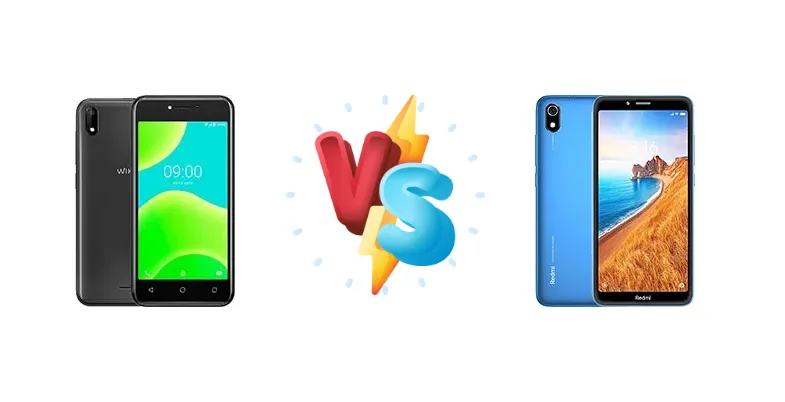
The sub-$100 smartphone market is fiercely competitive. The Wiko Y50 and Xiaomi Redmi 7A represent two distinct approaches to delivering affordable connectivity. The Y50 prioritizes simplicity, while the Redmi 7A aims for a more robust feature set powered by Qualcomm silicon. This comparison dissects their strengths and weaknesses to help you choose the right device.
🏆 Quick Verdict
For most users, the Xiaomi Redmi 7A is the superior choice. Its Snapdragon 439 chipset provides a significantly more responsive experience than the Wiko Y50’s quad-core Cortex-A7, making it better suited for multitasking and even light gaming. While the Y50 may appeal to those seeking extreme simplicity, the Redmi 7A offers a better balance of performance and features.
| Network |
|---|
| 2G bands | GSM 850 / 900 / 1800 / 1900 | GSM 850 / 900 / 1800 / 1900 |
| 3G bands | HSDPA 850 / 900 / 1900 / 2100 | HSDPA 850 / 900 / 1900 / 2100 |
| 4G bands | - | 1, 2, 3, 4, 5, 7, 8, 20, 38, 40 - Global |
| Speed | HSPA 42.2/5.76 Mbps | HSPA, LTE |
| Technology | GSM / HSPA | GSM / HSPA / LTE |
| | - | 1, 3, 5, 8, 34, 38, 39, 40, 41 - China |
| Launch |
|---|
| Announced | 2019, July. Released 2019, July | 2019, May 24. Released 2019, July 04 |
| Status | Discontinued | Discontinued |
| Body |
|---|
| Build | - | Glass front, plastic back, plastic frame |
| Dimensions | 146 x 73.5 x 8.7 mm (5.75 x 2.89 x 0.34 in) | 146.3 x 70.4 x 9.6 mm (5.76 x 2.77 x 0.38 in) |
| SIM | Nano-SIM + Micro-SIM | Nano-SIM + Nano-SIM |
| Weight | 160 g (5.64 oz) | 165 g (5.82 oz) |
| | - | Splash resistant |
| Display |
|---|
| Resolution | 480 x 854 pixels, 16:9 ratio (~196 ppi density) | 720 x 1440 pixels, 18:9 ratio (~295 ppi density) |
| Size | 5.0 inches, 68.9 cm2 (~64.2% screen-to-body ratio) | 5.45 inches, 76.7 cm2 (~74.4% screen-to-body ratio) |
| Type | TN LCD | IPS LCD |
| Platform |
|---|
| CPU | Quad-core 1.3 GHz Cortex-A7 | Octa-core (4x1.95 GHz Cortex-A53 & 4x1.45 GHz Cortex A53) |
| Chipset | - | Qualcomm SDM439 Snapdragon 439 (12 nm) |
| GPU | Mali-T820 MP1 | Adreno 505 |
| OS | Android 8.1 (Oreo) (Go Edition) | Android 9.0 (Pie), upgradable to Android 10, MIUI 12 |
| Memory |
|---|
| Card slot | microSDXC | microSDXC (dedicated slot) |
| Internal | 16GB 1GB RAM, 32GB 1GB RAM | 16GB 2GB RAM, 32GB 2GB RAM, 32GB 3GB RAM |
| | - | eMMC 5.1 |
| Main Camera |
|---|
| Features | LED flash, HDR, panorama | LED flash, HDR |
| Single | 5 MP | 13 MP, f/2.2, 1/3.1", 1.12µm, PDAF - China
or
12 MP, f/2.2, 1/2.9", 1.25µm, PDAF - Global, India |
| Video | 720p@30fps | 1080p@30fps |
| Selfie camera |
|---|
| Features | LED flash | HDR |
| Single | 5 MP | 5 MP, f/2.2, 1/5.0", 1.12µm |
| Video | - | 1080p@30fps |
| Sound |
|---|
| 3.5mm jack | Yes | Yes |
| 35mm jack | Yes | Yes |
| Loudspeaker | Yes | Yes |
| Comms |
|---|
| Bluetooth | 4.2, A2DP | 4.2, A2DP, LE |
| NFC | No | No |
| Positioning | GPS | GPS, GLONASS, BDS |
| Radio | FM Radio | FM Radio, built-in antenna |
| USB | microUSB 2.0 | microUSB 2.0, OTG |
| WLAN | Wi-Fi 802.11 b/g/n | Wi-Fi 802.11 b/g/n, Wi-Fi Direct |
| Features |
|---|
| Sensors | Accelerometer | Accelerometer, proximity, compass |
| Battery |
|---|
| Charging | - | 10W wired |
| Type | Li-Ion 2200 mAh | Li-Po 4000 mAh, non-removable |
| Misc |
|---|
| Colors | Dark Grey, Blue, Gold | Matte Black, Morning blue, Matte Blue, Matte Gold, Gem Red, Gem Blue |
| Models | - | MZB7995IN, M1903C3EG, M1903C3EH, M1903C3EI |
| Price | About 50 EUR | About 130 EUR |
| SAR | 0.86 W/kg (head) 1.40 W/kg (body) | 1.00 W/kg (head) 1.12 W/kg (body) |
| SAR EU | - | 0.56 W/kg (head) 1.17 W/kg (body) |
Wiko Y50
- Potentially simpler user interface
- May be more affordable (depending on region)
- Lightweight and compact (likely)
- Significantly weaker processor
- Limited multitasking capabilities
- Poor gaming performance
- Missing key specifications
Xiaomi Redmi 7A
- More powerful Snapdragon 439 processor
- Larger 4000mAh battery
- 10W charging support
- Better camera performance
- Still an entry-level device
- Limited storage options
- Plastic build quality
Display Comparison
Neither device boasts a standout display. The Wiko Y50’s display specifications are not provided, suggesting a basic LCD panel. The Redmi 7A features a 5.45-inch HD+ (720 x 1560) IPS LCD. While the Redmi 7A’s resolution is a step up, both displays will likely exhibit limited viewing angles and color accuracy. The Redmi 7A’s larger screen size offers a slightly more immersive experience, but neither is suitable for media consumption for discerning users.
Camera Comparison
Camera performance on both devices is expected to be limited. Details on the Wiko Y50’s camera are unavailable, but given its price point, it likely features a basic sensor. The Redmi 7A features a 13MP main camera with an f/2.2 aperture. While the megapixel count isn’t everything, the Redmi 7A’s larger sensor and wider aperture will capture more light, resulting in better image quality in low-light conditions. Both phones likely include basic software processing, but don’t expect flagship-level results. The Redmi 7A’s camera is likely the more capable of the two.
Performance
This is where the Redmi 7A decisively pulls ahead. The Wiko Y50’s quad-core 1.3 GHz Cortex-A7 processor is an older, less efficient architecture. In contrast, the Redmi 7A’s Qualcomm Snapdragon 439 is an octa-core (4x1.95 GHz Cortex-A53 & 4x1.45 GHz Cortex A53) chipset built on a more efficient 12nm process. This translates to significantly faster app loading times, smoother multitasking, and a more responsive user interface on the Redmi 7A. The architectural difference is key; the A53 cores are more capable than the A7 cores, and the eight cores provide parallel processing advantages. The Redmi 7A is the clear winner for anyone planning to use their phone for anything beyond basic calls and texts.
Battery Life
Battery capacity details for the Wiko Y50 are missing. The Redmi 7A packs a 4000mAh battery and supports 10W wired charging. While 10W charging isn’t fast by today’s standards, it’s sufficient for overnight charging. The Redmi 7A’s larger battery capacity, combined with the more efficient Snapdragon 439 chipset, should provide all-day battery life for moderate usage. Without knowing the Y50’s battery size, it’s difficult to make a direct comparison, but the Redmi 7A’s combination of capacity and efficiency gives it an edge.
Buying Guide
Buy the Wiko Y50 if you need a truly basic smartphone for essential communication – calls and texts – and prioritize ease of use above all else. It’s ideal for first-time smartphone users or those who want a device with minimal complexity. Buy the Xiaomi Redmi 7A if you prefer a phone capable of handling more than just basic tasks, including social media, streaming video, and light gaming. Its more powerful processor and 10W charging offer a more versatile and future-proof experience.
Frequently Asked Questions
❓ Is the Redmi 7A suitable for playing demanding games like PUBG Mobile?
While the Snapdragon 439 can handle some gaming, PUBG Mobile will likely require the lowest graphics settings and may still experience occasional lag. It's not ideal for serious gamers, but it can run less demanding titles without issue.
❓ Does the Wiko Y50 run Android Go Edition to improve performance?
Given the limited processing power of the Cortex-A7, it's highly probable the Wiko Y50 runs Android Go Edition. This stripped-down version of Android is designed for devices with limited resources, offering a smoother experience than full Android on such hardware.
❓ What type of charging port does the Redmi 7A use?
The Xiaomi Redmi 7A uses a micro-USB port for charging and data transfer. This is a standard port for devices in this price range, but it's slower and less convenient than the USB-C port found on more modern smartphones.
❓ Can I expand the storage on the Redmi 7A?
Yes, the Redmi 7A features a dedicated microSD card slot, allowing you to expand the storage up to 256GB. This is a crucial feature for users who plan to store a lot of photos, videos, or apps.