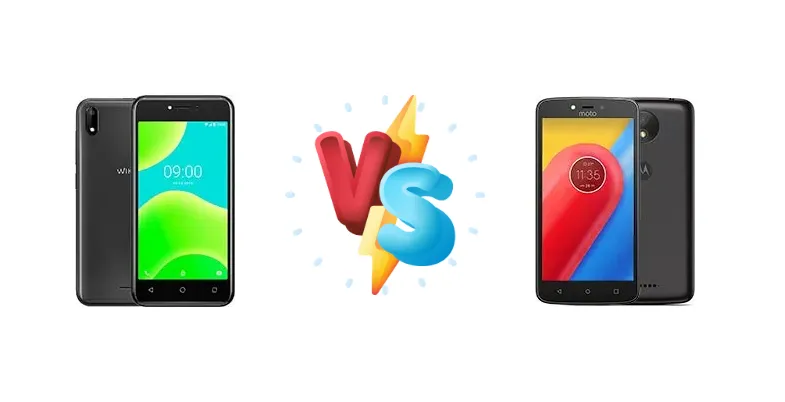
The Wiko Y50 and Motorola Moto C represent the extreme end of the budget smartphone spectrum. Both aim to deliver basic smartphone functionality at the lowest possible price point, but they achieve this with different hardware approaches. This comparison dissects those differences to determine which device offers the best value for users prioritizing affordability.
🏆 Quick Verdict
For the average user needing a functional, if basic, smartphone, the Motorola Moto C edges out the Wiko Y50. The Mediatek MT6737M chipset, despite its age, offers a more modern CPU architecture (Cortex-A53) resulting in a smoother, more responsive experience than the Y50’s Cortex-A7.
| Network |
|---|
| 2G bands | GSM 850 / 900 / 1800 / 1900 | GSM 850 / 900 / 1800 / 1900 - SIM 1 & SIM 2 (dual-SIM model only) |
| 3G bands | HSDPA 850 / 900 / 1900 / 2100 | HSDPA 850 / 900 / 1900 / 2100 |
| 4G bands | - | 1, 3, 5, 7, 8, 20, 38, 40 |
| Speed | HSPA 42.2/5.76 Mbps | HSPA 42.2/5.76 Mbps, LTE Cat4 150/50 Mbps |
| Technology | GSM / HSPA | GSM / HSPA / LTE |
| Launch |
|---|
| Announced | 2019, July. Released 2019, July | 2017, May. Released 2017, June |
| Status | Discontinued | Discontinued |
| Body |
|---|
| Build | - | Glass front, plastic back, plastic frame |
| Dimensions | 146 x 73.5 x 8.7 mm (5.75 x 2.89 x 0.34 in) | 145.5 x 73.6 x 9 mm (5.73 x 2.90 x 0.35 in) |
| SIM | Nano-SIM + Micro-SIM | Single SIM (Micro-SIM) or Dual SIM (Micro-SIM, dual stand-by) |
| Weight | 160 g (5.64 oz) | 154 g (5.43 oz) |
| Display |
|---|
| Resolution | 480 x 854 pixels, 16:9 ratio (~196 ppi density) | 480 x 854 pixels, 16:9 ratio (~196 ppi density) |
| Size | 5.0 inches, 68.9 cm2 (~64.2% screen-to-body ratio) | 5.0 inches, 68.9 cm2 (~64.3% screen-to-body ratio) |
| Type | TN LCD | TFT |
| Platform |
|---|
| CPU | Quad-core 1.3 GHz Cortex-A7 | Quad-core 1.1 GHz Cortex-A53 |
| Chipset | - | Mediatek MT6737M (28 nm) |
| GPU | Mali-T820 MP1 | Mali-T720MP2 |
| OS | Android 8.1 (Oreo) (Go Edition) | Android 7.0 (Nougat) |
| Memory |
|---|
| Card slot | microSDXC | microSDHC (dedicated slot) |
| Internal | 16GB 1GB RAM, 32GB 1GB RAM | 8GB 1GB RAM, 16GB 1GB RAM |
| | - | eMMC 5.0 |
| Main Camera |
|---|
| Features | LED flash, HDR, panorama | LED flash, panorama |
| Single | 5 MP | 5 MP, 1.4µm |
| Video | 720p@30fps | 720p@30fps |
| Selfie camera |
|---|
| Features | LED flash | LED flash |
| Single | 5 MP | 2 MP |
| Sound |
|---|
| 3.5mm jack | Yes | Yes |
| 35mm jack | Yes | Yes |
| Loudspeaker | Yes | Yes |
| Comms |
|---|
| Bluetooth | 4.2, A2DP | 4.2, A2DP, LE, aptX |
| NFC | No | No |
| Positioning | GPS | GPS |
| Radio | FM Radio | FM radio |
| USB | microUSB 2.0 | microUSB 2.0 |
| WLAN | Wi-Fi 802.11 b/g/n | Wi-Fi 802.11 b/g/n |
| Features |
|---|
| Sensors | Accelerometer | Accelerometer |
| Battery |
|---|
| Type | Li-Ion 2200 mAh | Li-Po 2350 mAh, removable |
| Misc |
|---|
| Colors | Dark Grey, Blue, Gold | Metallic Cherry, Pearl White, Fine Gold, Starry Black |
| Price | About 50 EUR | About 100 EUR |
| SAR | 0.86 W/kg (head) 1.40 W/kg (body) | 0.85 W/kg (head) 1.04 W/kg (body) |
Wiko Y50
- Potentially lower price point.
- Simplicity for first-time users.
- May be more readily available in certain regions.
- Older Cortex-A7 CPU architecture.
- Likely slower performance than Moto C.
- Limited upgrade path.
Motorola Moto C
- More modern Cortex-A53 CPU.
- Better performance for basic tasks.
- MT6737M chipset offers slightly better efficiency.
- May be slightly more expensive.
- Still a very basic smartphone.
- Limited storage and RAM (likely).
Display Comparison
Neither device boasts a standout display. Details regarding screen resolution, panel type (IPS vs TFT), and brightness are absent from the provided data. However, given their price points, both likely utilize low-resolution TFT panels. The absence of any mention of protective glass suggests neither offers scratch resistance. The focus here is purely functional, prioritizing cost over visual fidelity.
Camera Comparison
Camera performance is likely to be similar on both devices – basic and functional. Without sensor size or aperture information, it’s difficult to make a definitive statement. However, given the target market, both likely feature low-resolution sensors with limited dynamic range and image quality. Any marketing around camera features should be viewed with skepticism. The absence of OIS (Optical Image Stabilization) on either device suggests image stabilization will be purely digital, resulting in potentially blurry photos and videos.
Performance
The core difference lies in the chipsets. The Motorola Moto C’s Mediatek MT6737M, built on a 28nm process, features a quad-core Cortex-A53 CPU clocked at 1.1 GHz. The Wiko Y50 utilizes a quad-core Cortex-A7 CPU clocked at 1.3 GHz. While the Y50 has a slightly higher clock speed, the Cortex-A53 architecture is significantly more efficient and offers better instructions-per-clock (IPC) than the older Cortex-A7. This translates to a more responsive user interface and better multitasking, even with the lower clock speed. The 28nm process of the MT6737M also contributes to better thermal management, potentially reducing throttling under sustained load.
Battery Life
Battery capacity details are missing for both devices. However, given their low-power chipsets and basic displays, both should offer at least a full day of standby time and moderate usage. Charging wattage is also unknown, suggesting slow charging speeds via micro-USB. Real-world battery life will heavily depend on usage patterns, but neither device is likely to be a battery life champion.
Buying Guide
Buy the Wiko Y50 if you need a phone for extremely light tasks – basic calling, texting, and occasional very light web browsing. Its simplicity and potentially lower price (depending on region) make it suitable for first-time smartphone users or as a temporary device. Buy the Motorola Moto C if you prioritize a slightly more responsive user experience, even for basic tasks, and anticipate using the phone for slightly more demanding activities like social media or light app usage. The MT6737M provides a small but noticeable performance advantage.
Frequently Asked Questions
❓ Will the Motorola Moto C handle basic social media apps like Facebook and WhatsApp smoothly?
The Mediatek MT6737M chipset with its Cortex-A53 cores is capable of running basic social media apps like Facebook and WhatsApp without significant lag. However, expect longer loading times and occasional stutters compared to more powerful devices. It's sufficient for casual use, but not ideal for heavy multitasking.
❓ Is the Wiko Y50 a good choice for someone upgrading from a feature phone?
The Wiko Y50 could be a suitable entry point for someone upgrading from a feature phone, primarily due to its likely lower price. However, be aware that the performance is limited, and the user experience will be basic. It's best suited for users who only need core functionality like calling, texting, and occasional web browsing.
❓ Can either of these phones play modern mobile games?
Neither the Wiko Y50 nor the Motorola Moto C are suitable for playing modern, graphically demanding mobile games. The chipsets lack the processing power and GPU capabilities to deliver a playable experience. Simple, older games might be playable at low settings, but don't expect a smooth or enjoyable gaming experience.