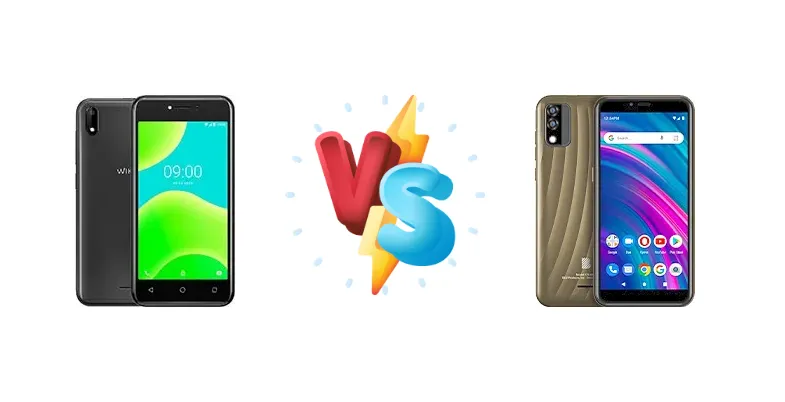
The Wiko Y50 and BLU C5 Max represent the extreme end of the smartphone price spectrum. Both aim to deliver basic smartphone functionality at the lowest possible cost. This comparison dissects their similarities and subtle differences to determine which offers the best value for users prioritizing affordability above all else.
🏆 Quick Verdict
For the average user seeking a functional, no-frills smartphone, the BLU C5 Max edges out the Wiko Y50. While both share the same Cortex-A7 processor, BLU’s established presence in the ultra-budget market and potentially better software optimization give it a slight advantage.
| Network |
|---|
| 2G bands | GSM 850 / 900 / 1800 / 1900 | GSM 850 / 900 / 1800 / 1900 |
| 3G bands | HSDPA 850 / 900 / 1900 / 2100 | HSDPA 850 / 900 / 1900 / 2100 |
| Speed | HSPA 42.2/5.76 Mbps | HSPA 21.1/5.76 Mbps |
| Technology | GSM / HSPA | GSM / HSPA |
| Launch |
|---|
| Announced | 2019, July. Released 2019, July | 2022, January |
| Status | Discontinued | Available. Released 2022, January |
| Body |
|---|
| Dimensions | 146 x 73.5 x 8.7 mm (5.75 x 2.89 x 0.34 in) | 159.2 x 76.5 x 9.8 mm (6.27 x 3.01 x 0.39 in) |
| SIM | Nano-SIM + Micro-SIM | Nano-SIM + Nano-SIM |
| Weight | 160 g (5.64 oz) | 164 g (5.78 oz) |
| Display |
|---|
| Resolution | 480 x 854 pixels, 16:9 ratio (~196 ppi density) | 720 x 1440 pixels, 18:9 ratio (~282 ppi density) |
| Size | 5.0 inches, 68.9 cm2 (~64.2% screen-to-body ratio) | 5.7 inches, 83.8 cm2 (~68.8% screen-to-body ratio) |
| Type | TN LCD | IPS LCD |
| Platform |
|---|
| CPU | Quad-core 1.3 GHz Cortex-A7 | Quad-core 1.3 GHz Cortex-A7 |
| GPU | Mali-T820 MP1 | - |
| OS | Android 8.1 (Oreo) (Go Edition) | Android 11 (Go edition) |
| Memory |
|---|
| Card slot | microSDXC | microSDXC |
| Internal | 16GB 1GB RAM, 32GB 1GB RAM | 16GB 1GB RAM |
| | - | eMMC 5.1 |
| Main Camera |
|---|
| Dual | - | 5 MP
Auxiliary lens |
| Features | LED flash, HDR, panorama | LED flash |
| Single | 5 MP | 5 MP |
| Video | 720p@30fps | 720p@30fps |
| Selfie camera |
|---|
| Features | LED flash | - |
| Single | 5 MP | 5 MP |
| Video | - | 720p@30fps |
| Sound |
|---|
| 3.5mm jack | Yes | Yes |
| 35mm jack | Yes | Yes |
| Loudspeaker | Yes | Yes |
| Comms |
|---|
| Bluetooth | 4.2, A2DP | 4.1, A2DP |
| NFC | No | No |
| Positioning | GPS | GPS |
| Radio | FM Radio | FM radio |
| USB | microUSB 2.0 | microUSB 2.0 |
| WLAN | Wi-Fi 802.11 b/g/n | Wi-Fi 802.11 b/g/n, Wi-Fi Direct |
| Features |
|---|
| Sensors | Accelerometer | Accelerometer |
| Battery |
|---|
| Type | Li-Ion 2200 mAh | Li-Po 2700 mAh |
| Misc |
|---|
| Colors | Dark Grey, Blue, Gold | Black, Blue, Red, Green, Bronze |
| Price | About 50 EUR | About 60 EUR |
| SAR | 0.86 W/kg (head) 1.40 W/kg (body) | - |
Wiko Y50
- Wiko brand recognition in certain markets
- Potentially cleaner software experience (depending on Android version)
- Affordable price point
- Cortex-A7 processor is outdated
- Limited RAM capacity (likely)
- Low-resolution camera sensors
BLU C5 Max
- Established presence in the ultra-budget market
- Potentially optimized software for performance
- Affordable price point
- Cortex-A7 processor is outdated
- Limited RAM capacity (likely)
- Low-resolution camera sensors
Display Comparison
Both the Wiko Y50 and BLU C5 Max likely feature similar LCD panels, given their price point. Without specific display specs, it's reasonable to assume both offer basic viewing angles and color reproduction. The absence of information regarding resolution suggests both are likely 720p or lower. The user experience will be largely defined by the panel's brightness, which is unknown, but likely limited for outdoor visibility. Bezels are expected to be substantial on both devices, maximizing screen real estate within a compact form factor.
Camera Comparison
Camera performance on both devices will be limited. Without sensor size or aperture information, it's safe to assume both rely on low-resolution sensors. Image quality will be acceptable in well-lit conditions, but will suffer significantly in low light. The inclusion of a 2MP macro camera on either device is largely a marketing tactic, as the image quality will be poor. Expect basic image processing with limited features.
Performance
The core of both devices is the Quad-core 1.3 GHz Cortex-A7 processor. This is an older architecture, designed for efficiency rather than raw power. Performance will be adequate for basic tasks like calling, texting, and light web browsing, but will struggle with demanding applications or multitasking. The lack of information on RAM capacity is critical; insufficient RAM will lead to frequent app reloading and sluggish performance. Thermal management is unlikely to be a concern given the low-power processor, but sustained use could still result in some throttling.
Battery Life
Battery life will be a key factor for users of these devices. Without specific mAh ratings, it's difficult to make a direct comparison. However, the energy-efficient Cortex-A7 processor suggests both phones should be able to last a full day with moderate use. Charging speeds are also unknown, but likely to be slow given the budget nature of the devices. The absence of fast charging support is expected.
Buying Guide
Buy the Wiko Y50 if you prioritize brand recognition within Europe and potentially easier access to local support. Buy the BLU C5 Max if you are in North or South America and value a slightly more established track record in the ultra-budget segment, and potentially a more streamlined software experience. Both are suitable for first-time smartphone users or as a temporary device.
Frequently Asked Questions
❓ Will either of these phones run popular apps like WhatsApp and Facebook smoothly?
Yes, both the Wiko Y50 and BLU C5 Max should be able to run apps like WhatsApp and Facebook, but performance may be sluggish with multiple apps open simultaneously. The Cortex-A7 processor is sufficient for basic app functionality, but don't expect a fluid experience with demanding tasks.
❓ Are these phones good for taking photos in low light?
No, neither the Wiko Y50 nor the BLU C5 Max are well-suited for low-light photography. The likely use of low-resolution camera sensors and lack of optical image stabilization will result in noisy, blurry images in dimly lit environments.
❓ What Android version do these phones likely ship with, and will they receive updates?
Given their price point, both phones likely ship with an older version of Android (potentially Android Go Edition). Software updates are unlikely to be frequent or guaranteed, as manufacturers often prioritize newer, more expensive models.
❓ Can I play games on these phones?
Simple, less demanding games may be playable on these phones, but don't expect a good experience with graphically intensive titles. The Cortex-A7 processor and limited RAM will struggle to handle modern games, resulting in low frame rates and lag.