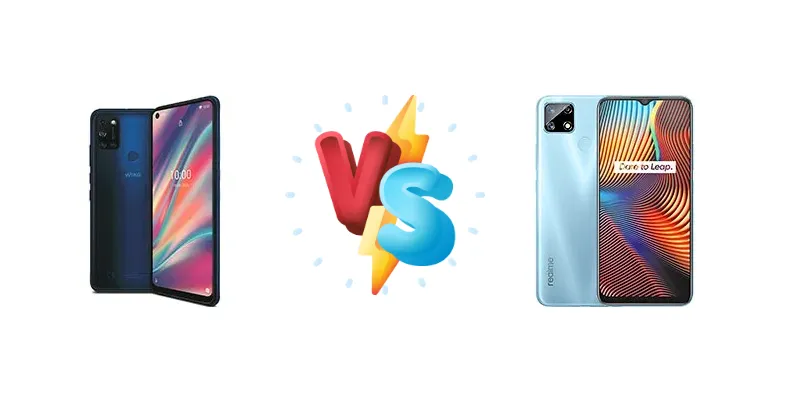
The sub-$150 smartphone market is fiercely competitive. Both the Wiko View5 and the Realme 7i (Global) aim to deliver essential smartphone functionality at an accessible price. However, they take different approaches to achieving this, with the Realme 7i prioritizing gaming performance and faster charging, while the Wiko View5 focuses on a more basic, streamlined experience. This comparison will dissect their key differences to help you determine which device best suits your needs.
🏆 Quick Verdict
For most users, the Realme 7i emerges as the stronger choice. Its Helio G85 chipset offers a significant performance uplift over the Wiko View5’s Helio A25, making it better suited for gaming and demanding applications. The inclusion of 18W charging is also a major advantage, providing faster top-ups compared to the Wiko View5’s likely slower charging speeds.
| Network |
|---|
| 2G bands | GSM 850 / 900 / 1800 / 1900 | GSM 850 / 900 / 1800 / 1900 |
| 3G bands | HSDPA 850 / 900 / 1900 / 2100 | HSDPA 850 / 900 / 1700(AWS) / 1900 / 2100 |
| 4G bands | 1, 3, 5, 7, 8, 20, 28, 40 | 1, 2, 3, 4, 5, 7, 8, 20, 28, 38, 40, 41 |
| Speed | HSPA 42.2/5.76 Mbps, LTE Cat4 150/50 Mbps | HSPA, LTE |
| Technology | GSM / HSPA / LTE | GSM / HSPA / LTE |
| Launch |
|---|
| Announced | 2020, September. Released 2020, September | 2020, December 22. Released 2020, December 23 |
| Status | Discontinued | Discontinued |
| Body |
|---|
| Dimensions | 166 x 76.8 x 9.3 mm (6.54 x 3.02 x 0.37 in) | 164.5 x 75.9 x 9.8 mm (6.48 x 2.99 x 0.39 in) |
| SIM | Nano-SIM + Nano-SIM | Nano-SIM + Nano-SIM |
| Weight | 201 g (7.09 oz) | 208 g (7.34 oz) |
| Display |
|---|
| Resolution | 720 x 1600 pixels, 20:9 ratio (~268 ppi density) | 720 x 1600 pixels, 20:9 ratio (~270 ppi density) |
| Size | 6.55 inches, 103.6 cm2 (~81.2% screen-to-body ratio) | 6.5 inches, 102.0 cm2 (~81.7% screen-to-body ratio) |
| Type | IPS LCD, 450 nits (peak) | IPS LCD, 450 nits (typ), 560 nits (peak) |
| Platform |
|---|
| CPU | Octa-core (4x1.8 GHz Cortex-A53 & 4x1.5 GHz Cortex-A53) | Octa-core (2x2.0 GHz Cortex-A75 & 6x1.8 GHz Cortex-A55) |
| Chipset | Mediatek MT6762D Helio A25 (12 nm) | Mediatek MT6769Z Helio G85 (12 nm) |
| GPU | PowerVR GE8320 | Mali-G52 MC2 |
| OS | Android 10 | Android 10, Realme UI |
| Memory |
|---|
| Card slot | microSDXC | microSDXC (dedicated slot) |
| Internal | 64GB 3GB RAM | 64GB 4GB RAM |
| | eMMC 5.1 | eMMC 5.1 |
| Main Camera |
|---|
| Features | LED flash, HDR | LED flash, HDR, panorama |
| Quad | 48 MP, (wide), AF
8 MP, (ultrawide)
5 MP (macro)
Auxiliary lens | - |
| Single | 8 MP | - |
| Triple | - | 48 MP, f/1.8, 26mm (wide), 1/2.0", 0.8µm, PDAF
8 MP, f/2.3, 16mm, 119˚ (ultrawide), 1/4.0", 1.12µm
2 MP (macro) |
| Video | 1080p@30fps | 1080p@30/60fps |
| Selfie camera |
|---|
| Features | - | HDR, panorama |
| Single | 8 MP | 8 MP, f/2.0, 26mm (wide), 1/4.0", 1.12µm |
| Video | - | 1080p@30fps |
| Sound |
|---|
| 3.5mm jack | Yes | Yes |
| 35mm jack | Yes | Yes |
| Loudspeaker | Yes | Yes |
| Comms |
|---|
| Bluetooth | 4.2, A2DP | 5.0, A2DP, LE, aptX HD |
| NFC | No | No |
| Positioning | GPS, GLONASS, GALILEO, BDS | GPS, GLONASS, BDS |
| Radio | FM radio | FM radio |
| USB | USB Type-C 2.0, OTG | USB Type-C 2.0, OTG |
| WLAN | Wi-Fi 802.11 a/b/g/n/ac | Wi-Fi 802.11 a/b/g/n/ac, dual-band, Wi-Fi Direct |
| Features |
|---|
| Sensors | Fingerprint (rear-mounted), accelerometer, proximity, compass | Fingerprint (rear-mounted), accelerometer, proximity, compass |
| Battery |
|---|
| Charging | - | 18W wired
5W reverse wired |
| Type | Li-Po 5000 mAh | 6000 mAh |
| Misc |
|---|
| Colors | Midnight Blue, Pine Green, Peach Gold | Glory Silver, Victory Blue |
| Models | W-V851-EEA | - |
| Price | About 370 EUR | About 190 EUR |
| SAR | 0.91 W/kg (head) 1.54 W/kg (body) | - |
Wiko View5
- Potentially lower price point
- Simple and straightforward user experience
- Adequate for basic smartphone tasks
- Significantly weaker performance
- Likely slower charging speeds
- Less capable camera system
Realme 7i (Global)
- Superior performance with Helio G85
- Faster 18W charging with 5W reverse charging
- More capable camera system
- Better gaming experience
- Slightly higher price
- May include more bloatware (typical of Realme)
Display Comparison
Neither Wiko nor Realme provide detailed display specifications beyond the basic panel type. However, given the price point, both likely utilize IPS LCD panels. The key difference lies in the processing power driving them. The Realme 7i’s more powerful chipset can handle more complex graphics rendering, potentially resulting in smoother animations and a more responsive touch experience. While both are 12nm, the G85’s GPU is significantly more capable. Expect similar color accuracy and viewing angles on both devices, but the Realme 7i will likely offer a more fluid visual experience.
Camera Comparison
Without detailed camera specs, a direct comparison is difficult. However, the Realme 7i’s chipset benefits image processing. The G85’s ISP (Image Signal Processor) is more advanced, allowing for faster image capture and better noise reduction. While both phones likely feature a primary camera, the Realme 7i’s processing power will likely result in sharper, more detailed photos, especially in low-light conditions. The Wiko View5 will likely rely more heavily on software processing, which may introduce artifacts or reduce dynamic range. It's safe to assume the Realme 7i will offer a more versatile and capable camera experience.
Performance
The Realme 7i’s Helio G85 chipset is the clear winner here. Its octa-core configuration, featuring 2x2.0 GHz Cortex-A75 and 6x1.8 GHz Cortex-A55 cores, represents a substantial upgrade over the Wiko View5’s Helio A25 (4x1.8 GHz Cortex-A53 & 4x1.5 GHz Cortex-A53). The Cortex-A75 cores in the G85 provide significantly higher single-core performance, crucial for app launch speeds and general responsiveness. The G85 also boasts a more capable GPU, making it better suited for gaming. The Wiko View5’s A25 is adequate for basic tasks, but will struggle with more demanding applications and multitasking. The Realme 7i’s architecture is simply more modern and efficient.
Battery Life
The Realme 7i’s 18W wired charging is a significant advantage. While the Wiko View5’s charging speed is unspecified, it’s likely to be considerably slower, potentially taking twice as long to fully charge. The Realme 7i also includes 5W reverse wired charging, allowing it to act as a power bank for other devices – a feature absent on the Wiko View5. While battery capacity isn’t specified for either device, the Realme 7i’s more efficient chipset and faster charging capabilities translate to a more convenient and user-friendly experience.
Buying Guide
Buy the Wiko View5 if you need a simple, no-frills smartphone for basic communication, social media, and light web browsing, and prioritize a lower initial cost. Buy the Realme 7i (Global) if you prefer a phone capable of handling moderate gaming, benefit from faster charging, and appreciate a more responsive user experience, even if it means spending slightly more.
Frequently Asked Questions
❓ Will the Realme 7i handle popular games like PUBG Mobile or Call of Duty Mobile?
Yes, the Realme 7i’s Helio G85 chipset is specifically designed for gaming. While you may need to adjust graphics settings for optimal performance, it should be capable of running PUBG Mobile and Call of Duty Mobile at medium settings with playable frame rates. The Wiko View5’s Helio A25 would struggle with these titles.
❓ Does the Realme 7i support fast charging protocols beyond 18W, like Quick Charge or Power Delivery?
While the Realme 7i supports 18W charging, it doesn't officially support Quick Charge or Power Delivery. Using a charger with higher wattage may not result in faster charging speeds, as the phone is limited to 18W input. It's best to use the included charger or a compatible 18W USB Power Delivery charger.
❓ Is the Wiko View5 a good option for elderly users who primarily need a phone for calls and texts?
Yes, the Wiko View5 could be a suitable option for elderly users with basic needs. Its simplicity and lower price point make it an accessible choice. However, the slower performance might be noticeable even with basic tasks, and the camera quality won't be exceptional.
❓ How does the Realme 7i handle multitasking compared to the Wiko View5?
The Realme 7i handles multitasking significantly better due to its more powerful processor and likely more RAM. You'll experience fewer slowdowns and app reloads when switching between applications on the Realme 7i, while the Wiko View5 may struggle with even a moderate number of open apps.